Despite China's leading position in the global electric vehicle (EV) industry and car shipping market, domestic automakers are encountering a significant logistical bottleneck: a severe scarcity of dedicated roll-on/roll-off (Ro-Ro) car carriers. With these specialized vessels operating at full capacity, Chinese car manufacturers have actively explored alternative shipping methods to sustain their international supply chains, according to CarNewsChina.
Leapmotor's flat rack solution
Facing the Ro-Ro vessel shortage, Leapmotor, an automaker backed by Stellantis Group, has adopted a "flat rack" shipping solution provided by the shipping company Cosco.
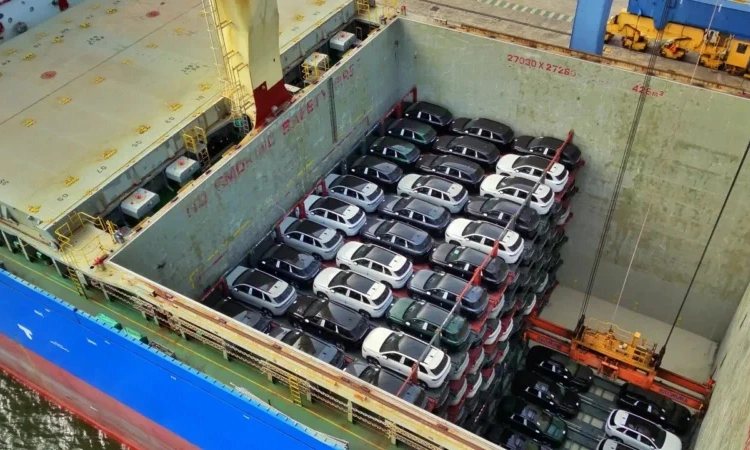 |
Cars are loaded onto flat racks and then onto conventional cargo ships. *Leapmotor* |
Leapmotor secures vehicles onto metal frames, which are then loaded onto regular cargo ships. This method proved effective, enabling the company to successfully transport more than 1,800 vehicles to Brazil, before utilizing Stellantis' existing logistics network for customer delivery.
Container and specialized frames
While Ro-Ro vessels have historically dominated sea transport due to their high efficiency, allowing vehicles to drive on and off, the current capacity crisis has accelerated the development of alternative methods.
Container shipping is emerging as a flexible, cost-effective, and environmentally friendly solution. New industry safety standards have been established to tighten the process of transporting cars by container, with a standard 40-foot container capable of holding 2-4 vehicles.
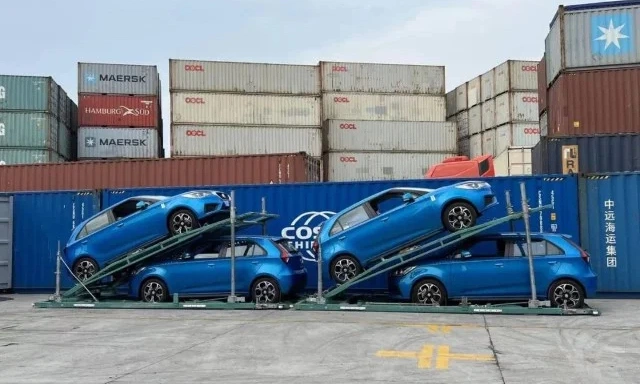 |
Cars being prepared for container loading before shipment. *Cosco* |
The shipping company Cosco has also transformed its fleet of 62,000 DWT multipurpose pulp carriers into versatile "sea kings". By employing self-developed foldable flat rack systems, each of these vessels can transport more than 1,000 cars. The approximately 14,6 m long frames allow vehicles to be driven on, secured, then hoisted into the cargo hold and stacked up to 8 layers high. Additionally, the company has developed a specialized, extra-wide V-Rack frame for commercial vehicles.
Despite these unconventional transport methods, Ro-Ro vessels remain crucial for car exports. BYD, a leading global new energy vehicle manufacturer, has even commissioned its own fleet of car carriers, with some already operational.
China now dominates the car shipping market
Hyundai Glovis, the logistics subsidiary of Hyundai Group, began operating the Glovis Lander, the world's largest pure car and truck carrier (PCTC) capable of transporting more than 10,000 small cars, in late June. This marks the third 10,800 CEU (car equivalent unit) class PCTC to enter service, following the Glovis Leader, delivered in late April, and the Glovis Lighthouse, which commenced operations in early June.
Currently, only three Hyundai Glovis-operated vessels worldwide can transport more than 10,000 10,800 CEU class cars. All three ships were jointly built by two shipyards under the China State Shipbuilding Corporation (CSSC) group. A South Korean shipping company, a shipbuilding powerhouse, is utilizing all three of the world's largest car carriers produced in China, according to Chosun.
China continues to hold an absolute leading position in the car carrier market. While South Korean shipbuilders focus on more profitable liquefied natural gas (LNG) carriers and are not actively seeking other orders, coupled with intense price competition from Chinese shipyards, they are gradually losing market share.
Some suggest China has captured the market by leveraging its price competitiveness due to standardized car carrier shipbuilding technology. Compared to the cost of similar car carriers ordered from South Korean shipyards, orders from Chinese shipyards are reportedly 15%-20% cheaper. Chinese shipyards reduce unit costs by mass-producing car carriers, a sector with relatively low technical barriers, and by manufacturing components themselves.
Experts also attribute the dominance of Chinese shipyards to the increasing volume of car exports originating from China, led by electric vehicles.
Eom Kyung-a, an analyst at Shinyoung Securities, stated: "The car carrier market is a specialized and limited transport market, dealing with only a single commodity – cars – making it difficult for countries without large-scale exporting manufacturers to operate in this sector."
My Anh