In automotive circles, "mapping ECU" or "remap ECU" refers to modifying the engine control unit (ECU) software. Technicians alter parameters such as fuel injection volume, ignition timing, turbo pressure, or RPM limits to change the vehicle's operating characteristics.
Many believe an ECU remap is needed when switching to E10 because ethanol has different combustion properties than mineral gasoline. It requires a different air-fuel ratio (AFR) and contains less energy per liter. Some car owners also worry that the original ECU might not recognize the new fuel, leading to a lean mixture (more air than fuel in the combustion chamber), engine overheating, or power loss. However, research indicates that most modern electronic fuel injection cars have the ability to self-adjust within a certain limit to adapt to fuel containing 10% ethanol.
E10 is a type of gasoline blended with 10% ethanol and 90% base gasoline. Since ethanol contains oxygen in its molecular structure and has a lower ideal air-fuel ratio than mineral gasoline, the engine needs to inject more fuel to achieve optimal combustion. Therefore, if the ECU maintains the same injection volume as when running on mineral gasoline, the combustion mixture would tend to be leaner before the system automatically readjusts the fuel volume.
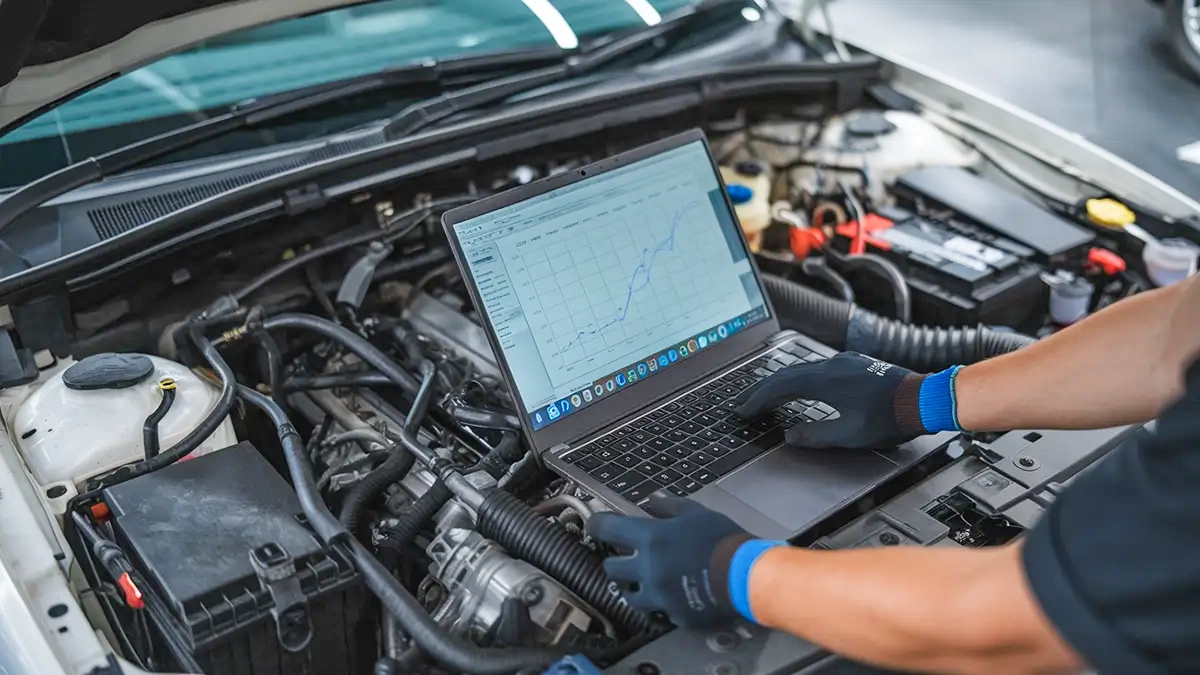 |
Mapping ECU. Photo: Klavkarr
How cars recognize the fuel type
According to technical experts, during operation in most conventional cars, the ECU does not directly measure the ethanol content in the fuel to determine if the car is using mineral gasoline or ethanol-blended fuel. Instead, after the air-fuel mixture combusts, the oxygen sensor in the exhaust system checks the residual oxygen in the exhaust gas. If the exhaust gas contains high oxygen, the ECU interprets the mixture as lean and increases fuel injection time. Conversely, if residual oxygen is low, the ECU reduces injection volume. This cycle occurs continuously multiple times per second, aiming to bring the AFR close to the target ratio.
For conventional mineral gasoline, the chemically ideal air-fuel ratio is around 14,7:1, meaning approximately 14,7 parts of air for one part of fuel. If using ethanol-blended fuel, the car will require more fuel to achieve optimal combustion. Thus, when switching to E10, the ECU automatically adds a small amount of fuel to compensate for this change, typically around 14,1:1-14,2:1. Therefore, general users typically do not need to remap the ECU simply for changing from mineral gasoline to E10.
When is an ECU remap necessary?
An ECU remap is primarily necessary when the vehicle runs on high-percentage ethanol blends like E40, E60, or E85, or when the owner upgrades the turbo, increases fuel pressure, and aims to optimize power using ethanol's superior anti-knock properties. In such cases, technicians will recalibrate ignition timing, fuel injection volume, and air-fuel mixture control strategy to leverage the high octane advantage of ethanol.
For example, some high-performance vehicles switching to E85 will need a remap to increase fuel injection, optimize ignition timing, and utilize ethanol's better anti-knock capability. Additionally, flex-fuel vehicles, which use E20-E85 gasoline, are equipped with an ethanol sensor in the fuel line. This allows the ECU to precisely determine the alcohol percentage in the gasoline and automatically adjust the AFR and other operating parameters accordingly.
Pham Hai