Around 3 a.m., with the truck plant's production line still active, a small team arrived to test a component of a new pickup, its existence largely unknown within the company. This clandestine Ford project has an ambitious goal: to develop an electric vehicle (EV) in the United States that can compete with Chinese models dominating global markets.
The secret is now out: a new pickup truck that Ford claims will be nearly as fast as a Mustang, offer a range of approximately 480 km on a single charge, and integrate technology to rival Tesla and Chinese EVs. The company aims for a 2027 launch with a price point around 30,000 USD, comparable to a Toyota Camry.
To achieve this, Ford must dismantle century-old manufacturing processes in an industry known for its conservatism. Securing a future beyond the gas-guzzling pickups and SUVs that have long driven Ford's profits is crucial.
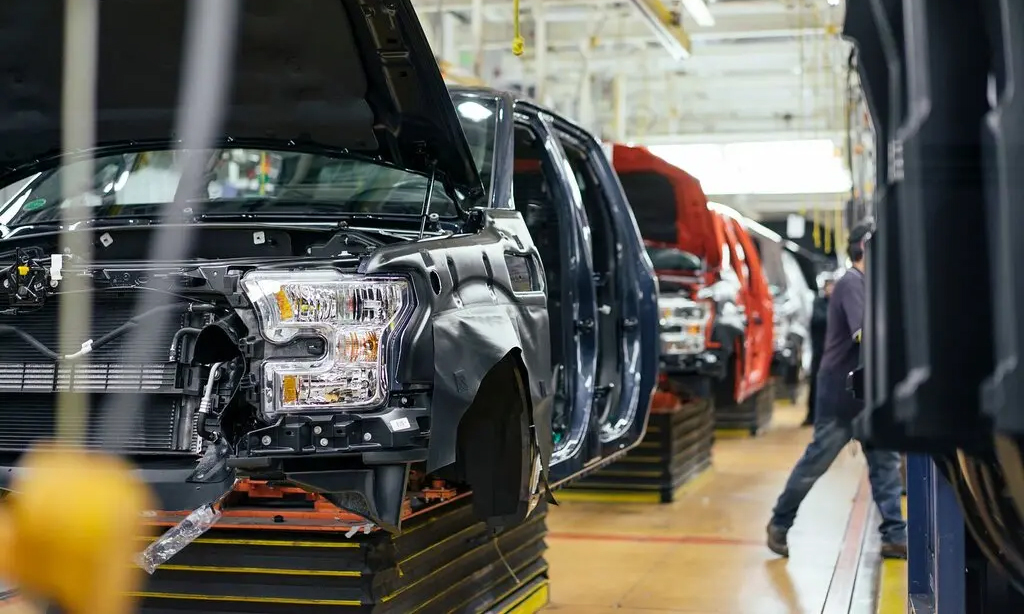 |
Production line at Ford's plant in suburban Detroit. Photo: Ford
The project, kept under wraps since its inception in 2022, was spearheaded by veterans from Tesla and Apple, who initially worked on the design from a California office. Ford later integrated some of its own staff to help bring this vision to fruition. This process was fraught with misunderstandings and mistrust as tech-savvy outsiders sought to convince cautious industry veterans.
Building these new EVs requires fewer personnel and simpler parts, necessitating a break from decades of engineering stagnation. Chief Executive Jim Farley calls this Ford's new "Model T moment". Rival automakers argue that surpassing China in the EV sector is impossible, citing their advantages: extensive government support, low labor costs, and a significant head start.
Ford's substantial gamble hinges on the collaboration between Detroit and Silicon Valley. Traditional automakers have sometimes attempted to incorporate outside expertise into their operations, but results have often been mixed, from abandoned self-driving car projects to expensive and unpopular EVs.
"I was terrified" when it came time to merge the two sides, said Alan Clarke, a Tesla veteran who helped design the Model S and Cybertruck and now leads Ford's new EV development. For two years, his development team worked in near isolation from offices in Irvine, California.
"We had to learn to trust each other", said Jolanta Coffey, a program director and one of the first Ford veterans to join the project.
Ford's previous EV models incurred billions of USD in losses. CEO Farley lamented that they had too many unnecessary parts and costs. In 2025, the company announced it would cease production of the highly publicized F-150 Lightning electric pickup, which is priced between 50,000 and 77,000 USD.
For the new pickup, Ford states it has eliminated thousands of meters of heavy copper wiring, reduced hundreds of components, and made it 15% more aerodynamic than its other pickup models.
This process involved re-evaluating the assembly line, an area Ford pioneered. Traditionally, this process has been repetitive, slow, and reliant on numerous external partners. On Ford's new "assembly tree", a modular system stamps out three large cast aluminum blocks that are merged at the end of the process, similar to how Tesla and Chinese automakers build EVs.
"We've never torn down everything and started over like this", Coffey stated.
Clarke joined Ford on the advice of his former boss at Tesla, Doug Field. Field, who has led Ford's EV and technology division since 2021, contributed to the development of Apple's Mac and Tesla's Model 3 before joining Ford. He refers to the project as Ford's "Skunk Works", a term coined by Lockheed engineers working on secret aircraft during World War II.
"We could look at it as, 'The Chinese are way ahead, it's terrifying that they're coming'", Clarke said, adding, "But get up and do something. Figure out how to compete".
To do this, they needed to solve a critical problem: car batteries are expensive. To sell EVs at a competitive price and turn a profit, engineers had to cut costs in every other aspect, from labor to components.
For one year, a team of 17 people, very small by Ford's standards, worked on the design for the first new EV. Their vision clashed with Farley's. He rejected the initial SUV-style model the California team was developing. Instead, he instructed them to build a mid-size pickup. He argued it would fill a gap in the EV market and receive a warmer reception from buyers.
The team gradually grew from dozens to hundreds. One of their initial assessments was that the computer-aided design system Ford had used for decades needed to be discarded. They then criticized Ford's processes and regulations, which the team deemed outdated or even illogical.
Field described one such rule: all Ford vehicles must be built with a small ridge above the window to prevent rainwater from entering when a driver or passenger cracks the window to smoke. Known as the "smoker's window", it increases aerodynamic drag, reducing battery range. The new pickup will not feature this.
Managers were determined to keep Ford employees away from the project. "There were many times I had to protect the team", Clarke said, fearing outsiders could slow progress.
Conceiving a design is one thing; building it is another. That is when Clarke and Field began recruiting company veterans to join the team. They sought out misfits and disgruntled individuals within Ford, the type of people, in Clarke's words, who were uncomfortable with Ford's often rigid structure.
They looked for individuals with design and engineering competence, but who were flexible and could handle uncertainty. Clarke estimated about 20% of Ford's workforce met that criterion.
He shared this view during a video call with Charles Poon, a 30-year Ford veteran who joined the project early on, who believed the 20% figure was too high.
Poon responded, "I think 2% is a more accurate number".
Potential candidates underwent a 12-question interview process, including types of questions typically asked at Apple or Google to assess their problem-solving approach, such as: How many pairs of shoes can you make from the hide of one cow?
Field said the early days of merging the secret research team with Ford's existing staff resembled the sitcom "Silicon Valley", where a group of awkward tech experts navigated the world of venture capital. Field stated he spent much of one year resolving conflicts between the two sides, down to minor details like how to calculate the size of the car's constituent parts.
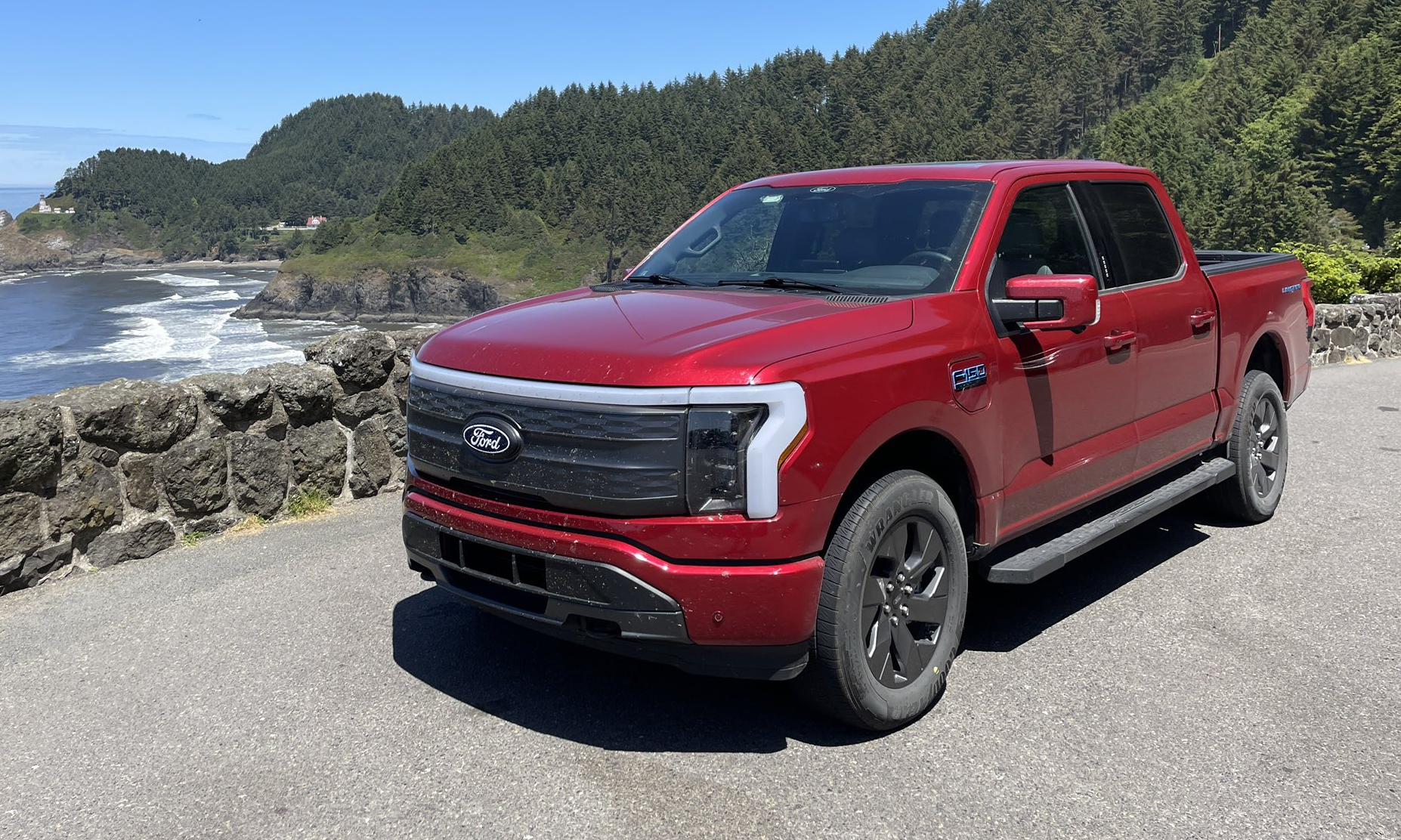 |
Ford has paused plans to refresh the F-150 Lightning electric pickup, which currently starts at 66,000 USD. Photo: Macheroadtrip
The research team is nearing the completion of a full vehicle. However, abandoning old processes brought new difficulties, including a problem that sent the team to the Michigan factory at 3 a.m.
Engineers worried that the open front section of the vehicle might warp or deform during the body's preparation for painting. This process, essential for a durable paint finish, involves moving the chassis through a massive liquid-filled chamber where it is cleaned and coated with multiple layers of primer.
"Is it going to collapse?", Kevin Young, the project's lead manufacturing engineer, recalled thinking as he watched the chassis disappear into the paint machine. "We didn't want anyone nearby to see it". Fortunately, the chassis piece remained intact.
At another point, the team realized the chassis had failed a crucial function: preventing water intrusion. Typically, a car is welded together. On this pickup, three sections are joined using specialized tools, rather than heat, to reduce time and cost.
But the chassis still leaked. Ford resolved the issue with a type of sealant, making the change early enough in the design process to avoid costly rework.
By late 2024, Lisa Drake, overseeing EV industrialization, was ready to order equipment for manufacturing the new battery packs. Field and Clarke asked her to postpone ordering some components so the team could continue optimizing battery range.
Equipping the factory in such a piecemeal fashion was ill-advised. "These people don't know what they're talking about", she said, describing her initial reaction, adding, "They don't understand".
However, Drake found a way to adjust the ordering process to gain more time without delaying the overall project.
The period of creative freedom has concluded. At a vast factory in Louisville, Kentucky, where Ford once produced gasoline-powered SUVs, teams of workers are now setting up machinery and three new assembly lines for EV production. The company has tested about 30 handcrafted prototypes to identify problems early in the process. Later this year, they plan to begin manufacturing, and then road-testing, the first factory-produced models. Ford states the pickup's interior will be more spacious than a small crossover SUV.
A few weeks ago, the design team approached Coffey, the chief engineer, with excitement, having found a new component that could reduce the pickup's production cost by 8 USD—a small but significant saving for a mass-produced vehicle. They needed to accelerate progress to implement the change. Making the change too late in the process would negate the savings.
"This is not the time to tinker with engineering", Coffey told them. She gave them a deadline of early May to finalize the plan, or they would have to proceed with the existing work. They met Coffey's deadline.
Analysts and consultants question whether Ford can deliver on its promises, and if so, whether consumers will buy the pickup. The U.S. market has grown less enthusiastic about EVs, following a year when the Trump administration rescinded incentives for EV buyers and eliminated regulations promoting their development.
When recently asked about the possibility of an automaker building a car in the U.S. that could compete with Chinese vehicles, Hyundai Motor CEO Jose Muñoz responded definitively: "That's impossible", he said. "Unless they are subsidized by the government".
Field announced in April that he would be leaving Ford. Clarke will take over as project lead.
On a recent morning, Jerry McKinny, a factory supervisor, stood amidst a crowd of suppliers, line workers, and engineers. It was the daily meeting at the Michigan plant, where Ford tests manufacturing processes for new models before mass assembly. Behind McKinny, a screen listed issues identified by production teams as they prepared the first electric pickup prototypes. "Squeaking air duct" was one problem. "Rattling sound" was another. Ford is one day ahead of schedule in its EV program, but the team remains concerned about staying on track.
McKinny was unfazed. "These are minor issues" compared to a conventional vehicle at this stage of development, he said.
After more than three decades at Ford, McKinny noted that witnessing such a dramatic change was difficult to adapt to. "The only thing I'd ever seen change here was the shape of the sheet metal", he said.
My Anh (according to WSJ)