After a period of market exploration, Honda Vietnam announced its commercialization strategy for its electric motorcycle product range on 4/6. This move is an important step in the Japanese automaker's roadmap to achieve carbon neutrality by 2050.
In addition to the ICON e:, which has been in market trials for the past year, Honda will introduce two more electric motorcycle products to Vietnamese customers this year: the CUV e: from 4/6 and the UC3 from July. Despite being a giant that holds 80% of the gasoline motorcycle market share, Honda is taking a measured approach in the electric vehicle segment, offering three products by the end of this year. In contrast, VinFast has about 20 products, and Yadea has 13. However, compared to other VAMM members—Yamaha, Piaggio, SYM, and Suzuki—Honda is currently the fastest-moving manufacturer.
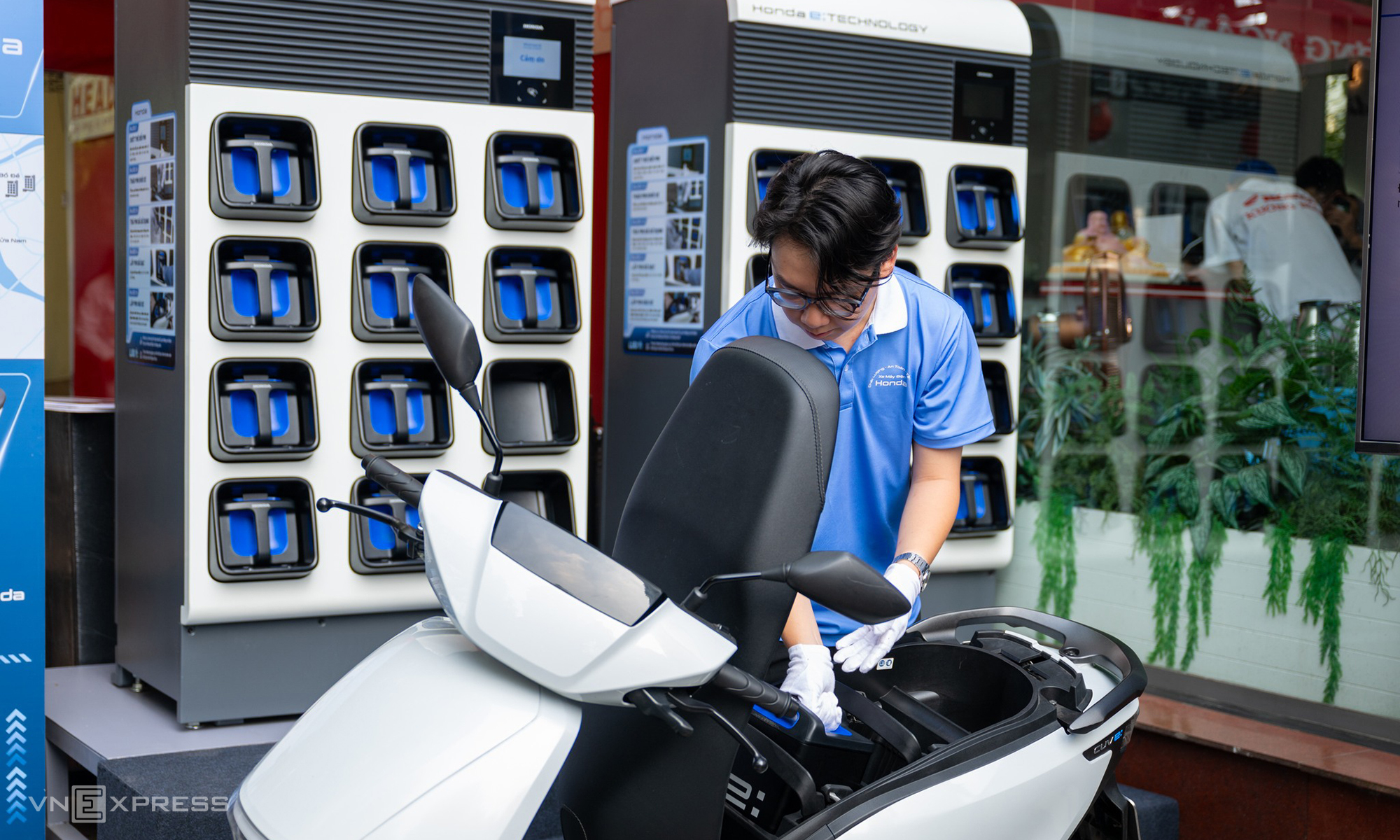 |
Honda CUV e: next to a battery swap station at a HEAD in Hanoi on 4/6. Photo: Luong Dung |
Honda's cautious approach is evident in its product distribution strategy. The CUV e: will only be sold at 59 HEADs (authorized dealerships) in Hanoi, TP HCM, and Da Nang. The more premium UC3 will be available at 83 HEADs across 20 provinces and cities. Pricing and charging system policies will vary depending on the model.
Honda is implementing several measures to bring its products closer to consumers. Customers in Hanoi and TP HCM can experience the CUV e: and UC3 for 7 days of free home use, starting in June for the CUV e: and in July for the UC3.
Both the CUV e: and UC3 models come with a three-year vehicle warranty. The battery has a two-year warranty, extendable by one year if customers perform regular battery checks according to the company's standard schedule. Additionally, customers who purchase a vehicle within the first two months of sales will receive a one-year complimentary roadside assistance card. Honda, in collaboration with its HEAD system, commits to repurchasing the UC3 within three years, provided it meets the criteria set by the company.
The CUV e:, an urban electric motorcycle, is priced at 65 million VND with two batteries and two chargers, or 45 million VND without two batteries (but includes two chargers). The service fee for using a battery swap station is 350,000 VND per month, while renting a battery for home charging costs 250,000 VND per month.
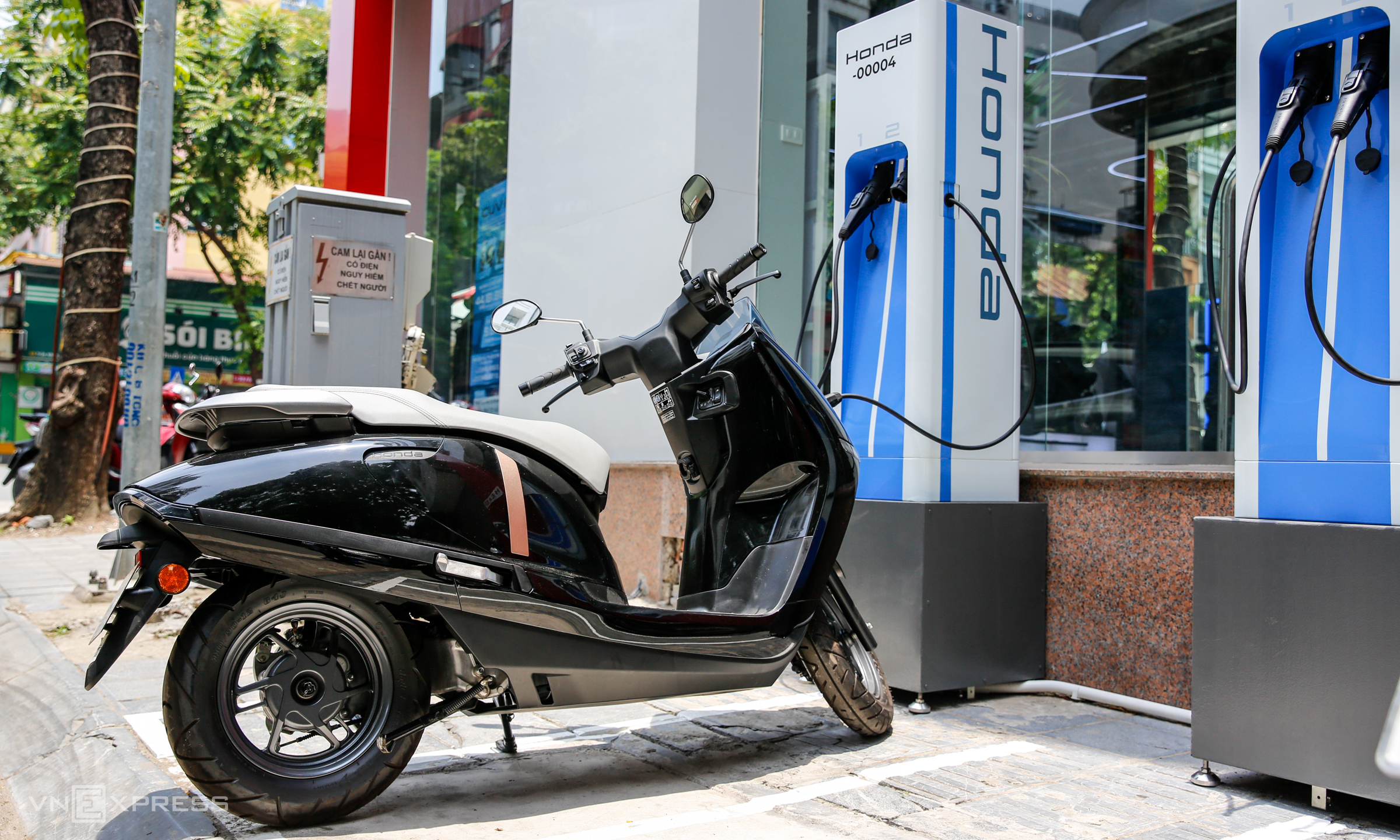 |
Honda UC3 next to a battery charging station located at a HEAD in Hanoi on 4/6. Photo: Luong Dung |
For the Honda e:Swap Battery Station system, these stations are located at HEADs that sell electric vehicles. After registering and making payments via the MyHonda+ application, customers will receive a chip card for unlimited battery swaps.
In contrast, the more premium scooter model, the Honda UC3, uses a fixed battery with fast-charging technology. To stimulate initial demand, the company is offering an introductory price for the UC3, which is 22 million VND lower than the suggested retail price for both versions. Instead of 80 million VND and 81,4 million VND for the two versions, the vehicle will be sold at 58-59,4 million VND.
This model targets performance-oriented customers, featuring an 8 horsepower rear-wheel motor and a top speed of 80 km/h. The UC3 uses the CHAdeMO charging standard, allowing for a 0-100% charge in approximately four hours and a 20-80% charge in about two hours, using the included 1,200 W charger. In addition to home charging, the UC3 can also fast charge at Honda Motor Charger Hubs located at HEADs that sell electric motorcycles, with a charging fee of 7,150 VND (including 10% VAT) per charge.
With the ICON e:, Honda now has three products spanning three segments: entry-level, mid-range, and premium. Given the limited number of products and cautious business strategy, the Japanese motorcycle manufacturer may not achieve the rapid sales volume seen with gasoline motorcycles. However, this signals the seriousness of Vietnam's oldest motorcycle brand in a product segment where sales significantly depend on after-sales service.
Luong Dung