When it rains, wet road surfaces reduce tire grip, making vehicles unstable if riders brake or change direction suddenly. To prevent skidding and falling, riders should decelerate early, maintain vehicle stability, gradually increase braking force, and avoid braking while leaning. However, each type of motorcycle has distinct operating characteristics, from power transmission and engine braking capability to weight distribution, requiring riders to follow specific guidelines when braking on wet roads.
Geared and manual clutch motorcycles
Geared and manual clutch motorcycles can utilize engine braking by releasing the throttle and downshifting. This method helps the bike slow down without putting all the braking force on the mechanical brake system. However, some riders have a habit of "clutching in" while braking, meaning they pull the clutch lever or press the gear shifter during deceleration. When this happens, the engine no longer transmits braking force to the rear wheel, causing the bike to coast due to inertia and rely more heavily on the mechanical brakes.
Therefore, when it rains, riders should release the throttle early, maintain an appropriate gear, and can downshift gradually to utilize engine braking. Simultaneously, combine both front and rear brakes, increasing braking force progressively instead of applying it suddenly. If significant deceleration is needed, avoid downshifting too low while the bike is still moving fast, as this can cause the rear wheel to experience excessive braking force, leading to "fishtailing"—where the rear wheel skids out of control.
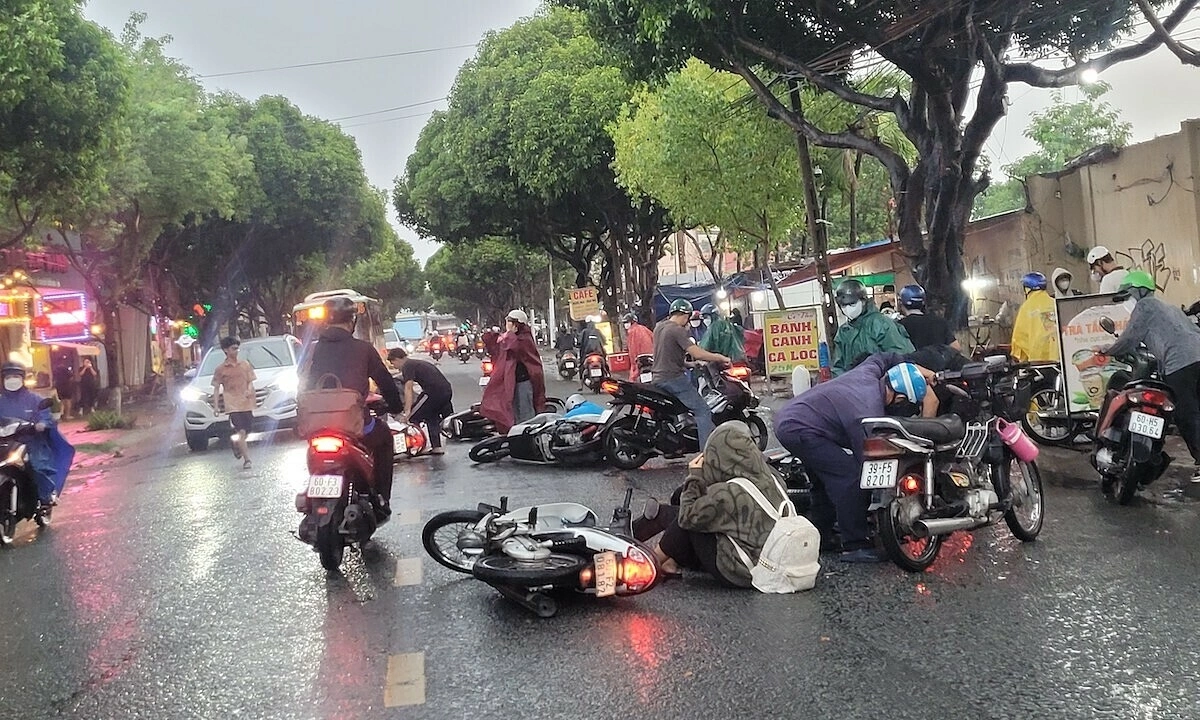 |
A motorcycle skids and falls on Phan Trung Street, Bien Hoa City, on 8/5. *Photo: Phuoc Tuan* |
Before entering a curve, complete most of the deceleration process while the bike is upright, and only then lean into the turn. Avoid strong braking while leaning on a wet road surface.
Scooters
Scooters do not have a gear shifter for riders to actively select gears, but they still provide engine braking when the rider releases the throttle. Therefore, when it rains, riders should release the throttle early to allow the scooter to decelerate naturally, then combine both brakes when further deceleration is needed.
Another characteristic is that many popular scooter models use small-diameter wheels. Compared to larger wheels, small wheels are more prone to wobbling when encountering potholes, water grooves, or road edges, especially on wet surfaces. Therefore, riders should decelerate before passing through these areas, avoiding sudden braking or steering once the wheels have encountered an obstacle.
Many scooter models today, especially in the mid-range and premium segments, are equipped with anti-lock braking system (abs). This system helps prevent wheels from locking up during forceful braking, allowing riders to apply greater braking force when an emergency stop is required. However, abs cannot eliminate the risk of instability when braking while the scooter is leaning. Therefore, even if a scooter has abs, it is still advisable to decelerate before entering a curve and avoid sudden braking while leaning.
Electric motorcycles
Electric motorcycles have different weight distribution characteristics compared to gasoline motorcycles. Many popular models use in-hub motors placed directly in the rear wheel, making the rear heavier. When braking or changing direction suddenly on a wet road, the rear wheel can lose stability, potentially causing the rear of the bike to swing out.
Therefore, when it rains, riders should decelerate early, keep the bike straight, and gradually increase braking force. When emergency braking is required, avoid simultaneously steering or making sudden direction changes. Before entering a curve, it is essential to decelerate while the bike is upright, and only then lean into the turn.
Another characteristic of electric motorcycles is that not all models feature regenerative braking to slow the bike when the throttle is released. Particularly in popular models, when riders release the throttle, the bike may continue to coast noticeably instead of decelerating significantly on its own. Therefore, in rainy weather, riders should not rely solely on releasing the throttle to slow down but must actively use their brakes early, especially when preparing to stop or enter a curve.
Hai Dang