India's transport minister, Nitin Gadkari, confirmed this information at an event in Nagpur. He stated that the new vehicle marks a significant milestone in India's efforts to promote alternative fuels. The manufacturer has not yet disclosed the vehicle's name, but it is expected to be a flex-fuel version of the WagonR or Fronx.
This development follows the Ministry of Transport's revision of vehicle testing and certification standards to include E100-compatible vehicles, paving the way for automakers to introduce pure ethanol-powered models to the Indian market, according to India Today.
In his speech, Gadkari reiterated the government's intention to reduce India's dependence on imported fossil fuels. He emphasized that nearly 87% of the country's petrol, oil, and gas demands are met through imports, which increases both pollution and foreign exchange outflow.
The minister also highlighted the economic advantages of ethanol-fueled vehicles, stating that ethanol fuel costs approximately 65 rupees per liter and can significantly reduce operating costs compared to conventional fuels. According to him, flex-fuel technology is a cost-effective and cleaner alternative, while also supporting domestic agriculture by creating demand for ethanol production.
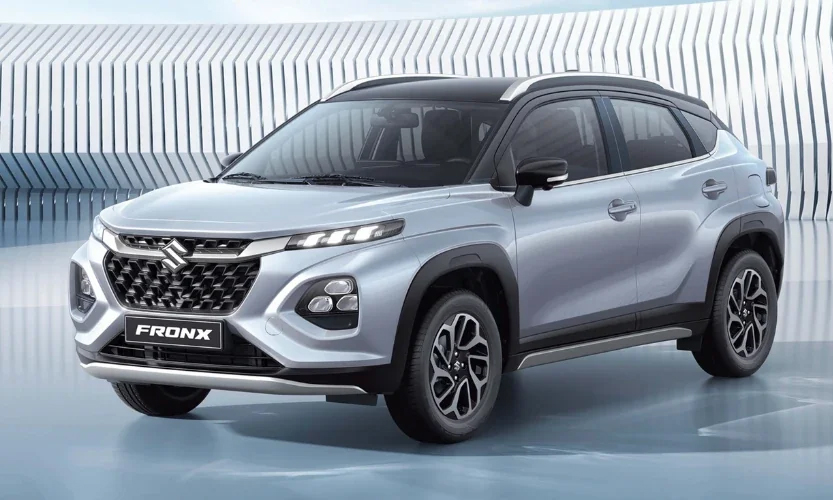 |
The Suzuki E100-fueled vehicle could be a version of the Fronx. Photo: Maruti Suzuki.
Gadkari also added that many manufacturers, including Toyota, Tata Motors, Mahindra, and Suzuki, are developing flex-fuel compatible products for the Indian market.
Maruti Suzuki has kept details about the specific vehicle under wraps, but the company previously showcased flex-fuel prototypes of the WagonR and Fronx at various auto shows. Both models are believed to feature upgraded fuel system components and modified engine calibration to safely handle high ethanol concentrations.
Unlike conventional petrol vehicles, E100-compatible cars require specially designed fuel lines, injectors, gaskets, and internal components because ethanol is more corrosive and absorbs moisture more easily than petrol.
Maruti Suzuki executives previously acknowledged that while the company possesses the necessary flex-fuel technology, widespread adoption could take time due to limited fuel infrastructure.
Currently, India adheres to the E20 petrol standard, which contains 20% ethanol. However, the government is exploring the possibility of gradually increasing the blend ratio beyond E20, with discussions reportedly underway regarding E22, E25, and even E30 fuel standards.
For E100 fuel, the Indian government plans to install 5,000 distribution stations across the country in the next two years to reduce crude oil imports.
According to the plan, the first 150 retail outlets will become operational in Delhi, Mumbai, Pune, and Nagpur within the next month. The E100 infrastructure will then expand to Bangalore, Chennai, Kolkata, and Hyderabad within the next 6-12 months, according to the Economic Times.
The launch of an E100-compatible Maruti Suzuki will be an important step in preparing India's automotive ecosystem for a broader transition to alternative fuels and reduced reliance on crude oil.
My Anh