Following a proposal from the Traffic Police Department to designate the leftmost lane on highways exclusively for passing, many readers have debated the issue, with some arguing: "If I am already driving at the maximum speed limit, vehicles behind me that want to go faster should just pass on the right." However, according to traffic safety experts, forcing vehicles behind to pass on the right complicates the overtaking maneuver and increases the risk of collisions.
Larger right-side blind spots
Traffic safety organizations like IAM RoadSmart emphasize that passing on the left aligns with traffic rules in most countries where vehicles drive on the right. Drivers tend to check their left rearview mirror more often, while a vehicle's right-side blind spot is typically larger.
This phenomenon is particularly pronounced in SUVs, trucks, and passenger buses. These vehicles, with their elevated driver's seats and larger bodies, create a more expansive right-side blind spot compared to passenger cars. If a vehicle unexpectedly appears on the right to pass, the driver in front may not detect it in time when preparing to change lanes or return to the right lane after overtaking another vehicle, thereby increasing the risk of a collision. For this reason, many countries consider passing on the right an exception, permitted only under specific traffic conditions.
Increased lane changes
Lane changing is one of the maneuvers that carries a higher risk of collision compared to maintaining a consistent lane. When a vehicle occupies the left lane for an extended period, following vehicles wishing to pass may be compelled to switch to the right lane instead of passing in the conventional manner. This necessity generates additional lane changes, consequently increasing the potential points of conflict between vehicles.
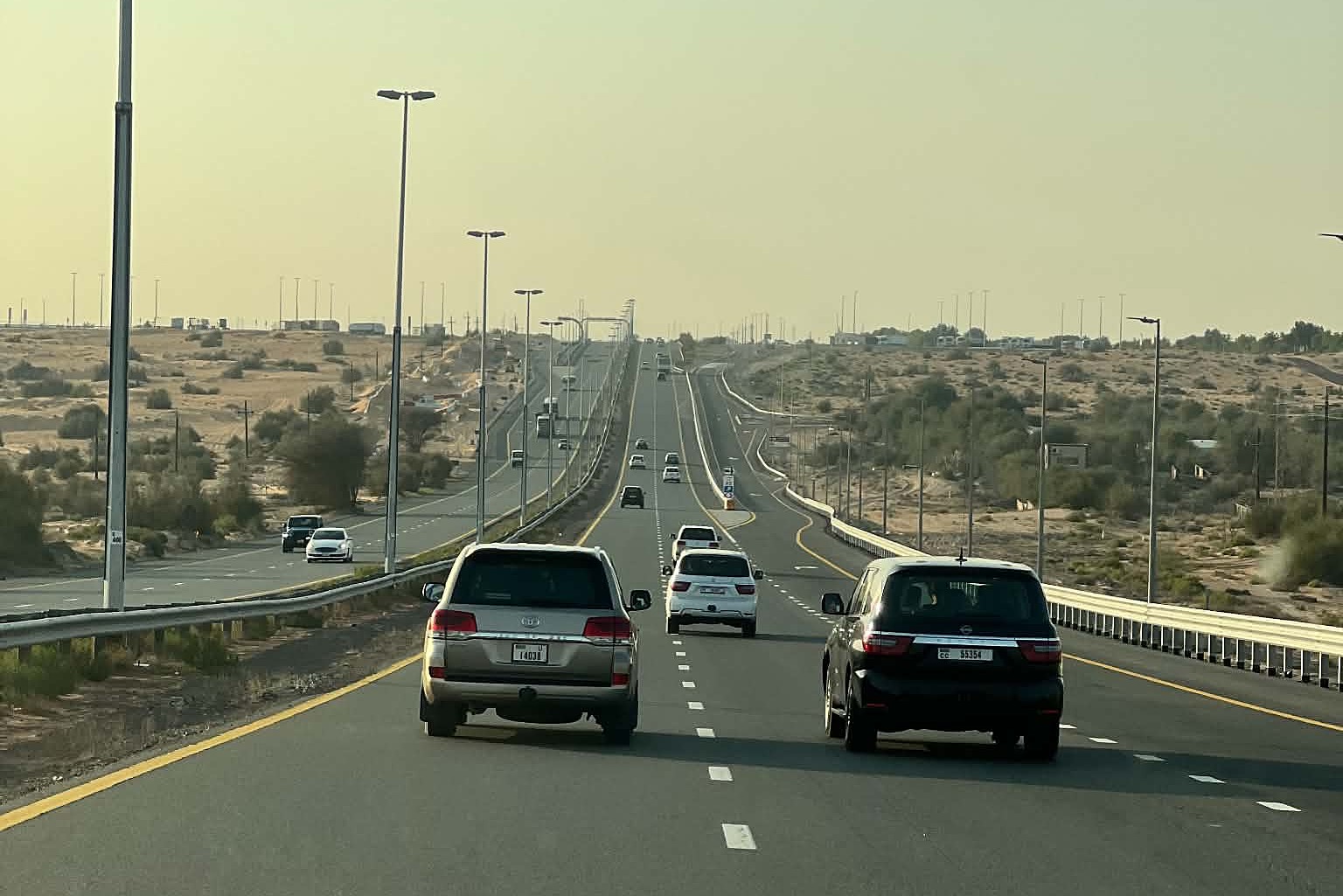 |
A highway in Dubai with two lanes in one direction, the left lane reserved for passing. Photo: Ho Tan
Under normal traffic conditions, a passing vehicle typically uses the left lane to overtake and then returns to the right lane upon completion of the maneuver. However, if the left lane is occupied, drivers may have to switch to the right lane to pass, and then switch back to the left lane to continue their journey or to overtake other vehicles ahead. In many instances, they might also need to weave through trucks or slower-moving vehicles in the right lane, further escalating the number of required lane changes.
Every lane change demands that the driver check rearview mirrors, verify blind spots, assess the speed of surrounding vehicles, and select a safe gap. Therefore, the more lane changes a driver performs, the greater the risk of errors and collisions.
Right lane has more complex situations
On highways, the right lane serves not only for slower-moving vehicles but also as the entry and exit point for traffic. Consequently, a vehicle attempting to pass in the right lane may encounter vehicles merging from an on-ramp at a significantly lower speed, or vehicles decelerating to exit the highway. In such scenarios, the driver is forced to either change lanes again or brake abruptly to avoid a collision.
In contrast, the lane adjacent to the median barrier typically experiences fewer merging or exiting situations, which makes passing simpler and more predictable.
Difficult to predict driver behavior
A fundamental principle of safe driving is that all actions should be predictable. When all drivers understand that passing vehicles will appear from a consistent side, they proactively observe that direction before initiating a lane change.
When vehicles can pass from both sides, it becomes challenging for drivers to anticipate the direction from which a following vehicle will appear. The necessity of simultaneously observing both the left and right sides before each lane change divides a driver's attention, increasing the risk of failing to notice a passing vehicle. This is why many countries maintain the rule of "keep right, pass left" rather than allowing drivers to choose their passing side.