As President Donald Trump prepared to meet Chinese President Xi Jinping this week, the US auto industry and bipartisan lawmakers continuously sent him a clear message: Do not allow China access to the US automotive market.
In january, Trump told the Detroit Economic Club it would be "great" if Chinese automakers wanted to build factories in the US and employ Americans, adding, "I love that. Let China in, let Japan in", according to Reuters.
His comments sounded an alarm within an industry that has systematically lobbied to ban Chinese vehicles from the US market through strict data security regulations and high tariffs on electric vehicles.
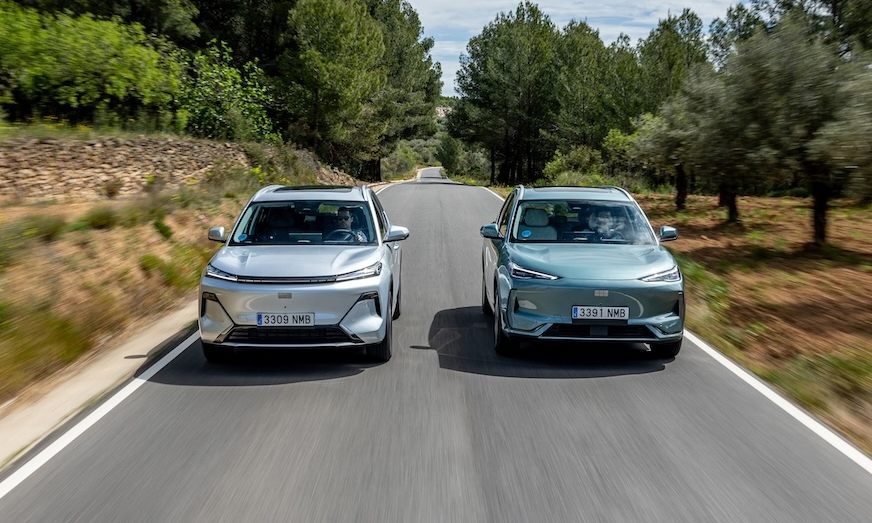 |
Two Geely car models in Spain. *Photo: Geely*
Consequently, automakers, suppliers, steel manufacturers, unions, and politicians intensified their efforts, arguing that Chinese automakers, backed by extensive state support, enormous scale, electric vehicle technological advantages, and extremely low prices, would overwhelm domestic and foreign manufacturers, undermining America's core manufacturing base.
Democratic Senator Elissa Slotkin of Michigan also specifically urged Trump not to reach an agreement with Chinese President Xi Jinping that would permit Chinese investment in the US auto industry or introduce Chinese car brands into American dealerships.
In april, three Democratic congressmen also urged Trump to promptly ban Chinese car companies from manufacturing in the US, citing not only the risk of making US car companies uncompetitive but also concerns about triggering an irreparable national security crisis.
Recently, the US auto industry has shown rare unity in supporting a ban on Chinese vehicles. The escalating car affordability crisis in the US, where Kelley Blue Book estimates the average listed price of a vehicle now exceeds 51,000 USD, makes existing manufacturers particularly vulnerable to cheaper Chinese models.
The US auto industry does not want to face the situation their European counterparts are experiencing: Chinese brands are gaining increasing recognition and market share on the continent.
In 2025, Chinese brands doubled their market share in the European automotive market to 6%, and consumer interest in Chinese electric vehicles is growing as fuel prices rise. Canada is starting to import 49,000 Chinese electric vehicles annually, and currently, 34 Chinese car brands are sold in Mexico, accounting for about 15% of that market with prices significantly lower than any product available in the US.
Germany's largest trade union, IG Metall, does not oppose Volkswagen potentially opening underutilized factories to Chinese automakers, but believes any such move requires careful evaluation.
Volkswagen is continuing its restructuring process, with a key component being job cuts: by 2030, about 50,000 jobs will be eliminated in Germany. The company currently has 660,000 employees worldwide, with about 280,000 in Germany. Alongside job reductions, production capacity will also be regularly reviewed.
Zwickau, Volkswagen's first factory to fully convert to electric vehicle production, had about 8,000 employees by the end of 2025. This plant could be a candidate for cooperation with China.
My Anh