In recent years, ACB has focused on integrating environmental, social, and governance (ESG) factors into its operations. In 2025, ACB successfully developed its Sustainable Development Strategy for the 2026-2030 period, incorporating ESG factors into its business activities, risk management, and operations.
Concurrently, ACB strengthened its governance mechanisms by establishing a Sustainable Development Committee under the Board of Directors, integrating ESG factors into the highest decision-making level. The bank stated that the direct involvement of the Board of Directors and the Executive Board ensures sustainable development goals are guided, monitored, and implemented uniformly across the entire system.
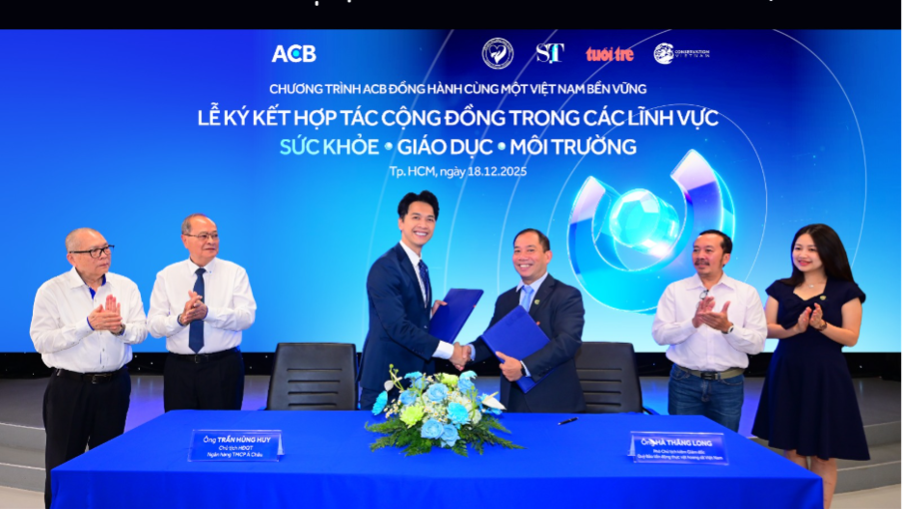 |
ACB representatives signing cooperation agreements in health, education, and environment. Photo: ACB |
Building on this foundation, ACB is progressively implementing a shared value creation (CSV) model through long-term cooperation programs in health, education, and the environment. According to the institution, this direction aims to connect the interests of the bank, its customers, and the community, leveraging the organization's core competencies.
These strategic directions are also detailed in the 2025 Sustainable Development Report, structured around four pillars: Economic, Environmental, Social, and Governance (Ec-ESG). The report focuses on 12 key themes significantly impacting business operations and stakeholders.
 |
ACB announcing its 2025 Sustainable Development Report alongside its 2025 Annual Report. Photo: ACB |
Under the economic pillar, ACB reported total assets exceeding 1,025 trillion VND, an increase of nearly 19% compared to 2024. Credit outstanding reached 687,000 billion VND, with the non-performing loan ratio maintained below 1% and the non-performing loan coverage ratio at 114%. The bank also contributed 5,782 billion VND to the State budget.
In the environmental sector, ACB reported a 12,7% reduction in greenhouse gas emissions, a 9% decrease in electricity consumption, and a 32,5% drop in gasoline consumption. Digitalization initiatives helped reduce approximately 225 tons of paper, equivalent to 124 tons of CO2eq.
The bank also implemented a Sustainable Finance Framework to standardize assessment criteria for green and social loans. Building on this, ACB launched the "Boost Green Credit - Accelerate Growth" package with a limit of 5,000 billion VND in 2025, an increase of 1,000 billion VND from the previous year, targeting both large enterprises and small and medium-sized enterprises. Green credit outstanding currently stands at nearly 395,6 billion VND.
Under the social pillar, ACB focused on enhancing customer experience, human resource development, and community contributions. In 2025, the bank processed over 2,3 million customer requests; provided more than 1,05 million hours of employee training; and implemented a series of community activities, including: granting 500 scholarships, distributing 100 health insurance cards, donating 4 billion VND to support flood and storm recovery, and nearly 1 billion VND to aid the impoverished nationwide.
In governance, ACB strengthened its compliance and risk management capabilities with over 47,000 hours of specialized training. Technology applications helped reduce operational inquiry time by 80%, equivalent to 1,6 million working hours annually. The bank prevented over 37,500 fraud cases, estimated to have protected more than 2,500 billion VND in customer assets, and completed the implementation of the IRB (internal ratings-based) approach in line with Basel standards.
Building on over three decades of operation and a refined governance model integrated with its overall strategy, ACB is progressively embedding sustainable development into its operations to create long-term value. According to the bank, this serves as a foundation for future customer- and community-centric initiatives, reinforcing its position and driving sustainable development in the new era.
"At ACB, sustainable development is not just a commitment to responsibility, but also a foundation for long-term growth", a bank representative emphasized.
Minh Ngoc
For more detailed information, readers can view ACB's Sustainable Development Report here.