Unlike field crabs, cua da crabs have a greenish-gray or slightly reddish shell, with legs and a body three to four times larger. Local residents refer to this species as "cua da" because its legs, claws, and underside are covered with a fine, skin-like layer of hair, providing protection. In some areas, it is known as "cua ra" or "ca ra".
Currently, grade one cua da crabs are priced at 650,000-700,000 dong per kg. In contrast, "cua canh"—crabs designated for soup—are significantly cheaper, at only 170,000-180,000 dong per kg. Market analysis indicates that this price point is approximately 5% higher than last year's same period and nearly double the price recorded in 2020 when cua da crabs first entered commercial farming. Despite a nearly twofold increase in the volume of crabs purchased early this season, the scarcity of grade one crabs means supply remains limited.
Phuong, a cua da crab trader with nearly two decades of experience in former Bac Giang (now Bac Ninh), shared that some days she spends collecting crabs without finding any. "Even on a good day, I only get over 10 kg," she stated, noting the high demand from customers.
Tuan, another trader in former Bac Giang, noted that in recent years, cua da crabs have gained popularity beyond the province, with customers from Hanoi and other areas placing orders. Early in the season, many buyers must place orders one to two days in advance to secure quality crabs for gifts or entertaining. He anticipates that from September onwards, as the crab yield improves in quality, supply will become more abundant, potentially leading to a decrease in prices.
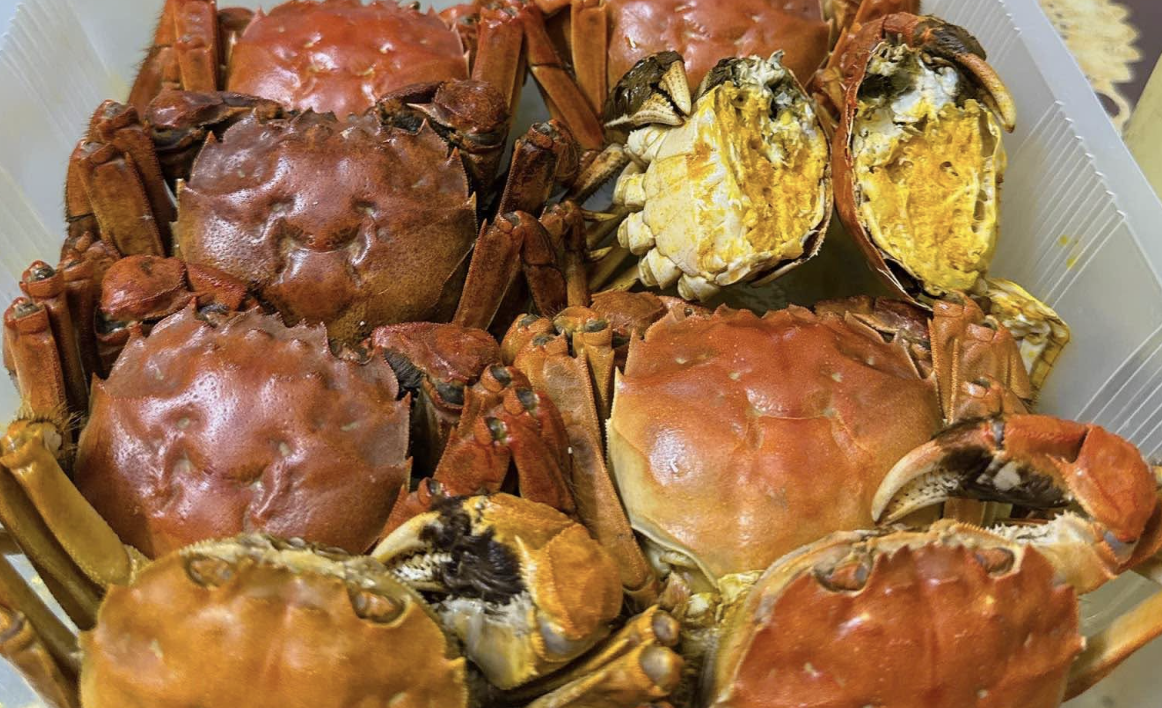 |
Cua da crabs are sold at a facility in former Bac Giang (now Bac Ninh). Photo: Pham Phuong |
Cua da crabs are sold at a facility in former Bac Giang (now Bac Ninh). Photo: Pham Phuong
Grade one crabs usually weigh 6-8 individuals per kg. These are carefully selected mature crabs, known for their firm meat and abundant roe. The classification process heavily relies on experienced observation of the crab's color, shell hardness, and overall maturity, making it challenging for those without expertise to distinguish them.
Historically, cua da crabs were primarily harvested from natural habitats like rock crevices and riverbank hollows along the Cau River. However, due to a brief harvesting season, typically from August to November, and the increasing scarcity of wild crabs, local communities transitioned to breeding and commercial farming. These operations are now concentrated in riverine ponds within Canh Thuy ward and nearby areas. Each crab batch requires over one year of cultivation before it can be harvested, a practice that helps satisfy the market's rising demand.
Duong Thanh Tung, Director of Bac Ninh Department of Agriculture and Environment, informed VnExpress that the province has initiated various farming models and offered technical assistance to residents. This support aims to develop cua da crabs as a commercial aquatic product. With an established brand and a stable market, this farming model has proven economically effective. However, the local authorities are not pushing for indiscriminate expansion of farming areas. Instead, they advocate for development on a reasonable scale, ensuring both the quality of this specialty product and the sustainability of the farming environment.
Thi Ha