On the opening day of Vietnam's carbon exchange in late June, Olivier Marquette, Chairman and CEO of AES Vietnam, initiated the sale of 100 greenhouse gas allowances, priced at approximately 5 USD per ton of CO2e. Their Mong Duong II thermal power plant in Quang Ninh was allocated 25,5 million tons of CO2e in allowances for 2025-2026.
A total of 1,210 allowances were transferred via the carbon exchange on its initial pilot trading day. Since then, the exchange has not recorded any further transactions.
Dang Hong Hanh, CEO of Energy and Environment Consultancy Company (VNEEC), explained the exchange's inactivity, stating that current supply is limited in both product type and volume. The only item traded on the exchange is emission allowances for the 2025-2026 compliance period, coded VN2025, representing over 511 million tons of CO2e. This product code is valid for trading until 24/12/2027.
Greenhouse gas allowances represent the maximum pollution limit a company is permitted to emit within a specific timeframe. Based on allocated allowances, companies exceeding their limits must purchase allowances from those with lower emissions.
Carbon credits, another product intended for the exchange, cannot be traded this year, according to Hanh. This is because the two groups of credits planned for listing (domestic credits and those under Article 6 of the Paris Agreement's clean development mechanism) are not yet ready.
For international credits, the earliest supply from transitional projects under the clean development mechanism (CDM) requires at least 6-8 months to complete procedures. Meanwhile, the methodological framework for domestic credit projects has not yet been issued.
The number of buyers and sellers during the carbon exchange's pilot operation phase also remains low, with only 92 companies, representing 110 large emitters, registered to participate. These companies themselves have not yet forecasted their emissions or determined their surplus or deficit of allowances for trading.
Furthermore, Dang Hong Hanh noted that many companies are still struggling with basic procedures for listing products on the carbon exchange, such as accounting, taxation, or recording revenue and expenses from allowances.
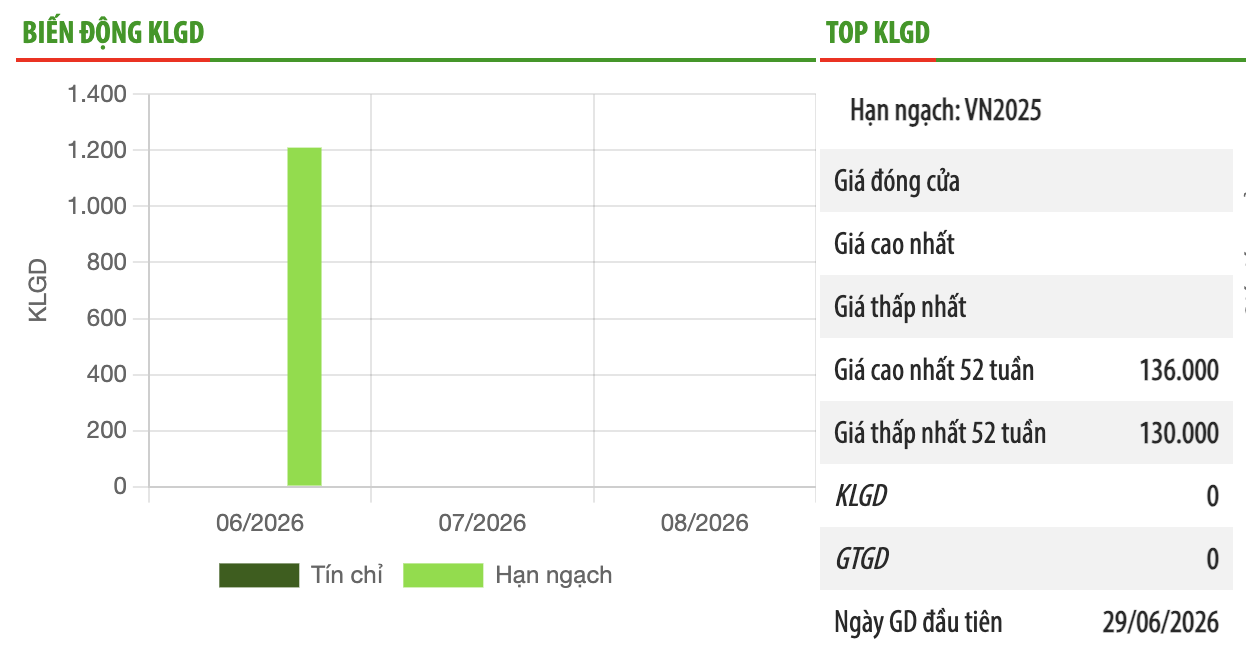 |
Carbon trading fluctuations from the exchange's opening day until 4/8. *Source: HNX* |
In practice, for a completely new market and product, companies like AES Vietnam admit their objective is to "familiarize themselves with the trading process."
Experts suggest that the initial quiet period is normal, as the primary goal at this stage is to verify the entire operating system and the coordination mechanism among regulatory agencies.
Similar to Vietnam, carbon exchanges in Trung Quoc and Han Quoc also experienced low trading activity during their initial months of operation. Beijing launched its emissions trading scheme (ETS) in 2021, after nearly 10 years of pilot programs in various localities. During the initial three months, trading was primarily for "learning and preparation," with active buying and selling occurring closer to the end of the compliance period when companies completed their emission inventories.
In Han Quoc, the ETS suffered from low liquidity for three years (2015-2017) because companies that reduced emissions were unwilling to sell their allowances. This situation forced the operator to add two major banks as market makers, selling government-held reserve allowances to increase supply.
To make the carbon exchange more active and increase liquidity, Nguyen Hong Loan suggests expanding the list of companies required to control emissions. Concurrently, the measurement, reporting, and verification (MRV) system – the foundation of allowances and carbon credits – should be standardized to ensure transparency and reliability.
Sana Ur Rehman, a senior analyst at EBC Financial Group, emphasized that MRV is the cornerstone of the entire market. If two factories apply different measurement methods or inventory boundaries, their allowance surpluses or deficits cannot be compared on the same basis.
Additionally, Loan believes that allowing financial institutions and market makers to participate, as in Han Quoc, will stimulate trading and foster transparent price signals based on supply and demand dynamics.
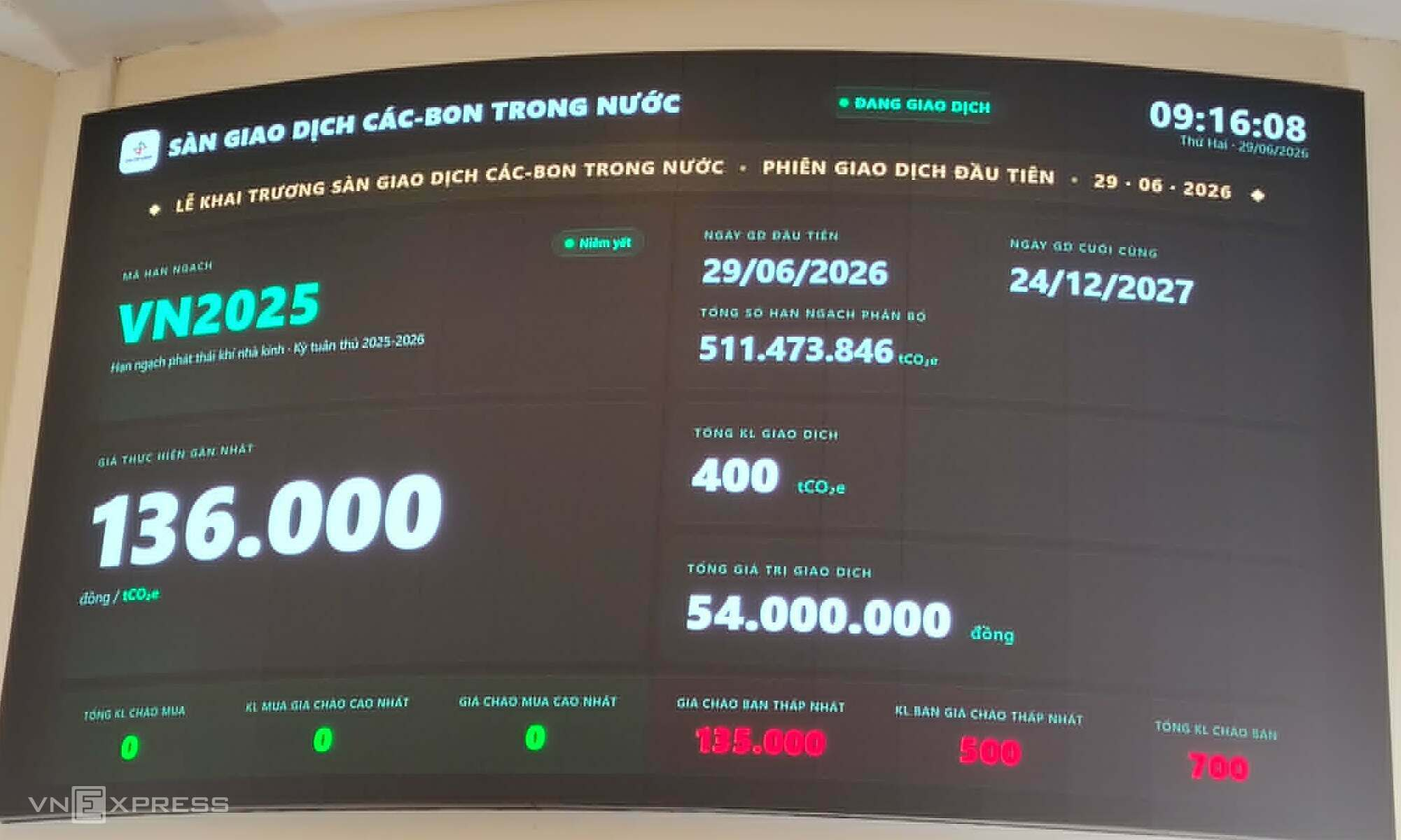 |
Carbon exchange information board on 29/6. *Photo: Thuy Truong* |
For companies, experts recommend prioritizing internal carbon footprint reduction and establishing a "carbon balance sheet" to calculate emissions, allowances, and costs under various price scenarios. Controlling electricity consumption should be done before considering investments in clean energy.
Nguyen Thanh Huy, acting Director of Novaon Industry (Novaon Group), advised companies to start with energy – the largest emission sector. They need to accurately measure electricity consumption, prioritize savings, and then evaluate options for clean energy investments like rooftop solar power.
In the long term, the EBC Financial Group expert believes that the operator needs to develop a common carbon data standard for companies, credit institutions, and investors. Transparently verified emission data will help banks and investors assess credit risk and value companies.
"Companies with emission reduction data will have an easier time accessing green capital, transforming the carbon exchange into an infrastructure for sustainable growth," Rehman said.
Thuy Truong