Standing Deputy Prime Minister Nguyen Hoa Binh, who also serves as Chairman of the Steering Council for the Vietnam International Financial Center, made this statement at the opening ceremony of a financial center management human resources training course on the morning of 27/2, held at Vietnamese-German University (VGU).
"Without a team of management staff knowledgeable about international financial markets, experts capable of designing products, operating transaction infrastructure, and monitoring risks, even the most advanced mechanisms and policies will struggle to be implemented effectively," he stated.
According to him, a financial center needs to be built on 5 core elements: global connectivity; stable, transparent, and advanced legal infrastructure; high-quality human resources; international-level operational and management capabilities; and a supportive development ecosystem. These five elements ensure the safe and effective operation of an international financial center, with the human factor playing a decisive role.
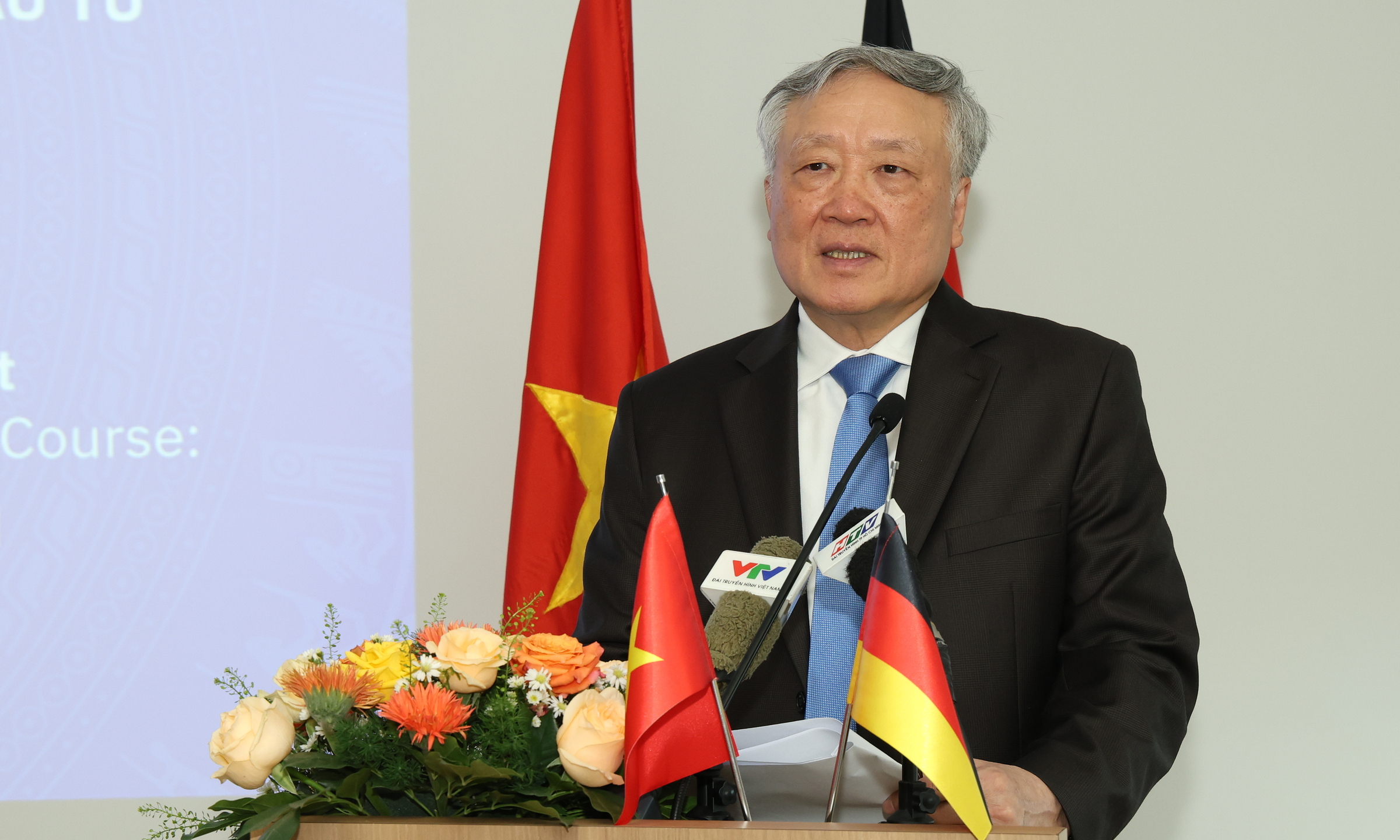 |
Standing Deputy Prime Minister Nguyen Hoa Binh spoke at Vietnamese-German University on the morning of 27/2. *Photo: VGU*
To strengthen its human resources foundation, the Center is implementing a high-quality human resources development project, which includes: training management teams; enhancing capabilities; and developing international-standard bachelor's and master's programs in finance, economics, and management.
VGU is responsible for training financial center managers and has already organized two courses providing participants with foundational knowledge on institutional models, financial center operations, financial markets, and macroeconomic stability.
The third course, which opened on the morning of 27/2, focuses on designing specific financial products and investment attraction strategies. It is directly taught by Hubertus Vaeth, founding chief executive officer of Frankfurt Main Finance and founding vice chairman of the World Alliance of International Financial Centers.
This course gathers 35 participants who are managers from the International Financial Centers in TP HCM and Da Nang, the State Bank of Vietnam, and commercial banks. VGU also plans to implement additional 12-week certificate programs, focusing on advanced quantitative analytical skills in finance and economics.
Standing Deputy Prime Minister Nguyen Hoa Binh suggested that the university organize additional training content relevant to the financial center's needs, such as carbon exchanges, sandbox mechanisms for fintech, and expand the target audience for participants. He also proposed that the Steering Committees of the International Financial Centers in TP HCM and Da Nang, along with VGU, continue to cooperate on training, research, and policy dialogue.
The International Financial Center in Vietnam was established under a National Assembly resolution on 27/6/2025, adopting a "one center, two destinations" model, located in TP HCM and Da Nang. Both centers in these two cities officially began operations earlier this year.
According to Standing Deputy Prime Minister Nguyen Hoa Binh, the successful establishment and operation of a financial center in Vietnam is part of the strategy to innovate the growth model, aiming for high and sustainable growth in the coming period. "A modern international financial center helps upgrade the capital market, directly connect with global capital flows, diversify financial products, promote green finance and digital finance, and support key projects in infrastructure, technology, and clean energy," he commented.
Sharing this view, Professor Doctor Rene Thiele, Rector of Vietnamese-German University, stated that developing a financial center is a key factor in the growth transformation process, with the goal of achieving double-digit GDP in the coming period. "And the financial market plays a crucial role in this context," he added.
Vien Thong