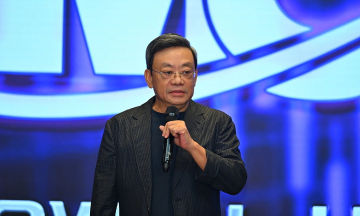
At the 2026 investment conference organized by Thien Viet Securities (TVS) on 10/7, financial experts extensively discussed how to optimize investment activities amidst significant volatility.
According to Nguyen Duy Linh, Chief Executive Officer of Saigon - Hanoi Securities (SHS), the current investment environment necessitates a change in investor mindset. Instead of solely seeking short-term profits, investors need to view each decision from an asset management perspective. Therefore, before investing, they should answer three questions: when will this money be used, what level of risk is acceptable, and what role does the asset play in the overall portfolio?
"A good asset is not necessarily a profitable investment if purchased at an excessively high price or if it constitutes a significant proportion of the portfolio," he said.
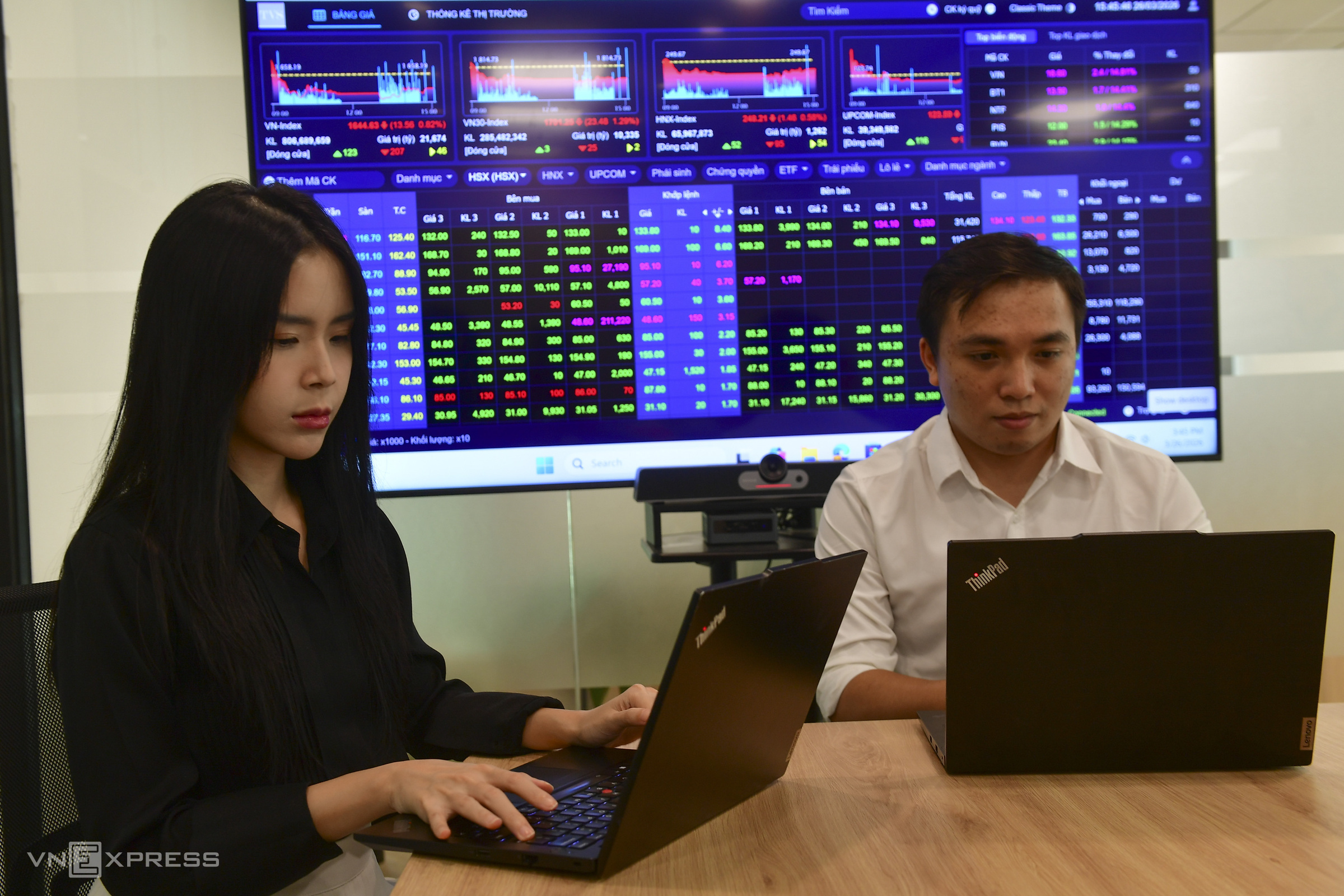 |
Investors monitor the stock market at a company in Ho Chi Minh City. Photo: Thanh Tung |
Many speakers emphasized that the biggest risk for investors today lies not in selecting the wrong asset, but in the approach to asset allocation. Nguyen Trieu Vinh, Deputy Investment Director and Equity Investment Director at Vietcombank Fund Management (VCBF), noted that many people only deposit savings due to prioritizing safety.
Conversely, other investors allocate most of their assets into stocks or real estate when market conditions are favorable. Both approaches lead to portfolios that are susceptible to imbalance in the face of inflation or economic cycle fluctuations.
Each asset type has distinct roles. Deposits meet liquidity needs, bonds help stabilize portfolios, while stocks drive long-term growth. Combining various asset groups, rather than betting on a single channel, helps investors achieve financial goals with lower volatility.
The SHS Chief Executive Officer also stated that the "all-in" mentality remains one of the most common mistakes, one he himself has made. When real estate prices rise, capital flows into land; when gold peaks or stocks surge, funds shift to these "hot" assets. Experts explain that each asset class has its own cycle of increases and decreases, and constantly chasing trends often leads investors to buy at high prices and sell during market corrections.
Vu Kim, Head of Wealth Management at Standard Chartered Vietnam, concurred, asserting that emotions largely influence investment decisions. In the market, investors often swing between two extremes: fear of missing out on opportunities and excessive worry when asset prices decline.
Kim analyzed that the first principle in asset management is understanding one's own needs before forecasting the market. Funds intended for use within one to two years should be invested in safe, highly liquid assets. Conversely, capital allocated for five to ten-year goals can tolerate greater volatility in exchange for potential returns.
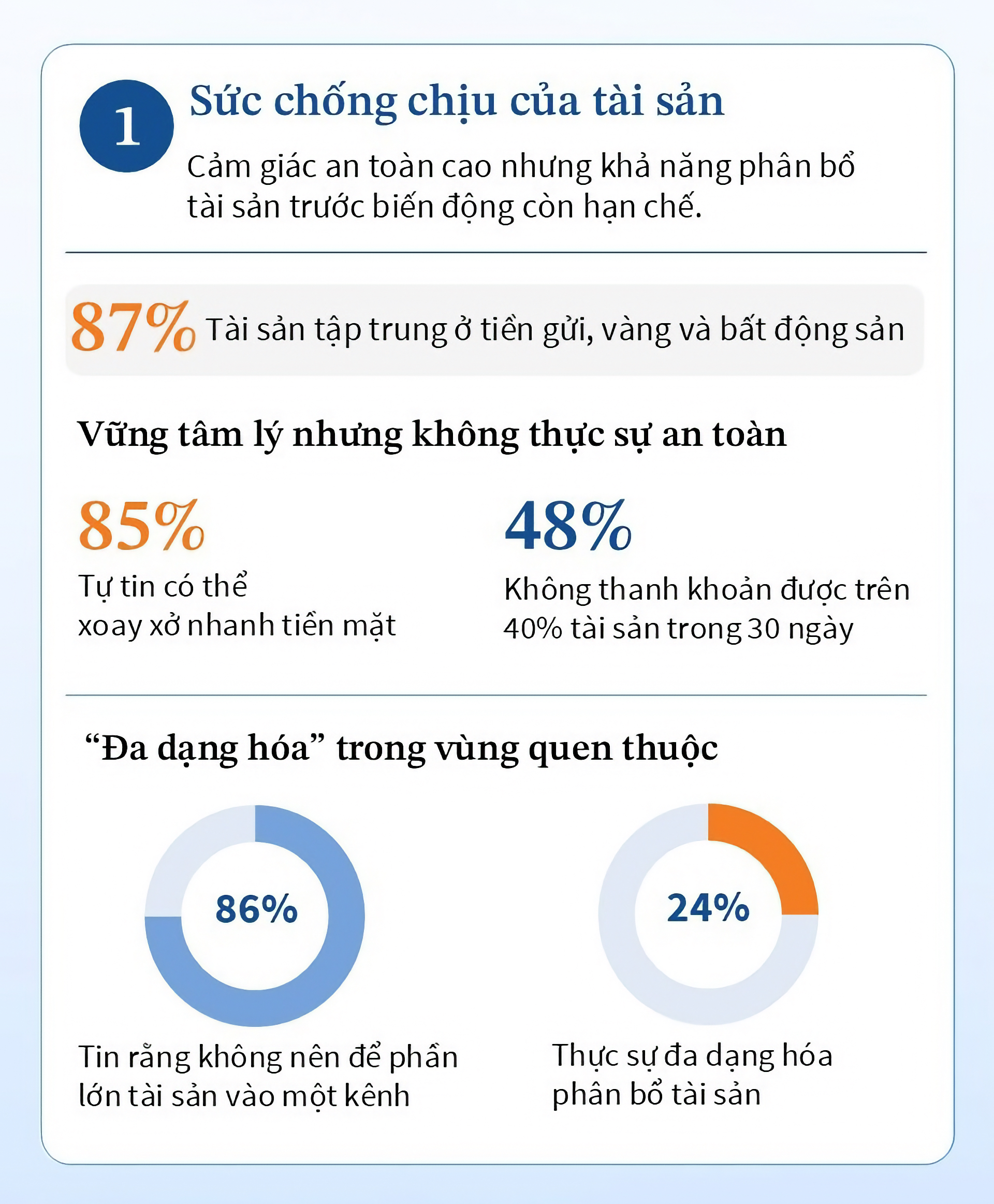 |
A TVS report indicates that 86% of investors believe they should not put most of their assets into a single channel, but only 24% actually diversify their asset allocation. Graphic: TVS |
Instead of attempting to predict market "peaks" or "troughs", the Head of Wealth Management at Standard Chartered Vietnam advises investors to periodically rebalance their portfolios to target weights. When an asset increases sharply, its weight should be reduced, and undervalued assets should be added. This strategy helps prevent chasing high prices or panic selling during market corrections.
From a fund management perspective, Nguyen Trieu Vinh suggests that investment duration should precede the question of "which asset to buy". For funds that are idle for under one year, deposits or bonds are generally more suitable than stocks due to limited volatility risk. However, if the investment goal extends for three years or more, stocks offer better opportunities for returns due to the market's ability to recover across cycles.
Beyond portfolio allocation, experts also caution investors against focusing solely on asset price fluctuations while overlooking risks that could directly impact financial plans. Inflation, exchange rates, personal liquidity, debt pressure, or health crises can all force investors to sell assets outside their plan if they have not prepared reserve funds.
Nguyen Duy Linh stated that technology and AI are helping investors access information faster, but they cannot replace critical thinking and discipline. Therefore, the difference between a successful investor and the majority lies in the ability to build a rational portfolio, adhere to an asset allocation strategy, and maintain discipline throughout the investment process.
Tat Dat