World oil prices have steadily climbed since early this month, fueled by escalating tensions in the Middle East. Brent crude currently trades at 93 USD a barrel, an increase of 16 USD since early August.
However, rising prices are not the most severe concern. A greater risk is emerging: the potential for a supply shock from a prolonged blockade of the Hormuz Strait to trigger a global fuel supply crisis.
Refineries face dual challenges from ongoing conflicts and export restrictions. This situation tightens the supply of gasoline, diesel, and jet fuel, essential for operating the global economy.
A key measure of refining profitability, the diesel crack spread, surged to 102 USD a barrel early this week, nearly tripling its pre-conflict level. This index calculates the profit refineries earn from converting each barrel of crude oil into diesel.
"This is a very unusual development. The market is signaling undersupply," stated Bob McNally, founder and head of Rapidan Energy Group, to CNN.
Global fuel supply remains at historically low levels, with three of the world's four major refining centers currently facing difficulties.
In the Middle East, several refineries have been attacked during the conflict. Facilities that escaped damage still struggle with transporting goods due to the Hormuz Strait blockade, which has lasted for months.
The Middle East is not the only region facing trouble. Refineries in Russia are also experiencing disruptions from Ukrainian drone attacks. According to research firm Capital Economics, about 40% of Russia's refining capacity is affected, representing approximately 3% of global refining capacity. To address domestic fuel shortages, Moscow has banned gasoline and diesel exports until 1/2027.
China, another major fuel exporter, is also not entirely immune. Beijing helped prevent oil prices from soaring to 150 USD a barrel by reducing oil imports more sharply than analysts anticipated. However, to avert domestic fuel shortages, China also restricted fuel exports.
This situation leaves the United States as the sole remaining major supplier. Its refineries are operating at full capacity to capitalize on record-high profit margins.
"The market is about to enter the strongest demand period of the year, but there is no room for any missteps," analysts at Bank of America wrote in a report last week.
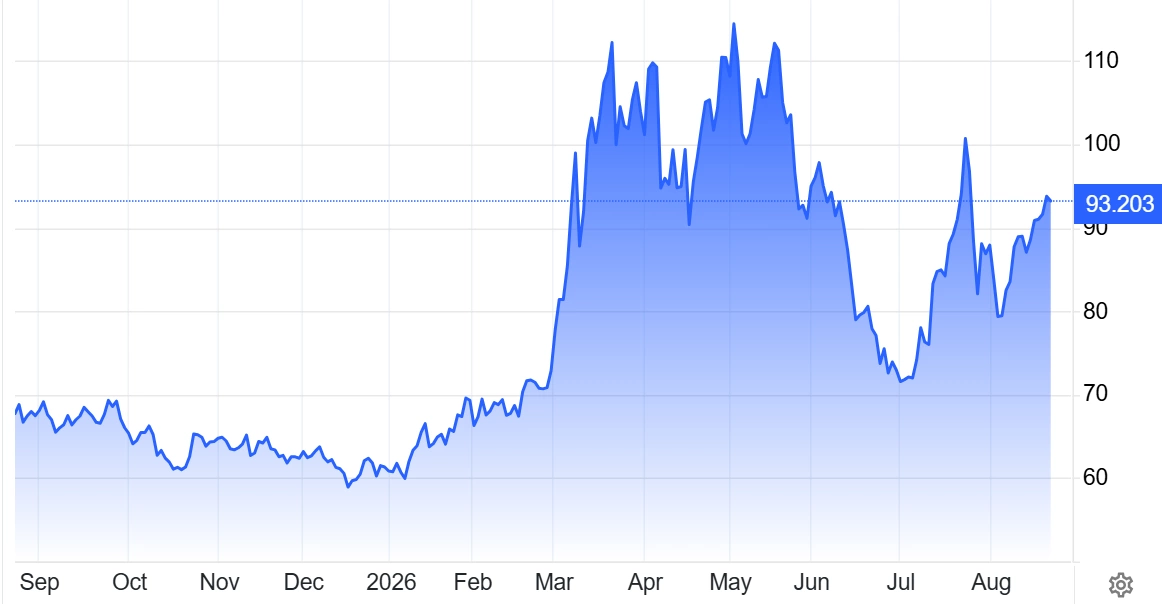 |
Brent oil price movements over the past year. Chart: Trading Economics |
Record-high profit margins mean refineries not disrupted by conflict are earning significant profits. "Refineries are running at full tilt. It's like Christmas came early," said McNally, a former energy advisor during President George W. Bush's administration.
Shares of Marathon Petroleum and Valero Energy on the US stock market have more than doubled since the beginning of the year. Phillips 66 shares also rose nearly 90%. Profits for major oil and gas corporations like Chevron and ExxonMobil surged. Exxon alone earned an average of 160 million USD each day last quarter.
Despite this, it remains uncertain how long US refineries can sustain full capacity operations. The peak hurricane season is approaching, and these refineries have experienced numerous disruptions from major storms. Additionally, in the autumn, they typically reduce capacity for maintenance during periods of weaker demand.
Compared to last summer, fuel prices this year are considerably higher, though they have not risen to the levels many feared at the start of the conflict. The average price for regular gasoline in the US reached 4,07 USD a gallon (1,07 USD a liter) early this week, a 30% increase from the same period last year.
Diesel prices, vital for the global economy, are also 48% higher than last year. This represents a "hidden" cost for consumers, as this fuel powers tractors on farms, as well as trains and trucks transporting goods across the US.
When fuel costs increase, businesses often pass a portion of these costs to consumers through higher prices for goods. Research from Brown University indicates that rising diesel prices have cost US consumers nearly 40 billion USD since the conflict began.
Meanwhile, jet fuel prices have risen over 70% in one year. With travel demand remaining high and low-cost airline Spirit ceasing operations in May, other airlines have increased ticket prices and baggage fees, while also cutting less profitable flights.
"The direct impact on consumers is evident at gas stations and airports. These will be the sources of widespread price pressure," analysts at Rystad Energy wrote in a report last week.
Witnessing major oil and gas corporations profit from supply disruptions, the public and small businesses are increasingly angered by high prices. If difficulties in the refining sector keep gasoline, diesel, and jet fuel prices high for longer, inflation will be challenging to curb.
"Unless supply issues in the Middle East, China, and Russia are resolved, diesel prices are likely to remain at peak levels, or even rise further if inventories continue to decline into winter," Bank of America noted.
Prices are already high enough to start curbing consumption. However, Bank of America suggests that the reduction in demand is not yet sufficient to bring the market back to balance, at least for now.
McNally, Chairman of Rapidan Energy Group, believes that either crude oil prices will have to increase to match pressure in the fuel market, or the Middle East conflict will need a turning point.
"Iran or the US President must make concessions. I cannot say which will happen first," McNally concluded.
Ha Thu (according to CNN, Reuters)