Global spot gold prices closed on 23/2 at 5,227 USD per ounce, marking a 121 USD increase. By the morning of 24/2, prices climbed further to 5,250 USD, reaching their highest level since 30/1.
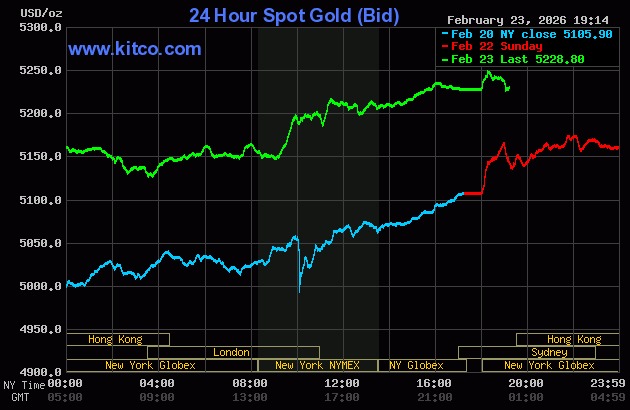 |
Global gold prices have accelerated since last weekend. Chart: Kitco |
The gold market's upward trend is driven by a wave of safe-haven buying amid instability in US trade policy. Following a Supreme Court ruling that overturned several import tax policies, President Donald Trump promptly responded by imposing new tariffs. On Truth Social on 23/2, he further criticized the court's decision and warned of additional tax increases.
Jeffrey Christian, Director of CPM Group, noted, "There are too many political and economic issues globally. We anticipate a significant price increase this week as activity normalizes after the Lunar New Year holiday." China's market, a leading global gold consumer, reopened today.
"Over the next few quarters, we expect gold prices to continue rising and potentially set new records," Christian added, signaling a bullish outlook for the precious metal.
Recent data also indicates inflationary pressures in the US. Figures released last weekend showed US inflation rising more sharply than anticipated in 12/2025. Other reports highlighted a notable slowdown in economic growth during Q4/2025. This economic climate could prompt the Federal Reserve to postpone interest rate cuts, a factor that typically supports gold prices.
Investors this week are awaiting further speeches from Federal Reserve officials and closely monitoring the US-Iran situation. Gold is traditionally considered a store of value during periods of economic and political volatility, and its price tends to increase when interest rates are low.
Beyond gold, other precious metals saw mixed movements. Silver rose 3.2% to 87.2 USD per ounce, and palladium edged up to 1,750 USD. Conversely, platinum declined 0.7% to 2,140 USD.
On the US stock market, Wall Street experienced a downturn, influenced by uncertainty surrounding President Trump's new tax policies and concerns that artificial intelligence could disrupt various economic sectors. The Dow Jones Industrial Average (DJIA) recorded its sharpest decline in one month, falling 823 points, or 1.6%. The S&P 500 lost 1%, and the Nasdaq Composite decreased by 1.1%.
Individual stock performances reflected the broader market's struggles. American Express shares fell 7.2%, reaching their lowest point since 4/2025. DoorDash and investment firm KKR saw declines of 6.6% and 8.9%, respectively. IBM's stock plummeted 13%. More than 60% of the stocks within the S&P 500 index traded in the red.
"When so much uncertainty comes at once, we are not surprised to see stocks fall sharply," commented Matt Maley, market strategist at Miller Tabak + Co. The instability in import tax policy is expected to continue impacting Wall Street this year, though the volatility is projected to be less severe than in 2025.
Ha Thu (according to Reuters, CNN)