Global logistics leaders anticipate that geopolitical, trade, and economic volatility will persist throughout 2026, establishing a "new normal" that the industry must manage. This outlook is detailed in the 2026 Agility Emerging Markets Index.
A survey, conducted by Agility in collaboration with Ti Insights, reveals the logistics industry's strategic response to this uncertainty: implementing artificial intelligence (AI), rigorously reviewing and controlling costs, and reconfiguring supply chains. Among the 503 experts surveyed, 86% expect increased volatility in 2026 or consider current trade, political, and economic disruptions a permanent state.
Integrating AI into specific supply chain or operational stages is a key part of this adaptation to enhance efficiency. According to Ti Insights, a significant 98% of businesses participating in the survey reported using AI to manage at least a portion of their supply chain or operations.
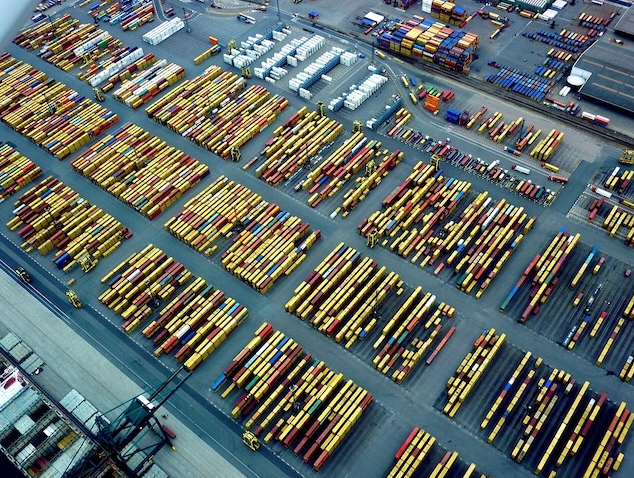 |
Antwerp Port in Belgium, viewed from above. Photo: Jan Paulussen |
Agility Global Chairman Tarek Sultan emphasized that both businesses and policymakers "realize there is no safe zone or time for rest" and are actively seeking sustainable growth paths amid exceptionally high uncertainty. He noted that "AI is both a contributing factor to volatility and a tool for managing it. Businesses face new trade barriers in real-time, drive energy transition, and navigate conflicts among economic partners."
The survey further highlights ongoing shifts in global manufacturing and supply, initially triggered by Covid-19, US - China tensions, and last year's wave of tariff increases. Businesses continue to restructure and refine their supply chains in response to these dynamics.
John Manners-Bell, CEO of Ti Insights, pointed out that "structural uncertainty"—stemming from geopolitical fragmentation, fluctuating trade policies, and uneven economic growth—was a recurring theme in the research. Despite this, the index confirms that supply chain businesses are not retreating but are "designing solutions to operate around uncertainty." However, he cautioned that the deployment of advanced digital tools is uneven across markets, primarily due to limitations in skills, infrastructure, and access to capital.
The 2026 Agility Emerging Markets Index, now in its 17th edition, assesses 50 emerging economies. It ranks them based on domestic and international logistics capabilities, business environment, and digital readiness. The top 10 for 2026 include: China, India, UAE, Saudi Arabia, Malaysia, Indonesia, Qatar, Mexico, Thailand, and Brazil.
Notable climbers in the rankings are Ukraine, which rose 7 places to 31, and Tunisia, up 4 places to 32. Conversely, some countries experienced declines: Cambodia fell 7 places to 37; Pakistan dropped 5 places to 38; and Bolivia saw a 5-place decrease to 49.
In terms of international logistics opportunities, the leading countries are China, India, Mexico, UAE, and Saudi Arabia. For domestic logistics, China, India, Indonesia, Qatar, and Saudi Arabia hold the highest positions.
Hai My (According to PortCalls)