On 27/3, spot gold surged by 116 USD to 4,493 USD per ounce. This rebound was driven by bottom-fishing as investors sought recovery after a sharp previous session decline. Market participants are also closely watching for signs of de-escalation in the Middle East conflict.
"Recent sell-offs present excellent buying opportunities, with prices dipping below the 200-day moving average," stated Daniel Pavilonis, senior market strategist at RJO Futures. "This is a great time to buy gold." He anticipates a gradual increase in gold prices over the next few weeks.
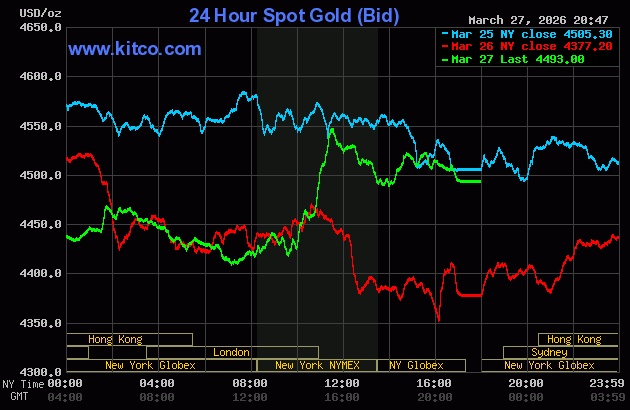 |
Global gold prices rose again during the 27/3 session. Chart: Kitco |
The four-week Middle East conflict has escalated across the region, driving up energy prices and igniting inflation concerns. This situation has dampened investor expectations for a US Federal Reserve (Fed) interest rate cut. Historically, higher interest rates reduce gold's appeal because the precious metal does not offer fixed returns.
Despite this, Commerzbank has raised its year-end gold price forecast from 4,900 USD to 5,000 USD, anticipating that the current downturn will be short-lived.
Crude oil prices continued their ascent amidst investor skepticism regarding a potential Middle East ceasefire agreement. Brent crude concluded the week with a 4,2% gain, reaching 112,5 USD per barrel, while WTI crude advanced by 5,5% to 99,6 USD.
Since the onset of the conflict, Brent prices have climbed by 53%, and WTI by 45%. The hostilities have curtailed global oil supply by 11 million barrels daily, which the International Energy Agency (IEA) has termed the largest supply disruption in history. Consequently, gasoline and oil prices have surged worldwide.
US President Donald Trump extended the deadline for Iran to reopen the Strait of Hormuz. Concurrently, the US deployed thousands of additional troops to the Middle East and is reportedly considering ground forces to secure Kharg Island, Iran's strategic oil export hub.
In the US stock market, all three major indices recorded their second consecutive session of declines, hitting their lowest levels since 8/2025. The Dow Jones Industrial Average (DJIA) and S&P 500 each dropped by 1,7%, while the Nasdaq Composite fell by 2,1%.
Ongoing Middle East instability and escalating energy inflation fears continue to exert pressure on the market. The Nasdaq index, already in a bear market from the prior session, has now declined over 12,5% from its 10/2025 peak. This index comprises technology stocks, which are particularly sensitive to interest rate outlooks and economic growth prospects.
"The stock market remains closely tied to oil prices; higher oil prices will depress stock values," noted Glen Smith, Investment Director at GDS Wealth Management. Both the DJIA and S&P 500 have now experienced five consecutive weeks of losses.
A surge in US government bond yields at week's end also prompted investors to divest from equities. The 10-year yield briefly hit 4,48%, its highest level since 7/2025, while the 30-year bond yield reached the significant 5% threshold.
By Ha Thu (Reuters, CNN)