Mohammed Obaid, a farmer in Basra province, Iraq, considers himself a victim of climate change. In 2019, 250 of his 250 date palms perished due to rising salinity, leaving him with only one surviving tree. This loss amounted to 10 million dinar (6,850 USD).
Date palms were once a cornerstone of Iraqi agriculture. However, their cultivation has been devastated by the construction of dams upstream on the Tigris and Euphrates rivers, coupled with reduced rainfall. These factors have led to increased seawater intrusion, threatening the future of date palm farming. Reuters reported on 30/1 that scientists, in collaboration with public and private sectors, are now employing tissue culture techniques to adapt seedlings to extreme climatic conditions.
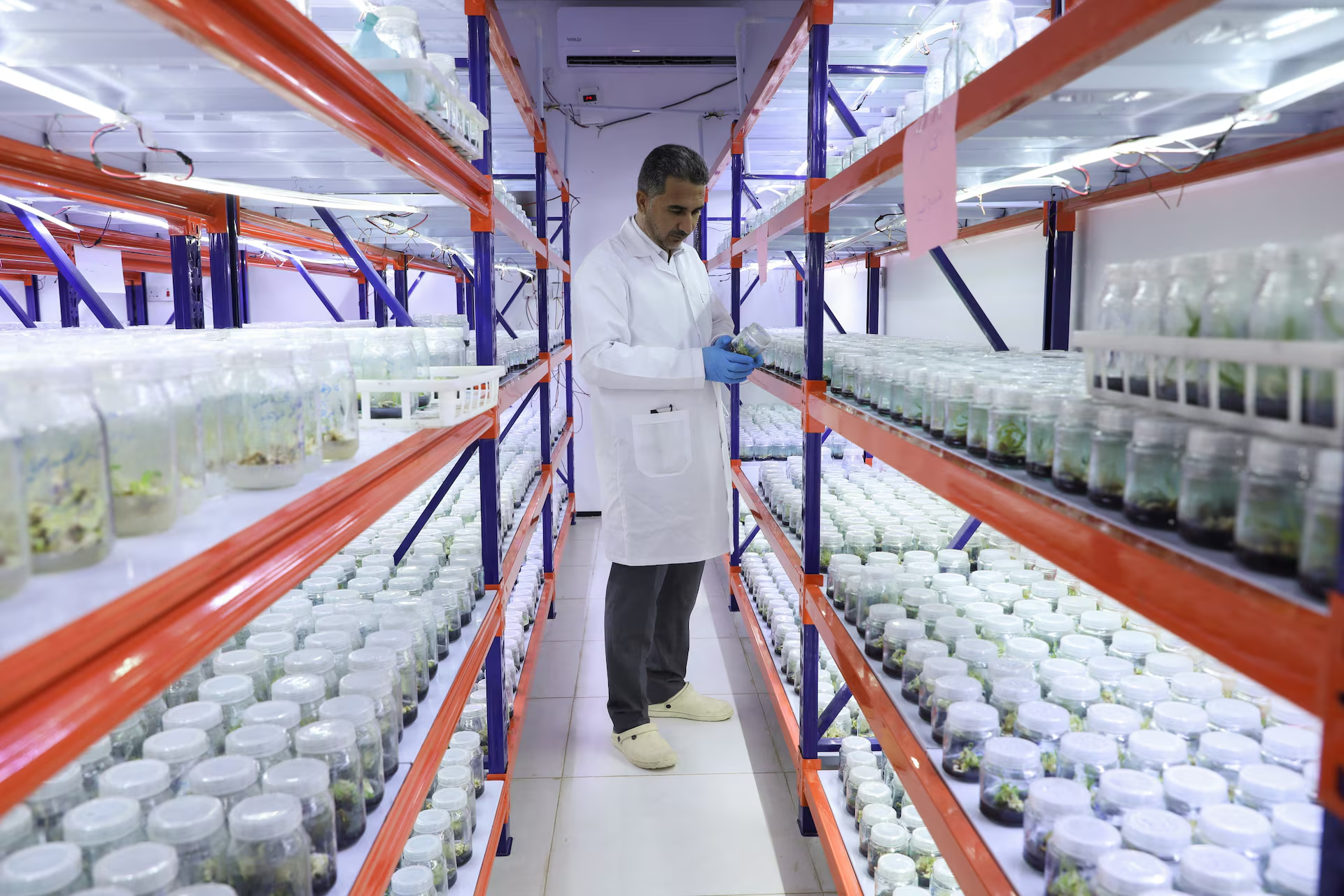 |
A scientist examines a tissue-cultured date palm seedling at a laboratory in Basra, Iraq, 20/1. *Photo: Reuters*
Nakheel Al Basra, one of Basra province's largest tissue culture laboratories, commenced operations in 2023. The facility can produce up to 250,000 date palm seedlings annually. Mohammed Abdulrazzaq, the laboratory director, stated that tissue-cultured date palms boast a success rate of up to 99%. This method allows for the propagation of thousands of shoots from a single date palm, a significant increase compared to the three to four shoots produced by traditional methods.
Following the successful increase in propagation efficiency, scientists addressed the next challenge: enhancing the trees' ability to survive temperatures reaching 52 degrees C and the soaring salt concentrations prevalent in Iraq.
To help the plants adapt to high temperatures, Ismail Sadiq, a researcher at the laboratory, explained that they initiate the process at 25 degrees C, then gradually increase it to more than double that temperature. Sadiq noted, "This process enhances the date palm's adaptability, enabling it to thrive even when transplanted to areas with similar temperatures."
He added that salt concentrations are also slowly raised, first to 6,000 and then to 8,000 ppm (milligrams of salt per liter of water). This gradual increase helps the plants acclimatize to the salinity intrusion encountered in the fields.
This "training" process is currently in its post-experiment phase. The date palms will require an additional six months to adapt to outdoor conditions before being planted directly into the soil.
Some farmers have reported that this technique significantly improves survival rates. Faysal al-Khazraji shared his experience, stating that he planted 100 tissue-cultured seedlings alongside 100 conventionally grown seedlings. All the tissue-cultured plants thrived after their training, whereas the conventional seedlings had a survival rate of only 25%.
Tissue-cultured date palms now account for over 15% of the seedlings in Basra's Al-Zubair and Safwan districts. Doctor Mohammed, from Basra, indicated that approximately 600,000 trees have been planted over the past five years, bringing the total to about 3 million. Among these newly planted trees, over 100,000 are tissue-cultured varieties. At its peak, Basra province boasted 13 million date palms, out of a total of 32 million trees across Iraq.
Bao Bao (Reuters, Al Jazeera)