Earlier this month, cosmetics giant Estee Lauder was fined 750,000 CAD (nearly 14 billion dong) by Canadian authorities for selling eyeliner containing a persistent substance without proper disclosure. The substance used was Perfluorononyl Dimethicone, a compound belonging to the per- and polyfluoroalkyl substances (PFAS) group, often called "forever chemicals" due to their stable nature and potential for long-term risks to humans, animals, and the environment.
PFAS are familiar substances in daily life, present in plastics, burger wrappers, and waterproof jackets. Their use has only been restricted in many developed countries in recent years.
 |
Illustrative image of some products using "forever chemicals". Source: AI |
Origin of PFAS and climate concerns
According to Bloomberg, PFAS compounds were initially discovered by chemists accidentally in laboratories. In 1938, a researcher at DuPont chemical corporation found the group's first compound, Teflon (PTFE), a synthetic fluorocarbon polymer known for its ultra-slippery, non-stick, and high-heat resistance properties. This substance later became widely used as a non-stick coating on pans.
This discovery helped scientists at 3M, a company specializing in cleaning solutions, create Scotchgard in 1952, a line of stain-resistant products for carpets, sofas, and mattresses.
Due to their excellent water resistance, heat resistance, and oil and grease repellency, these compounds deeply penetrated industrial and consumer sectors. According to the OECD, scientists have identified 4,700 PFAS compounds existing in the market and the environment. Some common applications include non-stick pans, food packaging, waterproof clothing, cosmetics, and various types of plastics. They are also prevalent in the electronics, semiconductor, and metal plating industries.
PFAS compounds possess exceptionally stable carbon-fluorine bonds, preventing molecules from biodegrading naturally for thousands of years. The greatest danger lies in their bioaccumulation potential, causing these chemicals to persist and gradually increase in concentration in soil, water, and human blood over time.
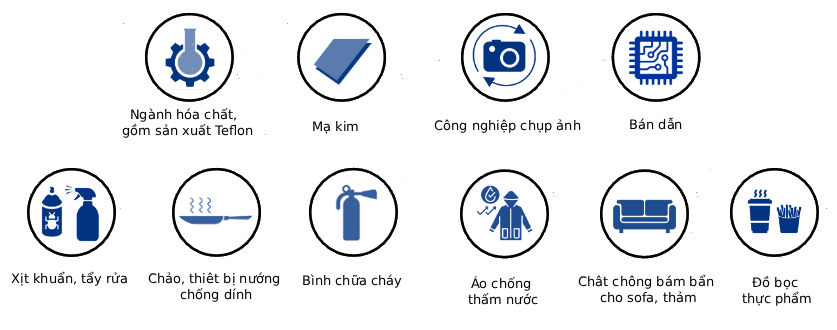 |
Applications of PFAS. Source: UNEP |
Many medical studies link PFAS exposure to serious health risks such as cancer, liver damage, impaired fertility, hormone disruption, and weakened immune systems, particularly concerning three subgroups: PFOS, PFOA, and PFHxS. According to the United Nations Environment Programme (UNEP), they can even be transmitted from mother to fetus via the umbilical cord and to infants through breast milk.
Furthermore, PFAS contribute to the climate crisis because their production processes lead to the emission of potent greenhouse gases, according to data from the US Environmental Protection Agency (EPA). For example, one of the gases emitted during PFAS production is HCFC-22, which has a global warming potential 5,000 times greater than CO2.
Following these studies, the three subgroups PFOS, PFOA, and PFHxS were successively added to the Stockholm Convention in 2009, 2019, and 2022. This convention, signed in 2001 and involving 186 countries including Vietnam, aims to shift production, management, and disposal of persistent organic pollutants (POPs).
Countries' responses to PFAS
Since 1999, blood tests collected from thousands of US residents showed four types of PFAS, including PFOA and PFOS, present in most samples. The Environmental Working Group, a public health advocacy organization, has mapped over 3,000 PFAS-contaminated sites across the United States. In Europe, an investigation by multiple media organizations identified 2,100 such contaminated locations.
Many European and North American countries have gradually brought PFAS compounds under regulation. The US Environmental Protection Agency outlined a strategic roadmap to address "forever chemicals" in 2021. The measures implemented are robust, classifying PFOA and PFOS as hazardous substances and requiring emission reporting. Additionally, public authorities compel polluting entities to bear responsibility for PFAS contamination remediation.
Europe has banned more "forever chemicals", including PFOS, PFOA, PFNA, and PFHxS, as well as the total sum of PFOS, PFOA, PFNA, and PFHxS in foods like eggs, meat, fish, animals, and offal, starting from 2022. Late last year, they approved regulations to completely ban the sale of toys containing "forever chemicals" and endocrine-disrupting chemicals by 2030, aiming to enhance children's health protection. Some countries have banned the production of cosmetics and textiles containing PFAS starting this year.
Canada has not yet banned this group of substances. Its government requires businesses to disclose information if they import more than 10 g or produce more than 1 kg of a substance from a list of over 300 identified PFAS, with quantities exceeding 10 g. Ottawa is currently consulting on risk management steps for PFAS production and consumption, with three phases for: fire-fighting foam, consumer goods with available alternatives, and other remaining groups.
Globally, some lawsuits related to "forever chemicals" have cost companies tens of billions of USD. One of the most expensive settlements involved 3M, related to public drinking water contamination from PFAS production, which required the company to pay 12,5 billion USD to settle in 2023. Previously, DuPont and two of its subsidiaries agreed to pay 1,2 billion USD to resolve similar claims.
In Vietnam, a 33 million USD project was launched mid-last year to mitigate emissions and impacts of persistent organic pollutants (POPs), including some PFAS compounds.
Bao Bao (according to EPA, UNEP, Bloomberg)