Following years of investment, Masan High-Tech Materials (MSR) continues to expand its strategic materials platform. This expansion includes adding approximately 115 million tons of potential resources and collaborating with GB Innovation to increase tungsten oxide capacity to 8,000 tons per year starting from 2027. The company is also accelerating its financial deleveraging process.
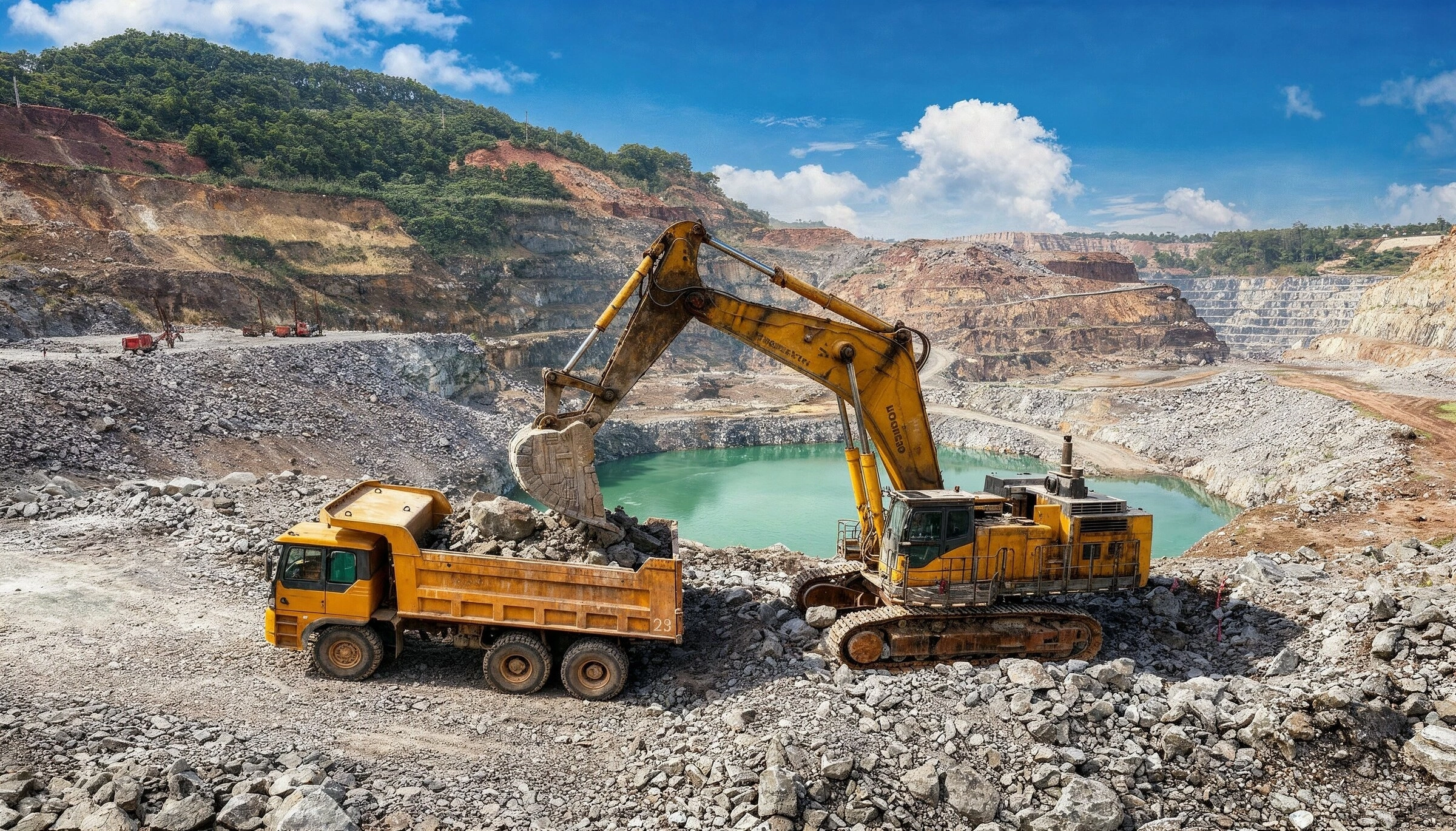 |
Mining operations at Nui Phao mine. Photo: Masan |
Thanks to this expansion, MSR's business results have improved significantly. In QII/2026, the company achieved record revenue of 8,138 billion VND and a profit after tax before minority interest of 1,666 billion VND. For the first six months of the year, MSR recorded 2,202 billion VND in profit, approaching its highest full-year target.
These strategic moves come as demand for high-tech materials is surging, fueled by advancements in artificial intelligence (AI), the semiconductor industry, and digital infrastructure.
According to a Goldman Sachs report, while much attention on AI often focuses on Nvidia, GPUs, or data centers, a less-discussed but indispensable material supply chain underpins the massive global investment wave in AI infrastructure.
The U.S. Geological Survey (USGS) highlights that producing AI chips, operating data centers, or developing high-speed connectivity infrastructure requires more than just silicon. Tungsten is utilized in numerous electronic applications, electrical contacts, and thermal management. Germanium, indium, and neodymium play crucial roles in semiconductors, fiber optics, optoelectronic components, and high-performance magnets. This implies that as AI advances, demand extends beyond computational power to the entire underlying material supply chain.
Market developments confirm this trend. Fastmarkets data from the past 12 months shows that the price of APT tungsten has risen by approximately 576%, indium by 105%, germanium by 61%, and neodymium by 68%. During the same period, many traditional metals like copper, gold, and platinum saw significantly lower increases. This indicates that AI investment capital is not driving a uniform price surge across the entire mining sector but is rather concentrating on materials critical to the technology value chain.
According to MSR leadership, AI is a significant driver, but not the only one. The tungsten market is currently supported by increasing demand from AI infrastructure, semiconductors, and high-tech manufacturing, while global supply remains limited. Notably, new supply is unlikely to increase rapidly in the short term. Developing new mining and processing projects typically takes many years to complete permitting, construction, operation, and customer approval. This makes it difficult to quickly narrow the gap between demand and supply, providing a foundation for strategic material prices in the medium and long term.
The company also notes that the market's focus has shifted beyond today's tungsten prices to which companies can ensure stable supply for years to come. More importantly, AI is transforming how the market views strategic materials. While mining companies were historically evaluated primarily by commodity price cycles, going forward, their position in the supply chain, processing capabilities, and ability to provide stable supply could become long-term competitive advantages. In this context, MSR's narrative extends beyond tungsten prices to its increasingly prominent role in the material supply chain serving the digital economy.
Hoang Dan