The National Assembly convened on the afternoon of 5/8 to discuss reducing business licenses and conditions during the amendment of the Law on Investment. Most opinions supported cutting business conditions, emphasizing that these reductions must be substantive rather than merely focusing on targets or quantity. According to the National Assembly report, the Government proposes reducing 58 conditional investment and business sectors, effective from 1/3/2027. This number adds two more areas compared to Resolution No. 66.17/2026, which remains valid until the end of 2/2027.
Alongside support for these reductions, many delegates also suggested stricter management for certain sectors, including diamonds.
Mr. Trinh Xuan An, a full-time delegate on the National Assembly Committee for Defense and Security, and Foreign Affairs, highlighted recent instabilities in the diamond market. He proposed classifying this sector as a "conditional investment and business line", similar to gold. "This matter requires further discussion, but I see it as a significant issue based on recent incidents involving PNJ and the broader diamond market. Diamonds should be designated a conditional business sector, with strict regulations applied to this field", the delegate stated.
Under the current Law on Investment, gold trading (excluding jewelry and fine art gold) is listed as a conditional investment and business sector. This regulation will continue to be maintained in the amended list.
In recent times, the diamond market has faced continuous difficulties. This follows rumors circulating on social media regarding diamond quality and the investigation of PNJ Lab leadership in a smuggling case involving nearly 30,000 diamonds. Many diamond brands in TP HCM have also temporarily suspended operations due to pressure from a surge of customers seeking to resell items.
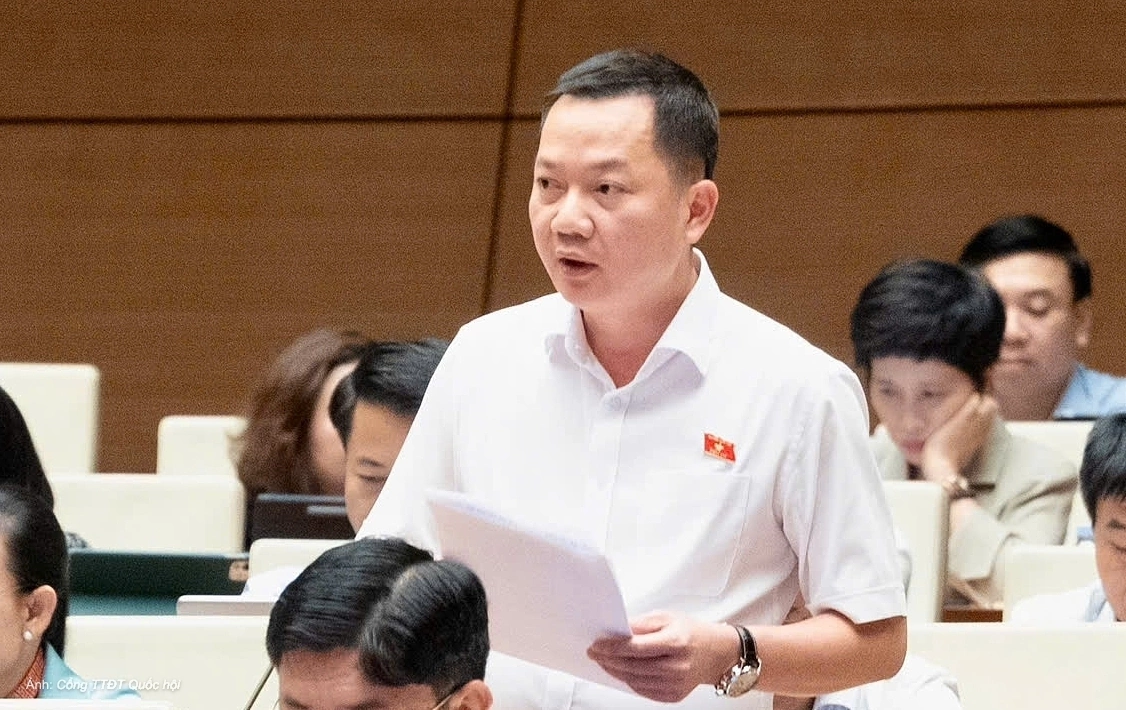 |
Delegate Trinh Xuan An speaking at the National Assembly hall on the afternoon of 5/8. *Photo: National Assembly E-portal* |
Additionally, Mr. Nguyen Van Huy, Deputy Head of the Hung Yen National Assembly Delegation, suggested the need to add investment and business conditions for certain new models that pose numerous risks but are not yet fully regulated.
According to Mr. Huy, the resort real estate market has recently seen many prolonged complaints and lawsuits related to the timeshare model. Several cases showing signs of fraud, disguised as selling resort packages, have been investigated and prosecuted. "These are no longer isolated civil disputes but have become issues affecting social order, safety, and the legitimate rights of consumers", the Hung Yen delegate stated. He assessed that a concerning aspect of this model is its mechanism for mobilizing significant amounts of money from people through the advance sale of service usage rights.
Mr. Huy explained that over 10 to 30 years, businesses "can collect hundreds of millions to billions for each timeshare contract". Meanwhile, the management and use of this cash flow are currently not subject to any specific control mechanisms. When businesses become unable to fulfill commitments or terminate contracts, the risk is almost entirely transferred to consumers.
He also proposed that the sector name should be determined by the nature of the activity—providing long-term accommodation rights based on advance payment—rather than solely on the product's commercial name. He explained that this approach would ensure legality and limit situations where businesses change names or transaction forms to evade legal regulation.
This bill will be considered and voted on by the National Assembly at the session on 24/8.
Anh Tu