Military Bank (MB) has emerged as the leader in asset growth among Vietnam's Big 5 banks. This significant achievement is attributed to stable credit expansion, a high current account savings account (CASA) ratio, and a competitive low cost of capital.
From 2020 to 2025, a period marked by the dual impact of the pandemic and macroeconomic volatility, many large banks experienced slower growth. In this challenging environment, MB distinguished itself with consistent growth across three key metrics: asset size, credit, and market capitalization.
According to financial reports, MB's total assets saw a compound annual growth rate of 19.6% from 2015 to 2025, significantly outpacing the 13-14% average of other banks in the Big 5 group. Specifically, between 2020 and 2025, the average annual increase was nearly 22%, notably higher than VietinBank (15.5%), BIDV (15%), and Vietcombank (12.4%).
Even during the two years most severely affected by the pandemic, MB's total assets consistently grew by 20-23% annually. By the end of QIII/2025, this figure reached over 1.32 trillion VND, an 18% increase from the beginning of the year. This is a remarkable outcome given the pressures faced by the financial market. At the 2025 Military-Political Conference, Luu Trung Thai, Chairman of MB's Board of Directors, announced that MB's total assets reached 1.6 trillion VND, a 35% increase from 2024. The group's pre-tax profit exceeded 34.2 trillion VND, up 18.7% from the previous year.
 |
Luu Trung Thai, Chairman of MB's Board of Directors, speaks at the 2025 Military-Political Conference, held on 16/1. |
Credit expansion has been a primary driver of MB's asset growth. This success stems from a credit strategy that balances caution with flexibility. While many banks faced pressure from real estate or corporate bond portfolios, MB prioritized capital flows into manufacturing, trade, small and medium-sized enterprises (SMEs), and retail sectors.
According to the QIII/2025 financial report, MB's outstanding customer loans surpassed 931.498 billion VND, a substantial increase from late 2024. Wholesale and retail lending accounted for the largest share at 27.82% (259.103 billion VND), followed by household loans at 22.14% (206.240 billion VND), and manufacturing at 17.47% (162.743 billion VND). In contrast, the real estate sector represented only 10.42% of total outstanding loans, with construction at 4.13%. This diversified credit structure has allowed MB to maintain growth while mitigating risks amid a cautious monetary policy environment.
 |
MB Military Bank staff. |
By the end of 2025, the bank's outstanding credit reached over 1 trillion VND, marking a 35% increase. An average credit growth rate of 23% per year from 2020 to 2025 demonstrates the bank's effective utilization of its allocated lending capacity. Furthermore, the integration of artificial intelligence (AI) into its appraisal and disbursement processes has shortened processing times and enhanced efficiency, particularly for SMEs and individual customers.
"Digital transformation and security are inseparable. We are not just digitizing services, but also digitizing our defense systems. In the digital world, protecting customers must begin before risks emerge", an MB representative stated.
 |
The bank applies technology and digital transformation to support customers. |
Beyond technological advantages, MB proactively implemented Basel II and Basel III capital adequacy standards, maintaining non-performing loans below 1.5% and a loan loss coverage ratio exceeding 200%. As a result, the institution consistently receives higher credit growth limits than the industry average.
MB has not only expanded its scale but also enhanced capital efficiency. Its return on equity (ROE) consistently remained above 20% throughout 2019-2025, nearly doubling its 2015 level. The current account savings account (CASA) ratio consistently hovers around 36%, one of the highest in the system, which significantly reduces the bank's cost of capital. With over 33 million customers, many from payroll and large corporate segments, MB has established a stable source of low-cost funds. Concurrently, the cost-to-income ratio (CIR) is maintained at 32%, below the industry average. These efficiency and safety indicators remain stable. The non-performing loan ratio in 2025 was controlled to below 1.3%, successfully meeting the set target. This outcome reflects the bank's focus on digital transformation, operational streamlining, and internal process optimization.
 |
MB is one of the leading banks in CASA ratio. |
Another factor contributing to MB's success is its comprehensive financial ecosystem, which includes banking, securities, insurance, and consumer finance. The strong interlinkage between its member units facilitates cross-selling and increases non-interest income.
Notably, Mcredit, the consumer finance company, is a key profit driver, benefiting from its expanding scale and the strong recovery of domestic consumer demand. Mcredit is currently among the top 3 consumer finance companies in Vietnam by lending market share.
In 2025, the profits of MB's member companies grew by 61%. Specifically: MBCapital increased its assets under management by 67%; Mcredit achieved a top 3 position in credit market share; MB's Bancas and MB Life ranked first and second, respectively; MBS reached top 7 in brokerage market share; and MIC was among the top 4 in non-life insurance market share.
MB's growth trajectory is also reflected in the stock market. From 2020 to 2025, the bank's market capitalization grew by an average of 19.5% annually, double the growth rate of Vietcombank and BIDV. Furthermore, in brand valuation measurements released by Brand Finance on 15/1/2026, MB's brand value exceeded 2 billion USD, placing it among the top 3 banks and top 10 most valuable brands nationwide.
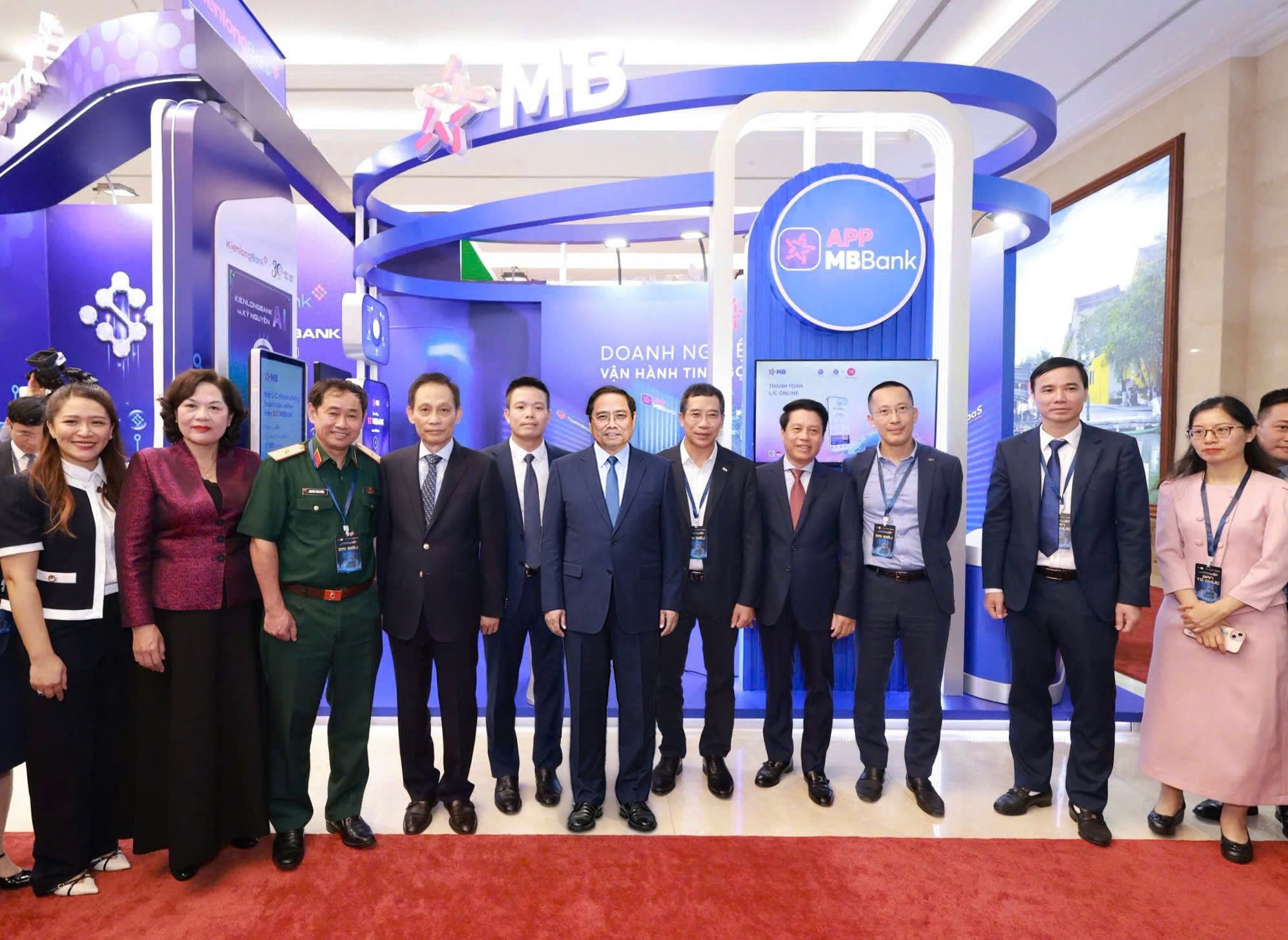 |
Bank leaders photograph with Prime Minister Pham Minh Chinh at the Government headquarters - "Digital Transformation Day for the Banking Sector 2025". |
Despite its strong growth, MB faces challenges in maintaining asset quality and profit margins as its scale continues to expand, according to a report by Guotai Junan Securities Vietnam. The bank's leadership states that MB's strategy is rapid yet sustainable growth: expanding its scale based on stringent risk management and real-time data. The focus for the upcoming period is to enhance capital efficiency, increase customer lifetime value, and maintain its leading position in digital transformation, aiming to become a digital enterprise and a leading financial group.
From a mid-capitalization bank one decade ago, MB has now risen to lead the Big 5 group in asset growth, with many outstanding indicators. This rapid yet steady growth opens significant opportunities for the bank to further consolidate its position in Vietnam's financial landscape.
 |
MB receives the Third-Class Labor Order. |
Content: Minh Ngoc
Photos: MB