The State Bank of Vietnam, through Official Letter 6190, has mandated that banks implement a service enabling individual customers to register transaction limits and a waiting period before funds are transferred to a recipient. Banks are required to develop a plan and complete this implementation by 1/3/2027.
This regulation applies exclusively to online money transfers made to new beneficiary accounts, meaning accounts not previously recorded in the customer's transaction history. It also covers transactions that exceed the limits a customer has registered within the preceding one year.
Should a customer not register for this service, the State Bank of Vietnam stipulates a default limit of 400 million Vietnamese dong, coupled with a minimum waiting period of 24 hours.
This service is entirely optional. Customers retain full autonomy to register for it, modify their chosen limits and waiting periods, or cancel the service if they no longer wish to use it.
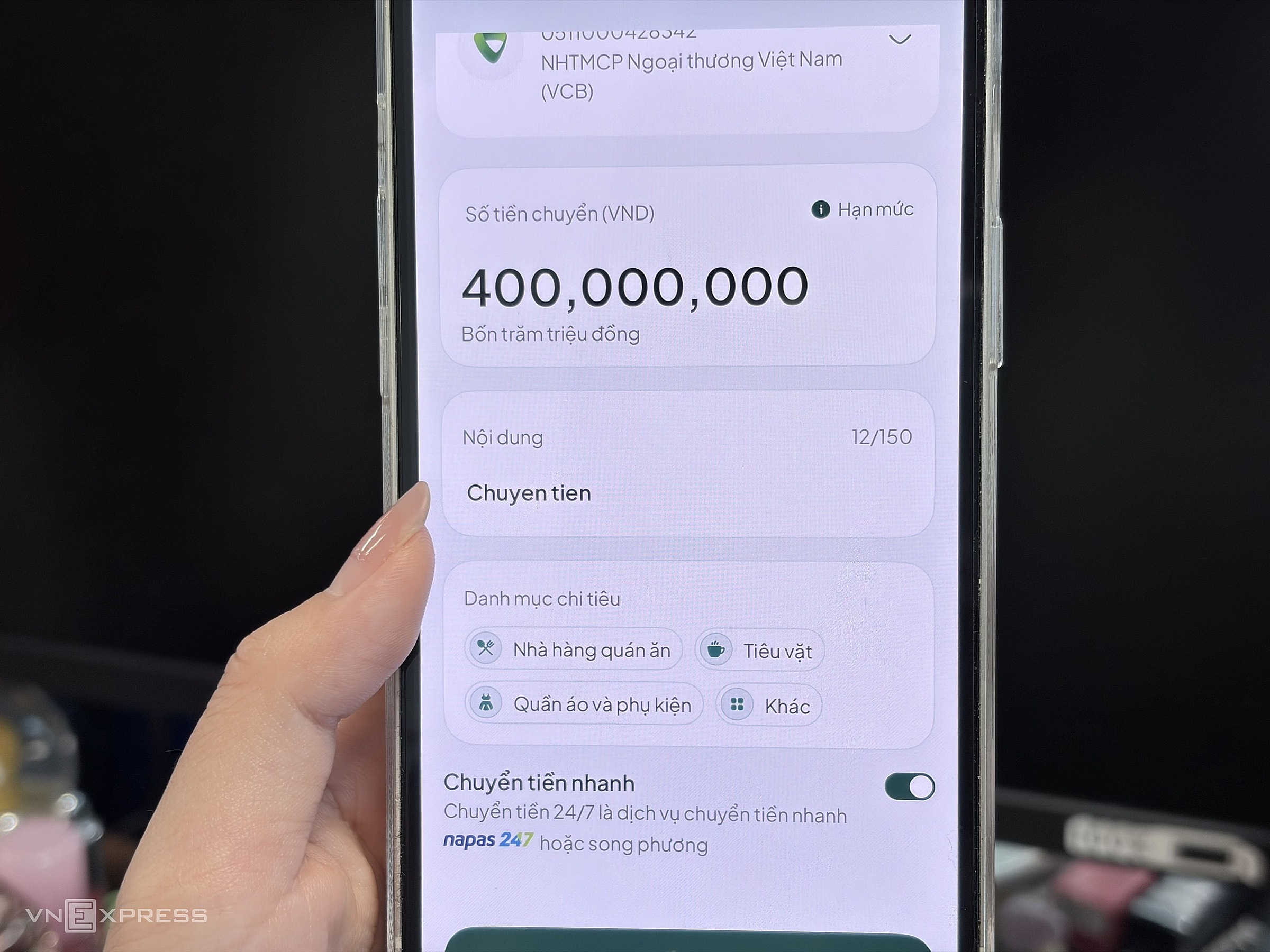 |
Fast money transfer transaction on a banking app. Photo: Quynh Trang
Pham Anh Tuan, Director of the Payment Department at the State Bank of Vietnam, emphasized that this new regulation empowers customers to select transaction limits and waiting times that align with their specific usage needs and risk tolerance. This approach replaces a single, universal mechanism for all users.
According to Tuan, many online transfer scams occur when victims are psychologically manipulated and coerced into making immediate transfers. The introduction of a waiting period provides customers with crucial time to calmly review the transaction, verify information, consult with family members, or contact their bank if they detect any suspicious activity.
This preventative measure has been successfully adopted by several countries and regions, including the United Kingdom, Australia, Singapore, India, and Taiwan, as a means to reduce fraud in electronic payments.
The Director of the Payment Department clarified that this new mechanism does not replace existing security protocols, such as biometric authentication, one-time passwords (OTP), multi-factor authentication, or unusual transaction monitoring. Instead, it serves as an additional layer of protection that customers can actively establish themselves.
The State Bank of Vietnam reiterates that it will not impose a universal transaction limit for all users. Customers are advised to determine their limits based on their individual needs and the frequency of their transactions.
For individuals who infrequently transfer large sums to new accounts, setting a lower limit can extend their scope of protection. Conversely, those who regularly conduct transactions for production or business purposes might opt for a higher limit to prevent disruptions to their payment flows.
The State Bank of Vietnam recommends that elderly individuals, those less familiar with digital banking, or anyone at a higher risk of becoming a target for scammers, consider establishing more cautious transaction limits.
Tuan also suggested that users managing multiple bank accounts consider setting different limits for each account, tailored to its specific purpose.
For example, an account used for routine daily expenses could have a limit appropriate for everyday payments. In contrast, an account primarily utilized for savings or managing substantial funds might benefit from a more cautious limit to enhance risk control capabilities.