PNJ stock plunged to its lowest price in nearly six years, closing at its floor price of 30,750 dong. This marks the lowest value for the Phu Nhuan Jewelry Joint Stock Company (PNJ) stock since the end of 10/2020.
The morning trading session for PNJ was subdued, but activity intensified significantly after 2 pm, with continuous order matching on the board. The total transaction value for PNJ reached nearly 1,272 billion dong, equivalent to over 41.3 million shares. This represents a record high for the stock's liquidity since its listing on HoSE at the end of 3/2009.
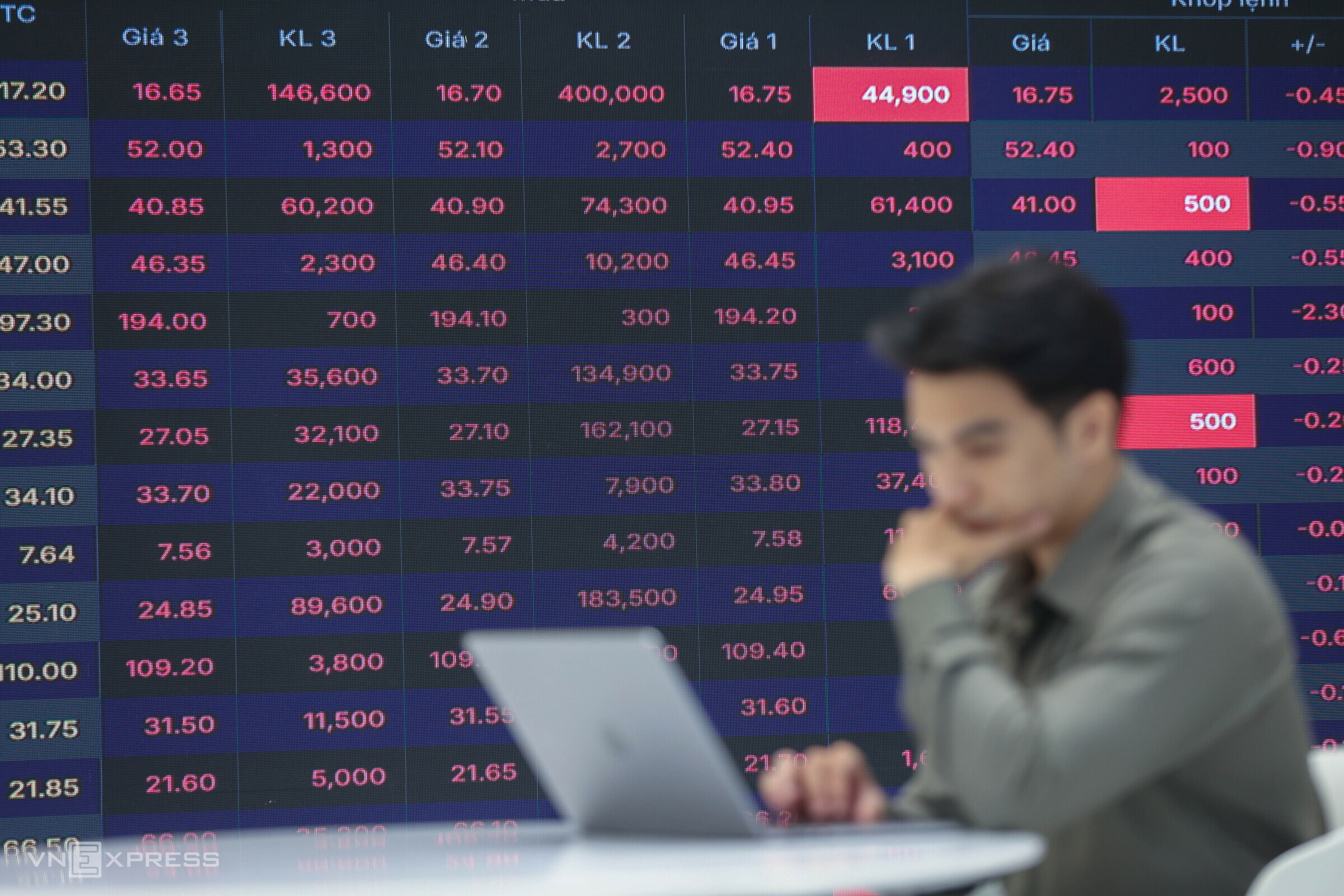 |
An investor watches the price board at a securities company in TP HCM. *Quynh Tran*
According to VnDirect's analysis of the transaction structure, active buy orders held a dominant position, accounting for 80% of the matched volume. Active buy orders (buy up) are initiated by investors who actively execute trades, matching immediately with the highest available sell price or the highest bid price on the market. Typically, a predominance of active buy orders indicates that there is a determined effort by buyers to accumulate shares.
The surge of active buy orders after 2 pm temporarily helped PNJ's market price rise above the floor. However, due to the substantial volume of outstanding sell orders at 30,750 dong, the stock quickly reverted to its floor limit within minutes. PNJ ended the session with 427,000 units remaining for sale, a relatively low figure compared to many previous sessions.
PNJ's stock is undergoing a sharp correction following the scandal involving the former director of P-Lab, a company specializing in gem appraisal, who was linked to a diamond smuggling ring. Since that time, the stock's market price has more than halved. The market capitalization of the leading jewelry enterprise has plummeted by over 16,500 billion dong, causing it to lose its status as a "billion-dollar company."
PNJ was one of 218 stocks that experienced a decline today. With 61% of stocks on HoSE adjusting downwards, the stock market was predominantly in the red throughout the day. The VN-Index closed at over 1,686 points, dropping over 13 points from yesterday.
All industry sectors, with the exception of oil and gas, recorded declines. The most significant negative movements occurred in the retail, securities, and technology sectors.
Market volatility led to increased caution among investors, who largely adopted a "holding" strategy. Consequently, the total transaction value on HoSE fell by over 30% compared to yesterday, settling at approximately 13,900 billion dong.
Foreign investors intensified their selling trend today, recording net sales of 1,338 billion dong, 2.7 times higher than the previous session. PNJ bore the brunt of this pressure, experiencing net sales of over 533 billion dong.
Overall, the VN-Index adjusted by over 101 points, or nearly 5.7%, this week. Intense selling pressure was observed almost continuously, characterized by rotational short-term margin calls across various stock groups that had seen significant gains previously.
From the previous session, Sai Gon - Ha Noi Securities (SHS) noted that despite an improvement in the overall index, market liquidity had decreased, indicating an uneven recovery after a period of heavy selling. Therefore, SHS analysts predict that the short-term trend for the VN-Index remains downward, and the market has not yet established a new growth trend. They anticipate a rotational recovery across various stocks in the upcoming sessions, following the intense selling pressure.
SHS advises investors to maintain a reasonable portfolio weight and focus on fundamentally strong, industry-leading stocks within strategic, high-growth sectors of the economy.
Tat Dat