At a Standing Government meeting on 16/3, Prime Minister Pham Minh Chinh declared Vietnam is determined to prevent fuel shortages under any circumstances. He called for price management to follow a market mechanism with state oversight, alongside implementing flexible and effective stabilization measures.
If the conflict in the Middle East persists, the prime minister noted that management agencies need to review and report to competent authorities to consider allocating a budget to support fuel price stabilization.
"The spirit is to make production, business, and people's lives the main pillar for policy formulation, ensuring stable production, business, and people's lives, minimizing impacts", the prime minister said.
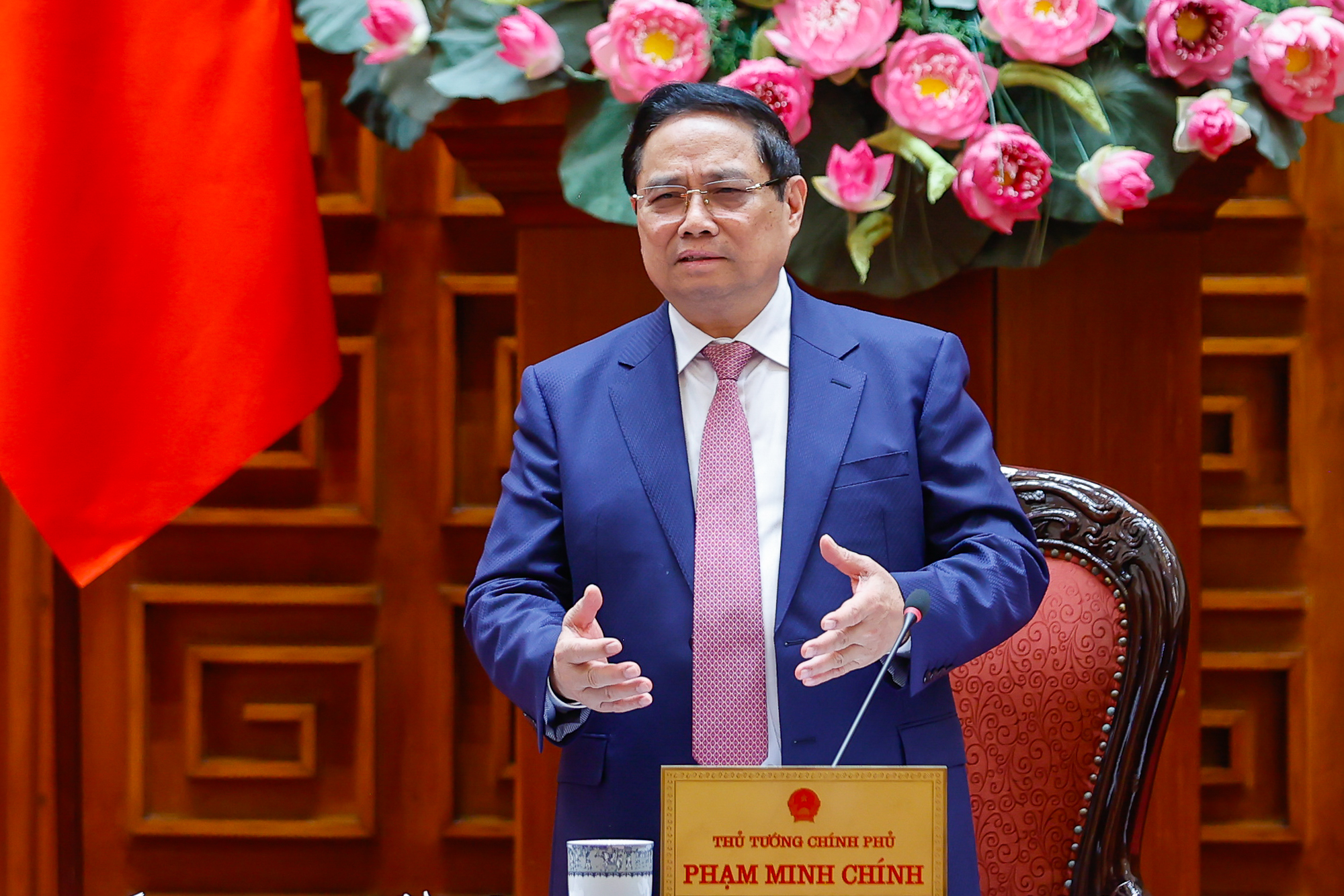 |
Prime Minister Pham Minh Chinh speaking at the meeting on 16/3. *Photo: VGP*
The government leader also strictly prohibited hoarding, price gouging, or exploiting policies for profit, disrupting the market. Ministries, including the Ministry of Public Security, are tasked with inspecting, auditing, and severely punishing violations. These ministries are also responsible for reviewing and proposing reductions in taxes, fees, and charges related to fuel to support businesses and people, with reports due by 20/3.
The prime minister instructed ministries to clearly assign responsibilities and coordinate efforts to implement fuel price management and stabilization measures. Government members are expected to provide feedback soon on the draft amendment to Resolution 36 concerning fuel management, enabling its prompt promulgation.
Tensions in the Middle East are causing the global energy market to react more strongly than several escalations between Israel and Iran last year. In this context, fuel prices in Vietnam, a nation partially dependent on imported sources, are being managed differently. Price adjustment frequency is higher, the stabilization fund is actively used again, and various policy tools are combined to respond to global energy fluctuations.
With world prices fluctuating constantly, the government's promulgation of Resolution 36 allows management agencies to operate fuel prices more flexibly, without necessarily waiting for a full 7-day cycle. This means that as soon as the base price increases by 7% or more compared to the immediately preceding announcement period, the inter-ministries of Industry and Trade can adjust prices the very next day.
The stabilization fund, which had been frozen since 2023, has also been reactivated. In just half a month since the Middle East fluctuations began, the inter-ministries of Finance and Industry and Trade allowed five withdrawals from the fund. VnExpress estimates that after these five withdrawals, the fund disbursed approximately 1,500 billion VND. According to announcements from two major players, Petrolimex and PVOIL, they had disbursed nearly 631.2 billion VND from the fund by 12/3.
Previously, regulators also considered options for allocating reserve funds and proposed reducing the environmental protection tax to add fiscal tools for market stabilization. Reducing the environmental protection tax to zero VND would correspondingly decrease gasoline prices by 1,000-2,000 VND per liter.
By Phuong Dung