Ho Chi Minh City, which frequently experiences flooding due to heavy rain and high tides, could benefit from innovative solutions like "sponge city" infrastructure. At a seminar on "Solutions to increase green spaces - support drainage and wastewater treatment in Ho Chi Minh City" on 18/12, Professor Doctor Dang Mau Chien, Chairman of the Interdisciplinary Council for Material Science and Technology, Vietnam National University Ho Chi Minh City, proposed using foam glass aggregate (FGA) for this purpose.
The "sponge city" concept, as defined by the World Economic Forum (WEF), describes urban areas with a high capacity to retain water, much like a sponge. This is achieved through solutions such as green spaces, lakes, parks, or specialized structures designed to absorb rainwater and prevent flooding. Professor Chien emphasized that this model integrates green infrastructure techniques to manage stormwater runoff at its source, following principles of infiltration, retention, storage, purification, utilization, and discharge.
FGA is manufactured from 99% glass waste, including bottles, construction glass, vehicle glass, solar panel glass, and glass dust. The material undergoes a sintering process, where a mixture of fine glass powder and a foaming agent is heated in a furnace. This results in foam glass with a closed-cell or mixed open-closed cell structure, and a porosity ranging from 60% to 90%, depending on the formulation and firing conditions.
Due to its unique properties, foam glass possesses high water storage and drainage capabilities. It is also remarkably light, with a density of 0,10 to 0,60 g/cm3, and is resistant to rot and fire. Globally, foam glass serves as a light-fill material for roads, green roofs, and other urban structures, combining load-bearing, drainage, and insulation functions.
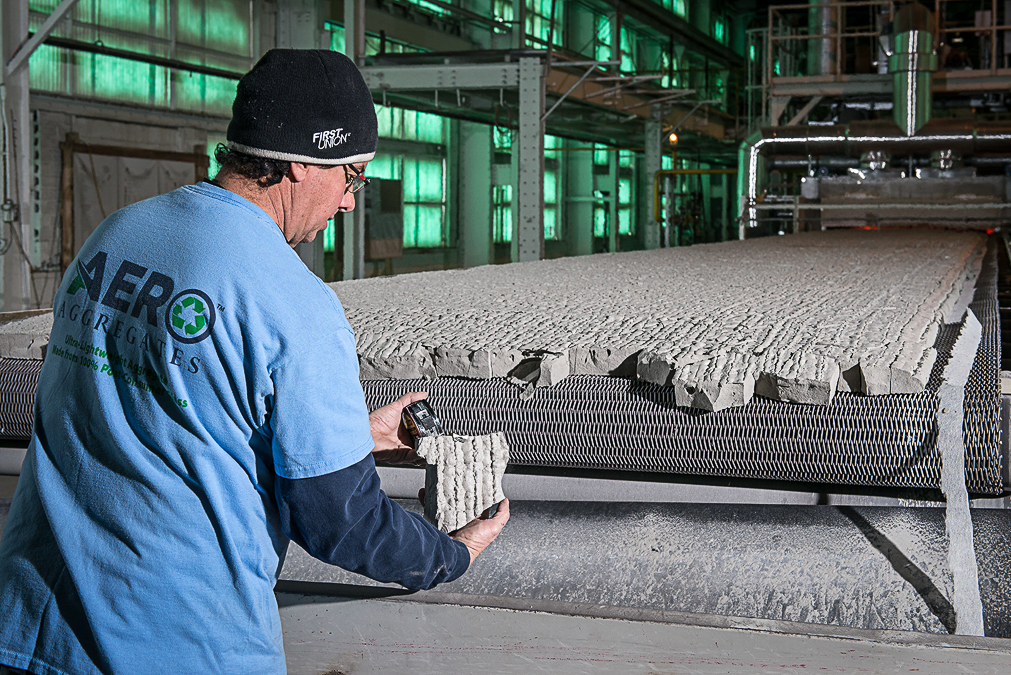 |
A FGA production line in the US. Photo: AeroAggregates |
Within the "sponge city" framework, foam glass can transform sidewalks and streets into "sponge units" that temporarily store water and release it slowly. This material also acts as a filter, ensuring that the slowly discharged water is cleaner as it infiltrates the ground or flows into rivers. Professor Chien noted that foam glass material, particularly in two sizes, effectively filters a large proportion of pollutants found in road runoff, including suspended solids, phosphorus, organic carbon, and heavy metals.
Similarly, Doctor Tran Quoc Cong from the Institute of Hydro-Engineering - Vietnam Institute of Water Resources Science - highlighted another form of recycled glass material: glass pumice. This material boasts a porosity of up to 90% and pore diameters ranging from 0,1 to 5 mm, allowing for rapid absorption (achieving 35% of its mass in water absorption after 12 minutes) and slow water release. Doctor Cong stated that these characteristics make glass pumice an ideal solution for "sponge city" applications, providing an urban model that adapts to climate change through decentralized stormwater management.
Glass pumice can be applied in various urban components: permeable grass swales, green roofs, ecological parking lots (using a glass pumice base with a grass surface), water treatment systems, and underground water storage modules. During heavy rainfall, this material functions as an underground reservoir. Experiments demonstrate its fast absorption capability and its ability to maintain long-term water storage, with water volume only decreasing to 80% after 24 hours, thus ensuring gradual drainage and preventing infrastructure overload. Doctor Cong also pointed out that glass pumice helps absorb and reduce the load on Ho Chi Minh City's sewer system during intense rains. For green roof applications, its lighter weight compared to traditional materials also reduces structural load.
Other experts at the seminar concurred on the promising potential of recycled glass materials. Beyond absorbing and filtering water for "sponge city" infrastructure, these materials offer additional indirect benefits. For instance, glass recycling contributes to solving the issue of glass waste, which is not biodegradable in landfills, and addresses the disposal of end-of-life solar panels. Additionally, "water reservoirs" constructed from foam glass or glass pumice can help replenish groundwater, mitigating subsidence caused by groundwater depletion.
Associate Professor Doctor Tong Xuan Tam, Ho Chi Minh City University of Education, suggested the need for more specific application models to thoroughly evaluate the effectiveness of these materials. Doctor Tran Quoc Cong recommended implementing pilot projects, alongside developing technical standards and preferential policies for green materials in sustainable urban projects. Professor Doctor Dang Mau Chien emphasized the importance of continued research to perfect the technology and establish foam glass production in Vietnam, aiming for effective waste treatment and affordable material costs for widespread application.
By Vien Thong