On 1/10, the Swiss Glacier Monitoring Network (Glamos) and the Cryosphere Observation Commission (under the Swiss Academy of Sciences) published a report on the severe glacier melting in the country.
According to the report, scientists estimate that glaciers melted about 2.2 trillion liters of water between July and September alone, following extended extreme heatwaves. Matthias Huss, Director of Glamos, described the melt volume as "massive," attributing it to the combined effect of a preceding winter with little snow and a record-hot summer.
"We are living in a new world where glaciers could gradually disappear in the future," Huss stated.
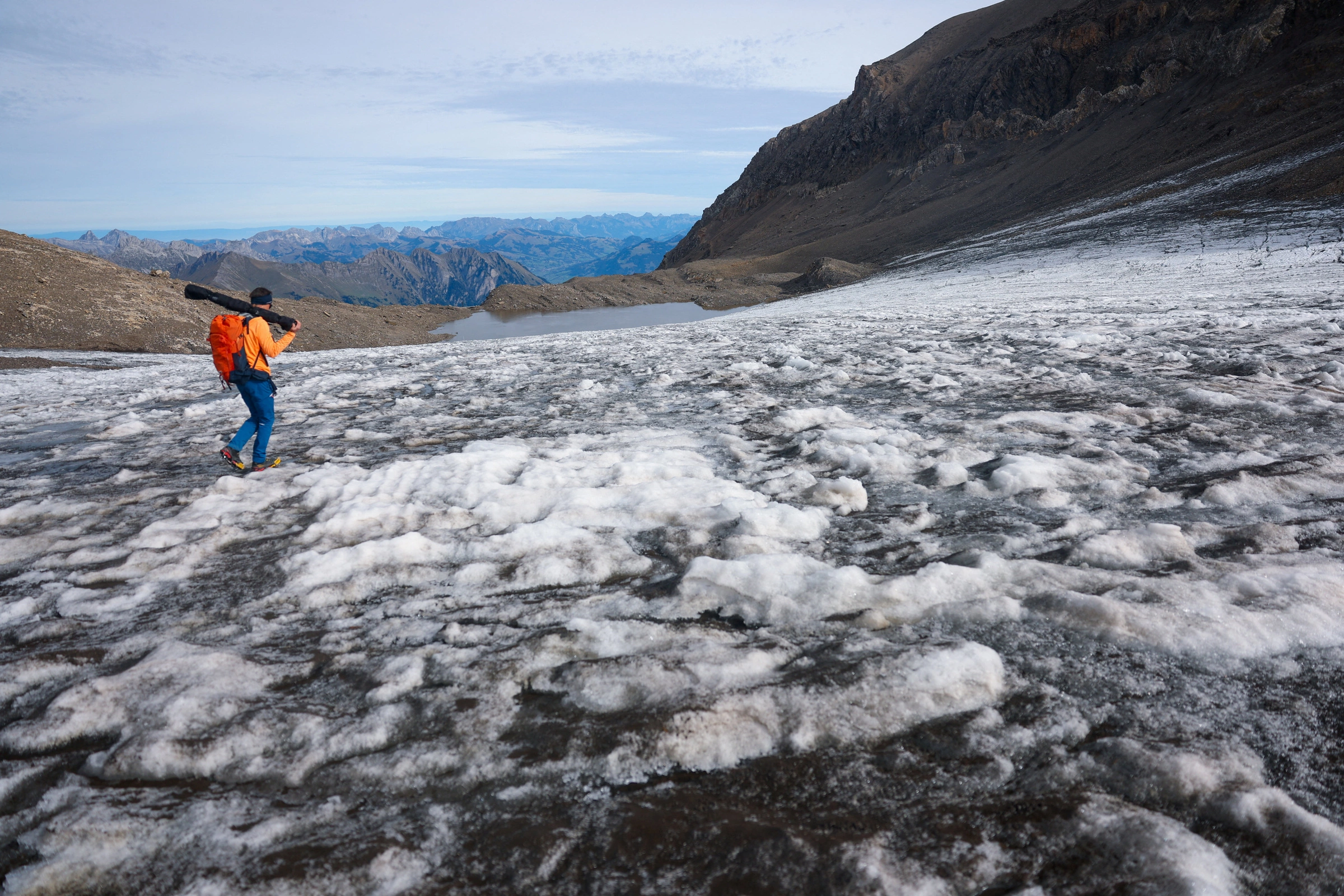 |
Matthias Huss walks on the Scex Rouge glacier to measure the reduction in ice mass due to climate change, in the Glacier 3000 area in Les Diablerets, Switzerland, on 24/9. Photo: Reuters. |
Over the past five years, Switzerland's glacier network has lost nearly one-fifth of its volume, threatening the future water supply. This also impacts the risk to permafrost regions across Europe.
Aletsch, Switzerland's largest glacier, experienced the most significant melting this year, while the Tsanfleuron glacier thinned by 4 meters. Huss noted that he had not imagined such a situation just a few years ago.
Increased melting can lead to glacier collapses. In May, a glacier collapse near the village of Blatten caused landslides, burying an entire village near the Alps. Local authorities had issued an early warning and evacuated approximately 300 people and all livestock, limiting human casualties.
Even if global temperatures remain stable at current levels, 40% of the world's glaciers will still disappear, according to a study published in the journal Science. This volume could be preserved if the global average temperature increase is kept at 1,5 degrees Celsius above pre-industrial levels, as committed by nations in the 2015 Paris Climate Agreement.
Bao Bao (according to Reuters)