This move comes as the Ministry of Finance is developing a draft to cut and simplify business conditions, which includes a proposal to remove the automobile manufacturing, assembly, and import sector from the list of conditional investment and business sectors.
Three large enterprises in this field, Truong Hai Group (Thaco), Thanh Cong Group (TC Group), and VinFast, have simultaneously petitioned the Prime Minister, the Ministry of Industry and Trade, and the Ministry of Finance to reconsider this proposal.
Thaco argues that reducing investment and business conditions for the automobile sector is not appropriate. This is because it is a foundational industry that impacts many other sectors and can affect social order, public safety, community health, and the environment. Therefore, automobile products require very high quality standards to ensure safety for users and the community.
Automobiles also have a long lifespan with high-quality requirements. Consumers need assurance of access to manufacturers and distributors with sufficient capacity for warranty, maintenance, supply of replacement parts, and recall of faulty products.
"Meeting conditions regarding workshops, production lines, warranty, and maintenance facilities are not administrative barriers but are essential to ensure the quality and responsibility of manufacturers throughout the product's lifecycle," Thaco stated.
Sharing this view, VinFast affirmed that physical and technical facility requirements demonstrate a serious and long-term investment commitment from vehicle manufacturing and assembly enterprises. The company also proposed retaining administrative procedures for automobile import and production to prevent unqualified businesses from entering the market.
"The risk of harm to consumers is even greater because automobiles are high-value goods with complex technology and engineering," VinFast expressed concern.
Over recent years, manufacturing and assembly enterprises like VinFast have invested heavily in workshop systems, technology lines, human resources, and domestic supply chains. TC Group believes that abolishing mandatory business conditions would create an unfair playing field between domestic manufacturing and assembly enterprises and automobile importers.
"If business conditions for domestic and imported vehicles are completely removed, importers could enter the market with lower barriers. This would disadvantage enterprises that have invested and have long-term strategies in domestic production," the company noted.
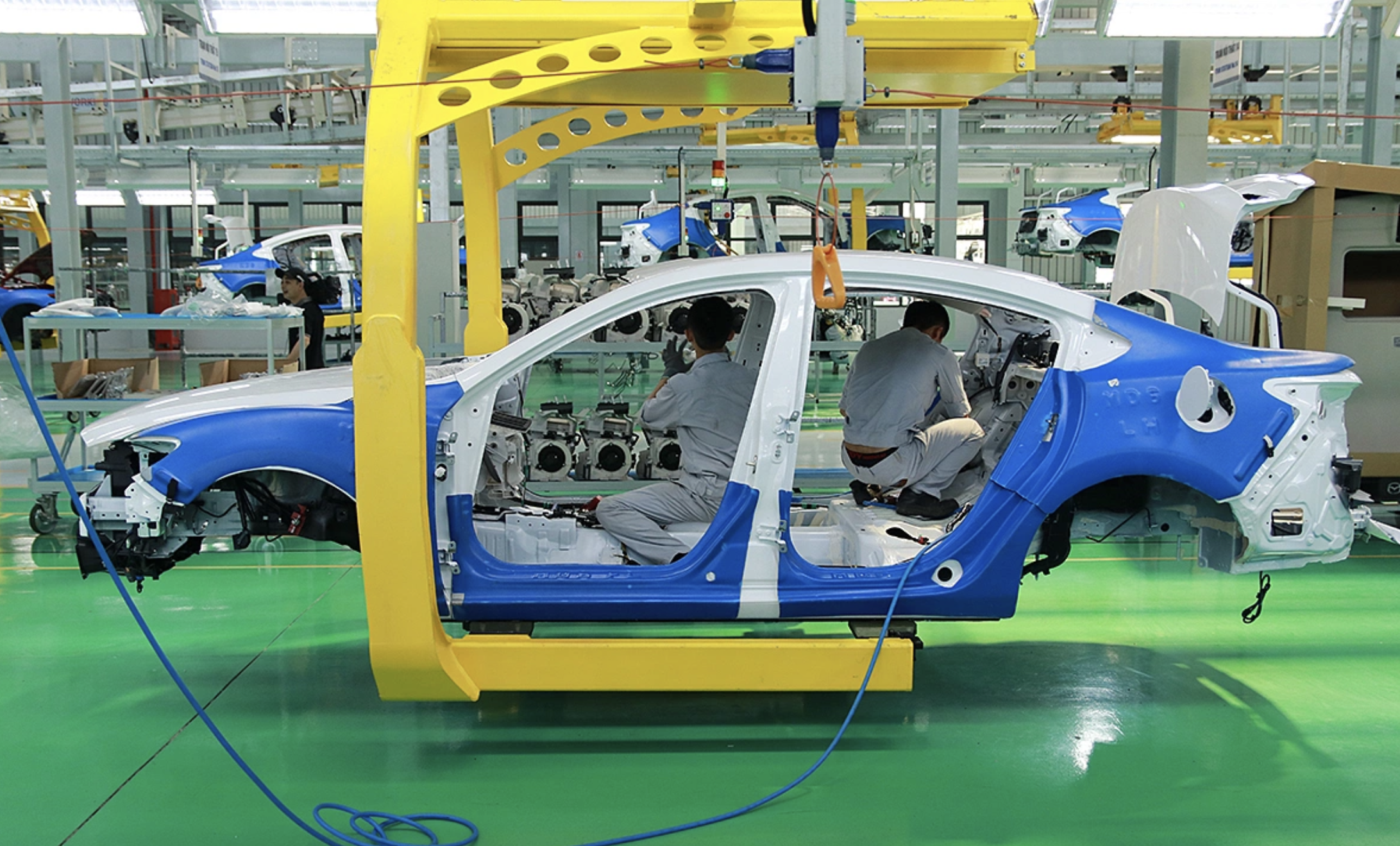 |
Vehicles assembled in Vietnam. Photo: Duc Huy |
Previously, when considering removing the sector from the conditional business list, the Ministry of Industry and Trade also mentioned some risks similar to those raised by the enterprises. Additionally, the ministry noted that current regulations encourage enterprises to invest in physical facilities to produce and assemble automobiles from discrete components. If these regulations are abolished, enterprises could import relatively complete vehicle bodies and perform only simple assembly steps. This would cause the domestic automobile industry to lose its motivation for localization and the development of supporting industries.
The Ministry also did not rule out the possibility that some neighboring countries, such as China, which have significant excess automobile production capacity, might shift this surplus to Vietnam in the form of simple assembly foreign direct investment (FDI) projects. This could be done to circumvent origin rules and then export to other countries. In such a scenario, Vietnam risks being investigated by other countries for transshipment activities and facing punitive tariffs on many other export sectors.
In contrast, the Vietnam Chamber of Commerce and Industry (VCCI) argues that the abolition plan aligns with reform trends and has sufficient practical basis.
According to VCCI, all automobiles produced, assembled, or imported currently must undergo technical safety and environmental quality inspections according to national technical standards before being circulated. The registration system, defective product recall mechanism, and product liability under the Law on Protection of Consumer Rights have created a sufficiently strong layer of post-inspection protection.
"Certificates for production and assembly and licenses for automobile import business are essentially a layer of pre-inspection overlapping existing technical management tools, increasing compliance costs without adding value to public safety," VCCI assessed.
VCCI evaluates that requirements for warranty facilities, official authorization, and type approval certificates from the manufacturing country create very high entry barriers, allowing the imported automobile market to be dominated by a few large enterprises. The result is that automobile prices in Vietnam remain among the highest in the ASEAN region when compared by purchasing power parity, while consumers have fewer choices.
Regarding concerns about transshipment and excess capacity, VCCI believes that Vietnam has a sufficient legal framework for anti-dumping, subsidies, and trade remedies. Rules of origin in free trade agreements to which Vietnam is a member also clearly stipulate the domestic value-added content ratio required to receive tariff preferences. These are appropriate tools, consistent with international commitments, to address origin evasion issues, rather than using business conditions as a disguised technical barrier.
In reality, after more than two decades, the localization rate of Vietnam's automobile industry remains low, averaging 7-10% for passenger cars, compared to 70-80% in Thailand. According to VCCI, this reality shows that market entry barriers are not an effective tool to promote localization. Instead, policies such as tax incentives for domestically produced components and support for research and development of supporting industries would be more suitable.
Furthermore, VCCI also suggests that current business conditions, designed for traditional automobile production models involving welding, painting, and assembly, may no longer be suitable and create barriers for new investors in electric vehicles and autonomous vehicles. International experience in the US, the European Union, Japan, and South Korea shows that these countries do not use a mechanism of issuing certificates of eligibility for production and assembly but manage entirely through technical standards, mandatory recall mechanisms, and product liability under civil law.
Therefore, VCCI supports the option of abolishing conditional investment and business sectors, while proposing that the Ministry of Industry and Trade coordinate with the Ministry of Transport to complete the system of technical standards and post-inspection mechanisms to ensure safety for users and the community.
The domestic automobile industry currently accounts for over 3% of the gross domestic product (GDP), creating jobs for approximately 200,000 direct skilled laborers in automobile manufacturing, assembly, and supporting industries. Domestic vehicle production and assembly have continuously increased, from 323,892 vehicles in 2020 to over 500,000 vehicles in 2025, accounting for approximately 65-75% of total vehicles sold.
Currently, there are about 650 automobile and auto parts manufacturers in Vietnam, with more than 400 enterprises supplying components that meet tier one supplier standards for major automakers, an increase of over 200% compared to 2016.
Phuong Dung