The aerotropolis concept, or airport city, was initiated by Professor John Kasarda, Director of the Center for Air Commerce at the University of North Carolina, United States. According to him, an airport city is an area where infrastructure, land use planning, and economic activities are centered around an airport.
In Europe, Amsterdam Schiphol International Airport in the Netherlands stands as a prime example of an "airport city" model. A vibrant ecosystem has formed around Schiphol, comprising logistics centers, offices, hotels, and commercial services, catering to both transportation and business activities.
Strategically located between the United Kingdom, Germany, and France, this airport connects 244 million people within a 1,000 km radius. Annually, Schiphol transports over 1,4 million tons of cargo, serves 71 million passengers, and contributes approximately 30 billion EUR to the Dutch economy, generating 300,000 direct and indirect jobs.
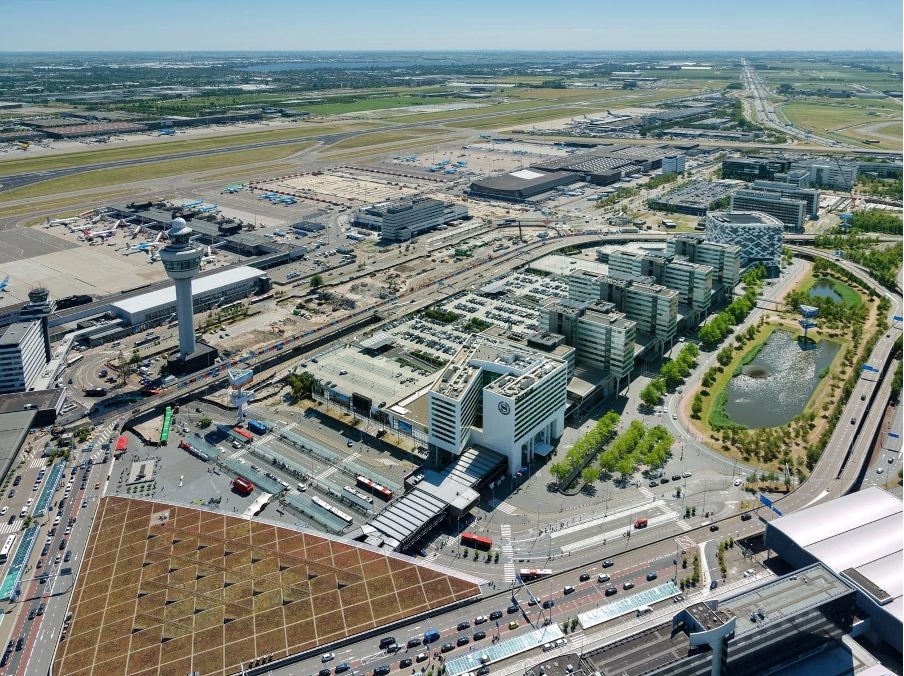 |
Schiphol Airport is surrounded by a complex of commercial, service, and hotel facilities. Photo: Marco van Middelkoop |
Schiphol Airport is surrounded by a complex of commercial, service, and hotel facilities. Photo: Marco van Middelkoop
In Asia, many airports are also evolving to integrate logistics, commerce, and services, moving beyond solely transportation functions. Singapore's Changi Airport is regarded as a "destination rather than a transit point." Beyond its global connectivity, Changi incorporates over 400 retail stores, 100 restaurants, the 1,7 billion USD Jewel complex, and Changi Business Park, which hosts technology and finance corporations. According to data from the Civil Aviation Authority of Singapore (CAAS), Changi contributes over 5% of the national GDP and creates over 200,000 jobs, demonstrating an airport's potential to become a national development engine.
 |
Singapore's Changi Airport has been honored as the world's best airport. Photo: Aerotime |
Singapore's Changi Airport has been honored as the world's best airport. Photo: Aerotime
Meanwhile, the combination of Incheon Airport City, South Korea, and the Songdo smart city is recognized by the World Bank as one of the most successful "aerotropolis models," due to the synergy between aviation infrastructure, industry, and education. This project has attracted over 40 billion USD in investment, establishing itself as a financial and technology hub in Northeast Asia.
According to the International Air Transport Association (IATA), air transport currently contributes approximately 3,9% to global GDP. For economies with a high proportion of exports, aviation infrastructure is increasingly vital in supply chains, especially for high-tech industries demanding rapid delivery and optimized inventory. This is why many countries are accelerating the development of "aerotropolis" models linked to logistics, commerce, and industry.
Development potential in Vietnam
In Vietnam, aviation infrastructure is identified as a strategic breakthrough in the National Airport System Master Plan, as per Decision 648/QD-TTg. Large-scale aviation infrastructure projects in key economic regions are expected to expand transport capacity, creating room for the development of "aviation city" models integrated with logistics, commerce, and services.
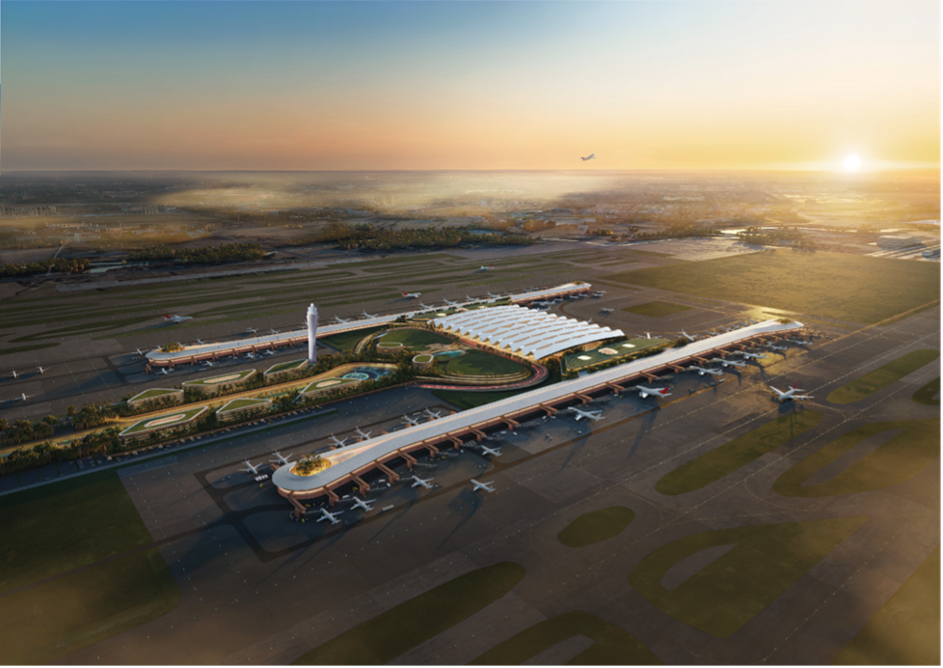
Among these, Gia Binh International Airport, a project developed by Masterise Aviation Infrastructure Joint Stock Company (a member of the Masterise Group ecosystem), is oriented towards a new-generation 2.0 aviation economic hub model, connecting aviation, logistics, and urban development to support export manufacturing chains in the northern region.
 |
Perspective of Gia Binh International Airport. Photo: MAI |
Perspective of Gia Binh International Airport. Photo: MAI
According to the investor, the development model for Gia Binh International Airport is structured with three integrated layers. The core area comprises an aviation infrastructure ecosystem, including the international airport, a logistics center, cargo transport, and commercial services, hotels, and offices to support transit activities.
Surrounding this is an economic ecosystem operating as a free trade zone (FTZ) model, focusing on commercial and financial centers, offices for high-tech businesses, along with educational, healthcare, and innovation facilities. Integrating production and service activities around the airport aims to help businesses optimize logistics costs and enhance supply chain connectivity.
The outermost layer is planned for modern urban development, featuring residential areas, green spaces, and cultural, tourism, and entertainment services to cater to communities of experts, engineers, and high-quality workforce.
The Gia Binh International Airport project is located in the industrial "capital" of the northern region, a hub for major technology corporations such as: Samsung, Foxconn, and Goertek. Currently, most electronic components and high-tech goods from Bac Ninh or Thai Nguyen must still be transported by road to Noi Bai Airport or Hai Phong seaport before export.
Experts believe that establishing a dedicated airport directly within the industrial "capital" can shorten transport times, reduce intermediate costs, and alleviate pressure on existing connecting transport infrastructure. This is a key factor in enhancing the competitiveness of Vietnamese export goods in the global value chain.
 |
Transport infrastructure connecting to the Gia Binh airport project. Photo: Tam Thao, Doan Loan |
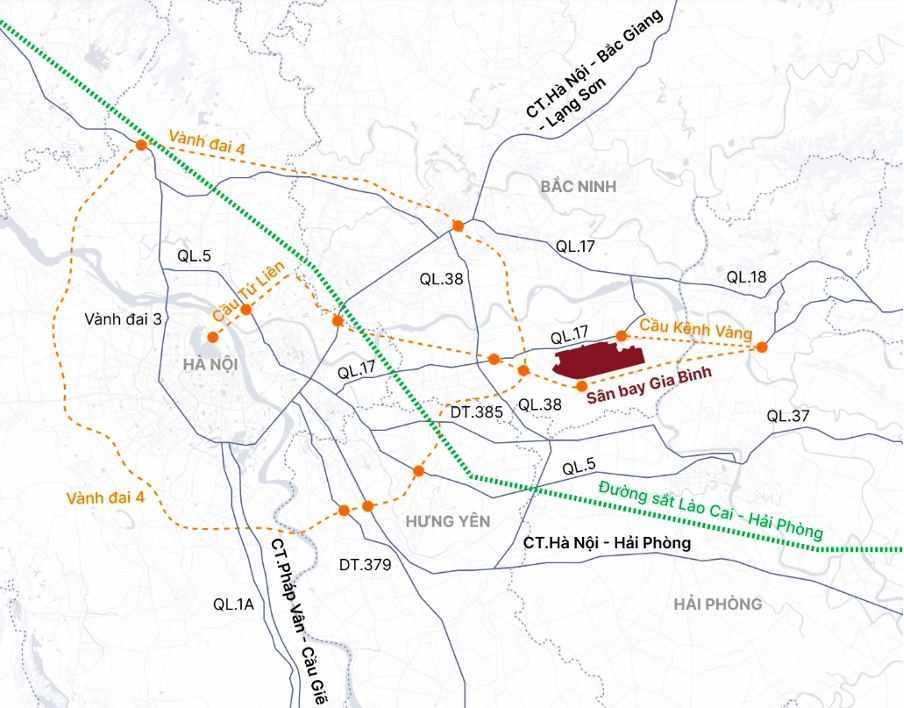
Transport infrastructure connecting to the Gia Binh airport project. Photo: Tam Thao, Doan Loan
The investor is currently accelerating the construction of inter-regional connecting infrastructure, including 120m wide arterial roads and a beltway system directly linking to the national expressway network. With a total investment of approximately 8 billion USD, the project is focusing resources to begin initial operations from late 2026.
According to planning consultants, the potential of the "aerotropolis" model lies not in runway scale but in its ability to form an ecosystem of logistics, commerce, and services around the airport. However, for this model to operate effectively, elements such as connecting infrastructure, digital logistics, regional planning, and mechanisms to attract businesses must be developed synchronously.
As Vietnam promotes upgrading production value chains and developing strategic infrastructure, integrated airport economic models like Gia Binh International Airport are expected to contribute to forming new growth poles, transforming Vietnam from an assembly center into a crucial link in the global logistics and high-tech network.
Minh Dang