Sports in Vietnam are gradually transitioning from a grassroots activity or high-performance pursuit into an economic sector, according to a report released at the Sports Economy Forum 2026 last weekend. The estimated size of Vietnam's sports economy for the 2024-2025 period is approximately 3-5 billion USD.
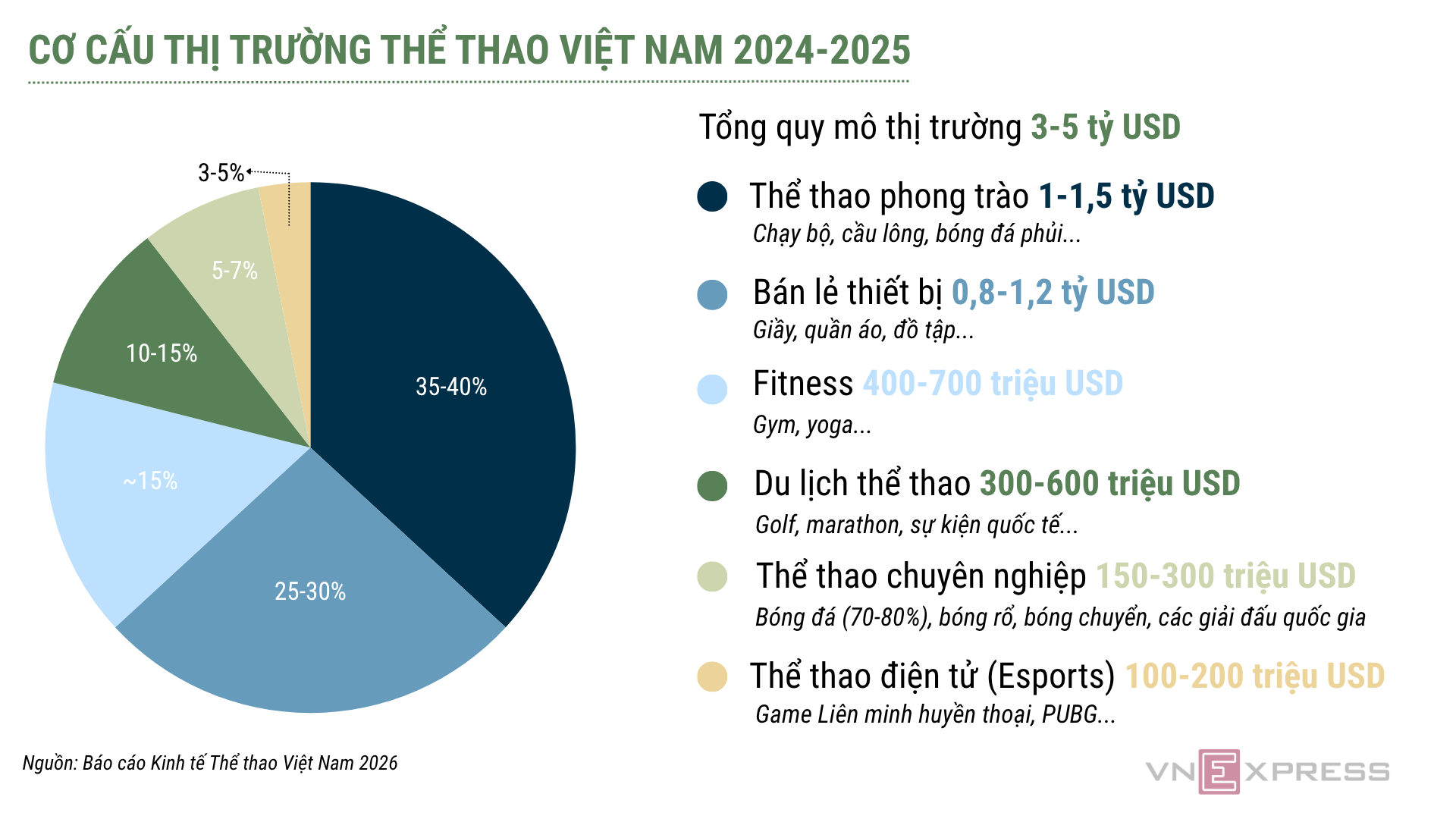 |
Scale and structure of Vietnam's sports economy market. *Graphic: Anh Tu*
Globally, Statista and other organizations estimate the sports market, encompassing media rights, sponsorships, and game day revenues, to be worth 400-500 billion USD.
The research group indicates that Vietnam is in the initial phase of developing its sports economy, where market demands have emerged, but the supply chain remains incomplete. With an annual growth rate of 8-15%, Vietnam's sports economy has significant room for expansion, projected to reach 8-10 billion USD by 2030 and 20-30 billion USD by 2040.
However, realizing these figures requires addressing several key challenges within Vietnam's sports economy.
Firstly, Vietnam's infrastructure limitations hinder many entities from organizing large-scale tournaments with high commercial value. Most stadiums and indoor arenas are old, lack modern equipment, are in disrepair, and remain under local management.
"For many years, Vietnamese sports has faced a familiar paradox – immense public interest, yet inadequate competition infrastructure. International tournaments, when they occur, often have to adjust their scale due to limitations," the research group wrote in the Vietnam Sports Economy Report 2026.
My Dinh and Thong Nhat stadiums, for instance, primarily serve competition purposes and have not fully exploited their economic potential. In contrast, developed countries utilize stadiums year-round for various events to increase operational days and diversify non-sports revenue streams. Indoor arenas, despite lower operating costs than stadiums and easier occupancy, still lack a robust tournament system for optimal utilization.
The introduction of new sports also faces difficulties due to a lack of suitable venues. The Automobile Sports Association reported that several Japanese partners recently expressed interest in bringing professional car racing to Vietnam but encountered obstacles due to the absence of standard race tracks.
This situation may improve soon with the entry of major corporations such as Vingroup, with its PVF stadium (60,000 seats in Hung Yen) and Trong Dong (135,000 seats in Hanoi), and Sun Group, with its Rach Chiec National Sports Complex project in TP HCM.
Le Van Thanh, Chairman of Dong Luc Joint Stock Company, advocates for accelerating the socialization of sports infrastructure. He believes that state investment in a large stadium for 20-30 years would be wasteful. Instead, private companies entrusted with land and stadium construction "will operate more efficiently."
Event organization procedures in Vietnam are also considered more complex than in some regional countries. Lim Son, Chairman of VSP, a company specializing in international boxing events, noted that in Korea, organizers do not need to apply for numerous permits, primarily collaborating with federations and associations and focusing on commercial aspects. In Vietnam, he faces an estimated 80% risk from procedural delays and approval times.
Similarly, To Duy, Chairman of the Board and CEO of New Sports, highlighted the lack of consistency among localities in granting event licenses. "Applying for the same event, each city handles it differently," stated the head of the company, which organizes basketball and pickleball tournaments.
Current development policies and incentives to encourage sports investment or host world-class events are also insufficient. According to statistics from the Vietnam Athletics Federation, over 100 annual running races are organized nationwide each year. However, only one of these events attracted over 20,000 participants, according to organizer data, and most lack specific statistics on their economic and tourism contributions to each locality.
In contrast, the Bangkok Marathon in Thailand, typically held at the end of the year, attracted nearly 48,000 runners from 86 countries and territories in 2025, generating significant economic benefits.
With substantial government support, the Bangkok Marathon does not charge high participation fees, often lower than many races in Vietnam. However, Thapanee Kiatphaibool, Governor of the Tourism Authority of Thailand (TAT), estimates this sports event contributes 48 million USD directly and indirectly to the Thai economy, with approximately 40 million USD specifically from tourism.
According to The Nation, the Thai Government has committed continuous support for three years (2025–2027) to help the Bangkok race join the World Marathon Majors (WMM), one of the largest marathon series globally.
Currently, WMM includes seven major races in Boston, Berlin, Chicago, London, New York, Tokyo, and Sydney. Generally, Thailand's state views investment in sports events as a national product, positioned to stimulate demand and attract international tourists.
 |
The VnExpress Marathon, with over 13,000 participants, took place in March in TP HCM. *Photo: VM*
According to Tran Thuy Chi, Chairwoman of Vietcontent Group, the state in Vietnam needs to transition into an "ecosystem architect," opening up the exploitation of public facilities, legalizing sports business, and providing financial incentives for the private sector.
The Chairman of Dong Luc proposed the early introduction of a sports economy law to develop the industry. According to Thanh, a sports investment fund should be operationalized. Through this, entrepreneurs and individuals contributing to the fund could also receive tax deduction benefits.
Cho Hae, Chairman of the Korea Sports Promotion Foundation, also believes the Vietnamese government needs to support and stimulate private sector investment in the sports economy. According to this expert, before 1988, Korean sports focused solely on performance and medals. However, the nation later recognized it as an economic development tool and enacted the Sports Industry Promotion Act in 2007, which included tax incentives.
Anh Tu - Trong Hieu