On the afternoon of 22/3 in Hanoi, experts from the British Council shared a roadmap for improving two key skills: writing and speaking, with over 500 candidates at an IELTS event.
For the writing section, Andy Milner, academic manager at the British Council, noted that the distinction between a band 7 and lower scores lies in the logic and completeness of arguments. A common mistake candidates make is to begin writing immediately after reading the prompt.
"Candidates need at least 5 minutes to analyze the question, filter ideas, and organize their presentation order. The more thoroughly one prepares, the faster one writes, and the more time one will have to refine vocabulary and grammar," Milner emphasized.
When tackling task 2, which is a social commentary essay, young candidates often struggle with a lack of experience, leading to a shortage of ideas. Milner suggested relating the topic to a real-life acquaintance, such as friends or relatives, to generate ideas from these individuals' circumstances and stories.
For task 1, which involves describing charts and graphs, candidates are only required to summarize available data. Milner advised candidates to avoid providing their own explanations or personal comments on the data. Additionally, they need to master vocabulary for describing tables and figures and write using a simple structure.
"Use a "boring" essay template that is sufficient to meet the prompt's requirements," he said, adding that while task 2 must include a conclusion, task 1 is required to have an overview.
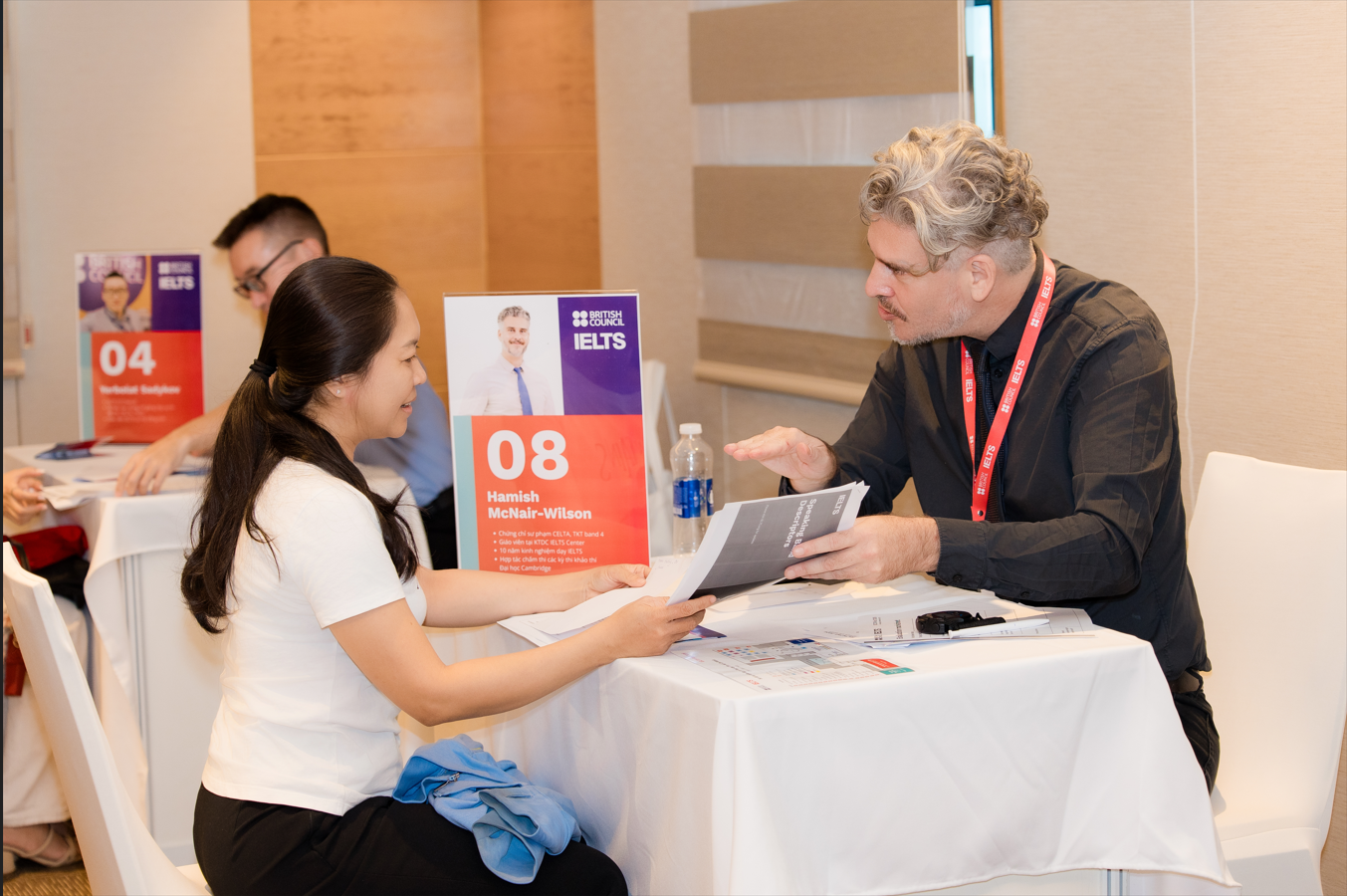 |
Candidates experience a mock test with experts at the IELTS event. Photo: British Council
The speaking test consists of three parts: Part 1 (self-introduction), Part 2 (presentation on a given topic), and Part 3 (discussion).
Andy Diaa, an IELTS expert at the British Council, believes the key lies in thorough preparation: mastering the scoring criteria, building vocabulary, and practicing detailed answers.
Specifically, there are two ways to build vocabulary: by topic (e.g., transport, land) and by collocation – pairs of words that frequently go together (e.g., the word "set" often appears in phrases like "set up", "set a goal", "set an alarm"). Candidates should apply these when narrating their own stories to remember them better.
For Part 2, during the one-minute preparation time, Andy Diaa suggests candidates write down at least two keywords for each prompt in the question, then use the 5Ws + 1H questions (who, what, where, when, why, and how) to expand on them.
He notes that Part 3 can be approached similarly to task 2 of the writing test. The keyword to remember for a coherent answer is TREE, where T stands for Topic, R for Reasoning, followed by Evidence and/or Example.
When practicing, if candidates are stuck for ideas, they can apply a similar tip to the writing section: by "role-playing" someone in the asked situation to express a viewpoint.
IELTS is a popular English language test for non-native English speakers. This test assesses candidates' four skills: listening, reading, writing, and speaking, on a 9-point scale.
Many universities in Vietnam currently use the IELTS certificate for admissions. Candidates with this certificate receive a maximum of 1,5 bonus points, converted across at least 5 different levels, according to regulations by the Ministry of Education and Training.
Khanh Linh