Ho Chi Minh City University of Technology (a public institution) and Ho Chi Minh City University of Technology and Education (a private institution) initially shared the same English name: Ho Chi Minh City University of Technology. After several years, these two universities were compelled to differentiate themselves using abbreviations: HCMUT and HUTECH.
This is just one of many instances causing confusion regarding the English names of universities. The most common situation involves universities with different Vietnamese names having similar English equivalents.
For instance, the term "Bach Khoa" (polytechnic) is translated differently. The university in Ho Chi Minh City is Ho Chi Minh City University of Technology, while its counterpart in Hanoi is Hanoi University of Science and Technology. The English name of Hanoi University of Science and Technology closely resembles that of University of Science and Technology of Hanoi. The only difference lies in the placement of "Hanoi" at the beginning or end, leading to nearly identical abbreviations: HUST and USTH.
Similarly, for "University of Technology," the institution under Vietnam National University, Hanoi is named University of Engineering and Technology, while another in TP HCM is simply University of Technology.
The most distinct variations appear among pedagogical universities.
| Vietnamese name | English name |
| Truong Dai hoc Su pham Ha Noi | Hanoi National University of Education |
| Truong Dai hoc Su pham Ha Noi 2 | Hanoi Pedagogical University 2 |
| Truong Dai hoc Su pham TP HCM | Ho Chi Minh City University of Education |
| Truong Dai hoc Su pham Da Nang | University of Science and Education |
This overlap also extends to abbreviations. For example, Thuyloi University uses the abbreviation TLU.
This has often surprised students from Thang Long University, who, when introducing themselves as studying at "TLU," are frequently mistaken for attending Thuyloi University.
Some universities, despite not being part of the national university system or having international affiliations, incorporate "National" or "International" into their names. Examples include Vietnam National University of Forestry and private institutions like Hong Bang International University and The Saigon International University.
A deputy rector at a university in TP HCM observed that the English translation of university names remains chaotic, with institutions adopting names independently due to vague regulations from the Ministry of Education and Training (MOET). This confusion affects not only parents but also leads to other consequences.
Five to ten years ago, approximately 15% to 20% of academic papers by faculty members from this university were miscategorized by international academic databases under other universities with similar English names.
Scholarship applications for master's and doctoral programs also faced difficulties. Many foreign professors mistakenly sent invitation letters or awarded scholarships to the wrong addresses due to the highly similar English names.
"This puts students at a disadvantage", he noted, explaining that the university had to publish articles to clarify and guide prospective students, parents, and partners on how to differentiate them. The university also proactively changed its English abbreviation and required faculty members to include this information in their academic papers, gradually improving the situation.
"Although our university's English name existed first and was copyrighted, the other university translated their name accurately and closely to their Vietnamese name, so we had no choice but to negotiate privately", he stated.
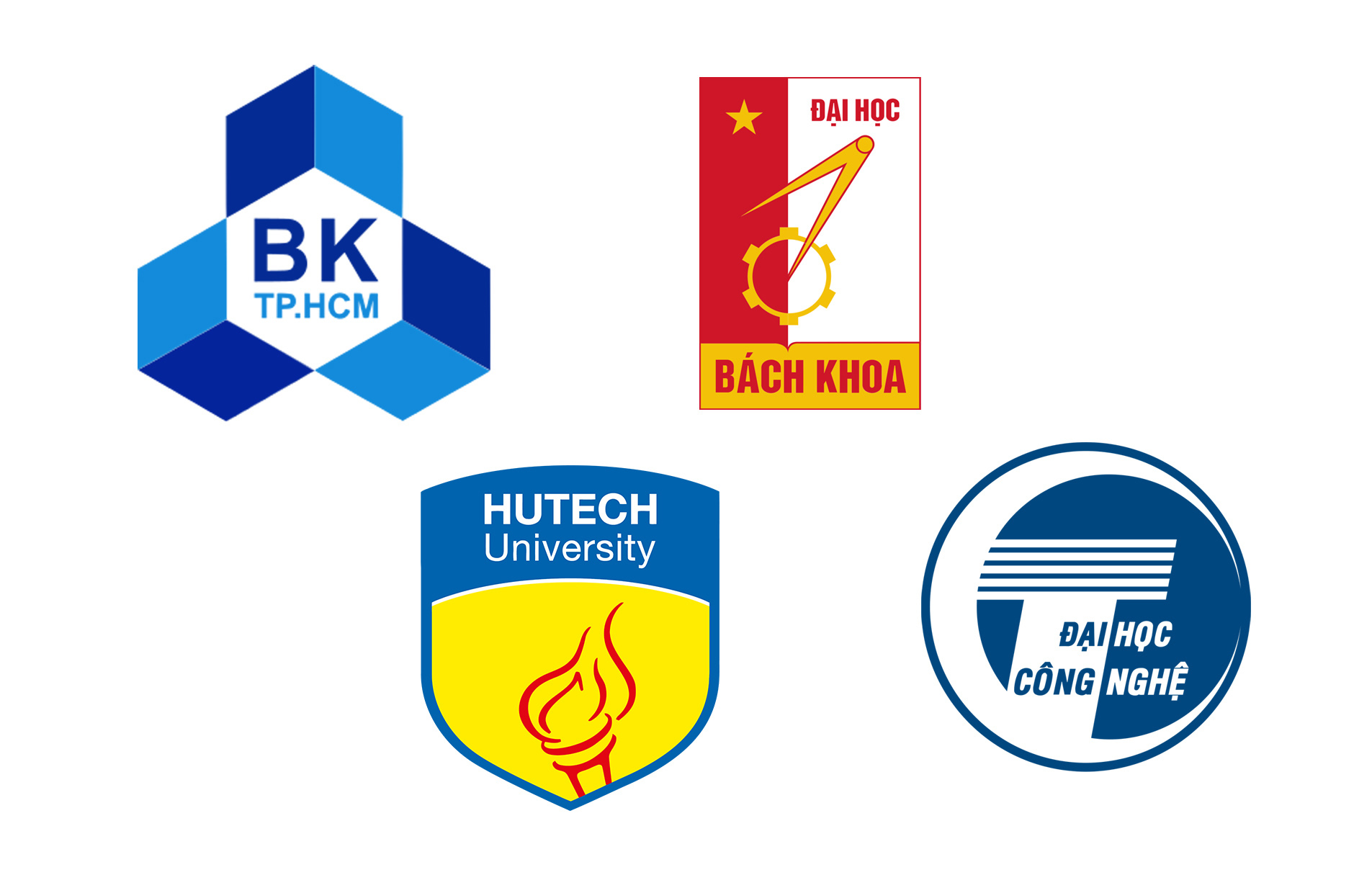 |
Logos of several universities. |
However, such cases of confusion are rare. A leader at a Hanoi university noted that English naming has been practiced for a long time to facilitate collaboration with international partners.
Most universities translate their names literally, but some choose English names that reflect their specific training programs. Furthermore, universities observe their peers to avoid duplication, resulting in diverse English names. "This actually reduces confusion for parents, students, and international partners", he observed.
Doctor Quang Nguyen, an English teacher with over 20 years of experience, also believes this diversity causes minimal impact. Having attended many international conferences and spent considerable time studying and working in the United States, he has never encountered confusion regarding university names. "English names are primarily used for working with foreigners. As long as they can identify the institution, that's what matters", Doctor Quang said.
The Ministry of Education and Training (MOET) plans to regulate the principles for naming educational institutions. For foreign language names or international transaction names, universities must provide an equivalent translation of their Vietnamese name, without exaggerating their level, status, or type.
Doctor Quang suggested clarifying the requirement for "equivalent translation of their Vietnamese name" but advised against a mechanical, word-for-word translation. For example, translating "Bach Khoa" in "Dai hoc Bach khoa" as "100 faculties" would sound very odd. Instead, universities should translate based on the nature and characteristics of their training.
Experts generally agree that the requirement to avoid exaggerating the level, status, or type when naming institutions is reasonable. "A normal domestic university adding 'international' to its name could lead to misunderstandings about the true nature of that institution", said the Hanoi university leader.
Duong Tam - Le Nguyen