Nguyen Nhat Anh's latest work traces childhoods transplanted from rural areas to urban centers, moving from expansive open spaces to cramped old apartment buildings, and from a sense of belonging to a state of temporary residence. Set in post-war Saigon, the story unfolds as the city welcomes a new wave of migrants. The urban landscape emerges through narrow alleys, dilapidated housing, and families living in close proximity, both physically and emotionally. This is the Saigon of newcomers, carrying memories of their villages and striving daily to integrate.
 |
Cover of "The girl next door and four candies", published by Tre Publishing House. Photo: Tre Publishing House |
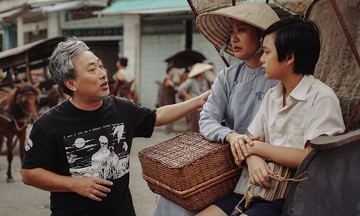
Characters Thieu, Tuong, and Man are children who left their impoverished rural homes. They arrive in the city driven by a fundamental desire for survival: a roof over their heads, access to education, and sufficient food. Nguyen Nhat Anh employs a gentle narrative pace, allowing the stark differences between rural and urban life to gradually unfold through their new, more crowded existence, fostering deeper bonds and mutual reliance.
The author uses small details to paint a vivid picture of daily life. Children study on two low chairs, simple meals are eaten in a narrow room, and communal living makes privacy a rarity. The city emerges as a place where people must share both material possessions and emotions, rather than merely a land promising a new life.
Amidst this existence, the "four candies" take center stage. For children, candy represents a reward, a treat, something to be shared or kept. In their confined living spaces, the act of sharing candy becomes a way for characters to assert themselves and engage with the community. These four candies are not complex symbols, but rather a simple test of character. Who readily gives? Who hesitates? Who takes them for granted? Through these choices, the personalities of the characters gradually emerge.
Neighborly relationships are portrayed as a vital support network. A Lin's family, old Mrs. A Pho, and other residents are bound by shared circumstances. In an urban setting where blood ties are often absent, neighborly bonds evolve into an extended family. Children growing up in this environment quickly learn to observe, adapt, and share.
Unlike the naturally formed communities in Nguyen Nhat Anh's rural settings, the urban environment in "The girl next door and four candies" is a product of deliberate construction. Relationships are fostered through simple acts: sharing candies, making space at meals, and accommodating more people in a corner of a home. These very details cultivate a sense of "belonging" within the city.
On a deeper level, the work explores the profound issue of belonging. Characters embark on a journey to learn how to live within the city, gradually discovering their place to connect. Children, lacking initial urban memories, find every moment to be a new experience. Nguyen Nhat Anh utilizes childhood as a lens, revealing the city as both reserved and innocent.
The work also captures the cultural essence of a past urban era through images of newspapers, writing, and painting. While the gentle, steady narrative voice helps maintain the story's simplicity, it occasionally diminishes the inherent tension between individuals and the city, a hallmark of immigrant life. On various book forums, readers have noted that the pace of life in the story feels calmer and more tranquil than reality.
This choice reveals Nguyen Nhat Anh's deliberate intention: to portray human existence in the city with a gentle and generous spirit. "The girl next door and four candies" is not a chronicle of conquests, but a narrative of finding one's place through acts of sharing.
From this perspective, the book transcends the scope of children's stories, resonating with anyone who has left their rural home for the city, seeking to integrate into urban life through the simplest gestures, transforming temporary stays into lasting connections.
 |
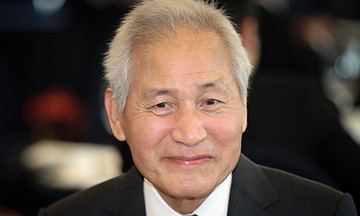
Nguyen Nhat Anh at the launch of "The girl next door and four candies". Photo: Hoang Dung |
Tran Cuong