Eng English
China 中国人

Eng English
China 中国人
  • News
  • World
  • Business
  • Entertainment
  • Sports
  • Law
  • Education
  • Health
  • Lifestyle
  • Travel
  • Science
  • Digital
  • Automobiles
  • Trở lại Thể thao
  • Health
Saturday, 11/7/2026 | 10:11 GMT+7

41% of students can swim as Vietnam seeks drowning prevention solutions

With only 41% of students able to swim and 12% of schools having pools, health officials propose integrating safe swimming into the core curriculum.

Drowning is a leading cause of child mortality in Vietnam, as stated by Deputy Minister of Health Nguyen Tri Thuc at an inter-sectoral workshop on child drowning prevention on 10/7. Annually, the country records over 4,700 drowning deaths, with nearly 2,000 cases involving children. Vietnam's extensive river network and long coastline, combined with increasing climate change and natural disasters, heighten the risk of drowning accidents.

A primary factor contributing to child drowning is the limited awareness among families, communities, and society regarding this issue. Many children lack swimming skills and water safety knowledge, and they often do not recognize the dangers of swimming or playing near riverbanks. Furthermore, numerous localities suffer from inadequate facilities and a shortage of swimming instructors. The percentage of schools offering swimming lessons remains very low, with insufficient pools and equipment.

Data collected from 34 departments of education and training indicates that as of 15/6, only 2,919 out of 25,090 schools nationwide have swimming pools, which is approximately 12%. The rate of students who can swim stands at 41%, while each school, on average, has only 0,57 certified swimming instructors. A representative from the Ministry of Education and Training identified the biggest constraint as a lack of funding for infrastructure investment and social resources, particularly in remote and disadvantaged areas.

Deputy Minister of Health Nguyen Tri Thuc speaks at the workshop. Photo: Ministry of Health

At the workshop, many experts highlighted that current swimming education relies on short-term programs and projects, which fail to achieve sustainable effectiveness. Associate Professor, Doctor Pham Viet Cuong, from the Center for Injury Policy and Prevention Research at Hanoi University of Public Health, noted that children's safe swimming skills can diminish by nearly 50% after about six months if not practiced regularly.

Drawing from implementation experiences in Dong Thap, Quang Tri, and Hue, he proposed integrating safe swimming into the official education curriculum. This program would include specific output standards, such as continuously swimming 25 meters and treading water or floating for 90 seconds. Additionally, he emphasized the need for consistent funding from local budgets, the development of mobile and smart pool models, and mechanisms for schools to share swimming facilities. These measures aim to expand swimming opportunities for students, especially those in remote, disadvantaged, and flood-prone areas.

Master Doan Thi Thu Huyen, country director for the Campaign for Tobacco-Free Kids, shared this view, observing that extreme weather and natural disasters are increasing drowning risks, particularly in rural areas. She recommended embedding drowning prevention goals into local development plans, establishing unified standards for safe swimming instruction, and investing sustainably in facilities and teaching staff. She also stressed the importance of monitoring and evaluating children's skill retention after training, rather than merely counting participation numbers.
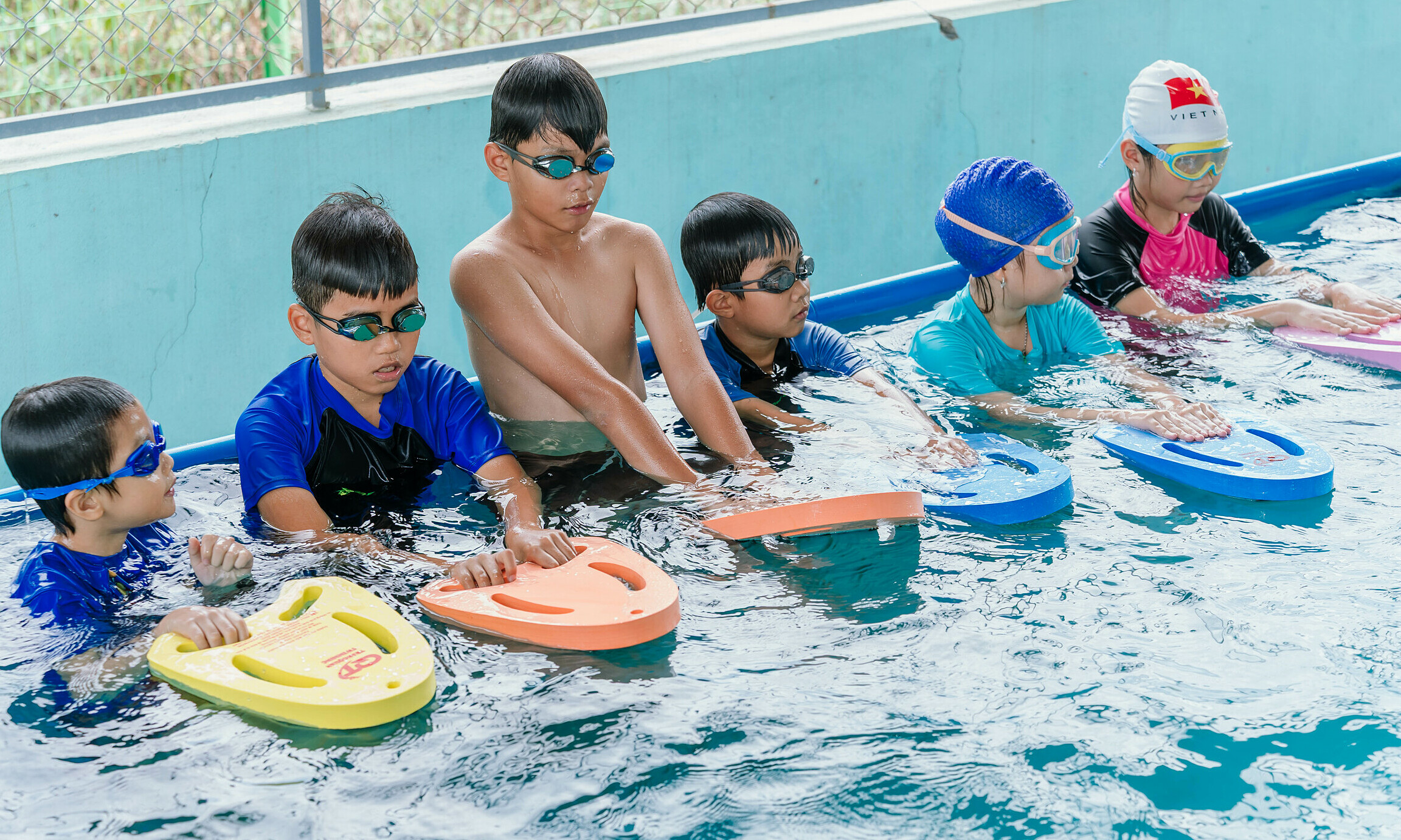
Children learn to swim in Da Nang. Photo: Tue Minh

Meheret Melles-Brewer, team lead for Environment and Healthy Lifestyles at the World Health Organization (WHO) in Vietnam, further added that climate change, floods, and urbanization are escalating drowning risks. She advocated for integrating drowning prevention into national strategies for disaster risk reduction and climate change adaptation. The WHO is committed to continuing its support for Vietnam in refining policies, enhancing capacity, and promoting sustainable investment in drowning prevention efforts.

Le Nga

By VnExpress: https://vnexpress.net/41-hoc-sinh-biet-boi-viet-nam-tim-giai-phap-chong-duoi-nuoc-5096158.html
Tags: swimming lessons drowning prevention

News in the same category

Three cooling jelly toppings that can harm kidney patients

Three cooling jelly toppings that can harm kidney patients

Patients with chronic kidney disease should avoid syrup, red beans, and chewy taro balls when eating jelly to prevent hyperglycemia, and the accumulation of potassium and phosphorus which can be dangerous for the body.

Dual-purpose surgery aids breast cancer patients in body restoration

Dual-purpose surgery aids breast cancer patients in body restoration

A surgical technique using abdominal fat for breast reconstruction helps many women with breast cancer regain their figure and confidence post-treatment.

Respiratory support methods for premature infants

Respiratory support methods for premature infants

Premature infants with underdeveloped lungs are prone to respiratory distress and may require oxygen therapy, continuous positive airway pressure, non-invasive ventilation, or intubation.

Does radiation therapy cause hair loss?

Does radiation therapy cause hair loss?

I am 25 years old and about to undergo radiation therapy for scalp cancer. Will this treatment cause me to lose all my hair? (Ngoc Le, Dong Nai)

Can fat freezing technology be used on upper arms?

Can fat freezing technology be used on upper arms?

My upper arms are quite large despite being only slightly overweight; diet and exercise haven't reduced them. Can fat freezing technology, which helps reduce fat, be used for the upper arm area? (Thu Trang, Hanoi)

Should you drink tea or coffee in the morning?

Should you drink tea or coffee in the morning?

Green tea and coffee are both popular morning beverages, but the better choice depends on individual goals and health conditions.

VNVC invests 100 million USD in high-tech vaccine production

VNVC invests 100 million USD in high-tech vaccine production

To acquire new generation vaccines, VNVC is investing 100 million USD in phase one, focusing on final production stages such as formulation, vial filling, and vaccine quality control.

Silent habits that nourish a healthy gut

Silent habits that nourish a healthy gut

Chewing thoroughly, eating to about 80% fullness, supplementing with vegetables, fermented foods, and walking after meals help nourish the gut and support efficient digestion.

Should you use air conditioning when your child has a cough and runny nose?

Should you use air conditioning when your child has a cough and runny nose?

My child has a phlegmy cough and runny nose due to unpredictable weather. At night, should I use an air conditioner or a fan for my baby? (Minh, Hanoi)

Can hyperplastic polyps develop into cancer?

Can hyperplastic polyps develop into cancer?

I underwent an endoscopy and a small colon polyp was found. The doctor advised regular monitoring, not removal yet. Can hyperplastic polyps develop into cancer? (Hong, TP HCM)

Eng English
China 中国人
  • News
  • World
  • Business
  • Entertainment
  • Sports
  • Law
  • Education
  • Health
  • Lifestyle
  • Travel
  • Science
  • Digital
  • Automobiles
FPT Tower, 10 Pham Van Bach Street, Dich Vong Ward,
Cau Giay District, Hanoi, Vietnam
Email: contacts@vnportal.net
Tel: 028 7300 9999 - Ext 8556
Advertise with us: 090 293 9644
Register
© Copyright 2026 vnnow.net. All rights reserved.
Terms of use Privacy policy Cookies