


Response:
Pectus excavatum is the most common congenital chest wall deformity. It results from abnormal development of the costal cartilages, which causes the sternum to be pushed inward. This condition can be noticeable at birth or become more pronounced during puberty, a period of rapid skeletal growth.
The optimal age for pectus bar insertion surgery is typically between 12 and 18 years. During this phase, a child's skeletal structure is still developing and retains sufficient flexibility for effective correction. While surgery in adults can also be effective, the hardened bone structure often makes the procedure more complex and requires a longer period for the bar to remain in place.
Most mild cases of pectus excavatum primarily impact aesthetics, leading to self-consciousness and a lack of confidence in social interactions or group activities. However, when the chest is deeply sunken, the thoracic cavity's volume significantly shrinks, putting direct pressure on vital internal organs. Patients may then experience symptoms such as shortness of breath during exertion, chest pain, reduced exercise endurance, or heart palpitations.
The indication for pectus bar insertion surgery, known as the Nuss procedure, typically relies on detailed clinical and paraclinical standards. A significant determining factor is the Haller index, calculated from a chest computed tomography (CT) scan, which reflects the severity of the chest wall depression. A Haller index greater than 3,25 indicates a substantial degree of pectus excavatum, and surgery is often considered, particularly when the patient exhibits symptoms or evidence of cardiac or pulmonary compromise.
Given your child's fatigue and self-consciousness, it is advisable to consult a thoracic surgery specialist. The doctor may recommend necessary tests such as respiratory function measurement, echocardiogram, and CT scan to accurately assess the degree of compression. Timely intervention improves physical health, alleviates psychological stress, and helps children gain confidence in their lives.
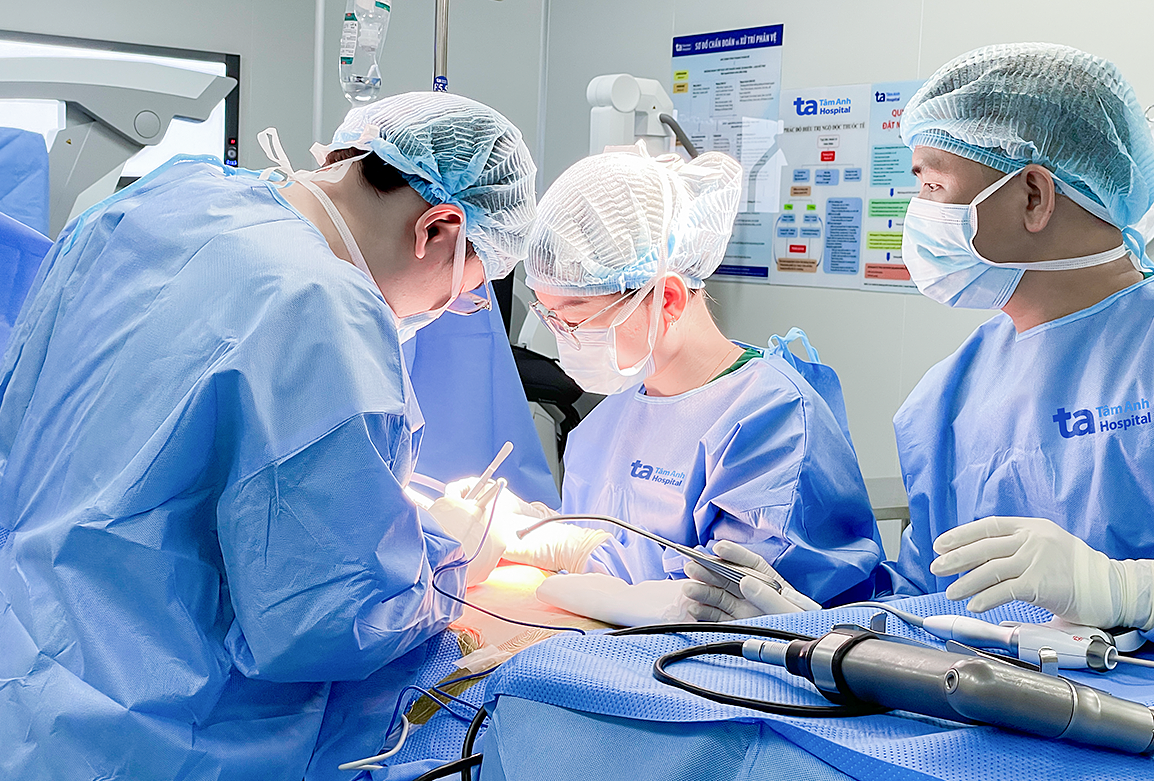 |
Master of Science, Doctor, First Degree Specialist Phan Vu Hong Hai performs pectus bar insertion surgery for a patient with pectus excavatum. *Photo: Tam Anh General Hospital* |
The Nuss procedure is a minimally invasive technique. A surgeon inserts one or more metal bars, pre-shaped to match the chest's deformity, through small incisions on both sides of the chest wall. These bars elevate the sunken area to a normal position. The bar typically remains in the body for two to three years until the skeletal framework stabilizes in its new shape before being removed.
Symptomatically, patients require intervention when the deformity begins to affect respiratory and circulatory function. Common manifestations include shortness of breath during exertion, rapid fatigue during exercise, persistent chest pain, or frequent respiratory infections. Severe pectus excavatum can compress the heart, altering its position (often shifting it to the left), reducing cardiac output, and leading to heart rhythm disorders.
Master of Science, Doctor, First Degree Specialist Phan Vu Hong Hai
Center for Thoracic - Vascular Surgery
Tam Anh General Hospital, Ho Chi Minh City
| Readers can submit questions about cardiology here for a doctor's response. |


