On the morning of August 1, generations of medical professionals at Bach Mai Hospital lined up, holding portraits of Professor Dinh, to bid farewell as the hearse carrying his coffin passed through the hospital on its way to Van Dien Cemetery. Professor Vu Van Dinh passed away on July 29 due to old age and frailty, at 94 years old.
Director of Bach Mai Hospital, Dao Xuan Co, spoke movingly about the profound impact the professor left on the hospital's development and the field of emergency resuscitation.
"Successive generations of students will always preserve the flame that our teacher ignited in the mission of caring for, protecting, and improving public health," Doctor Co expressed.
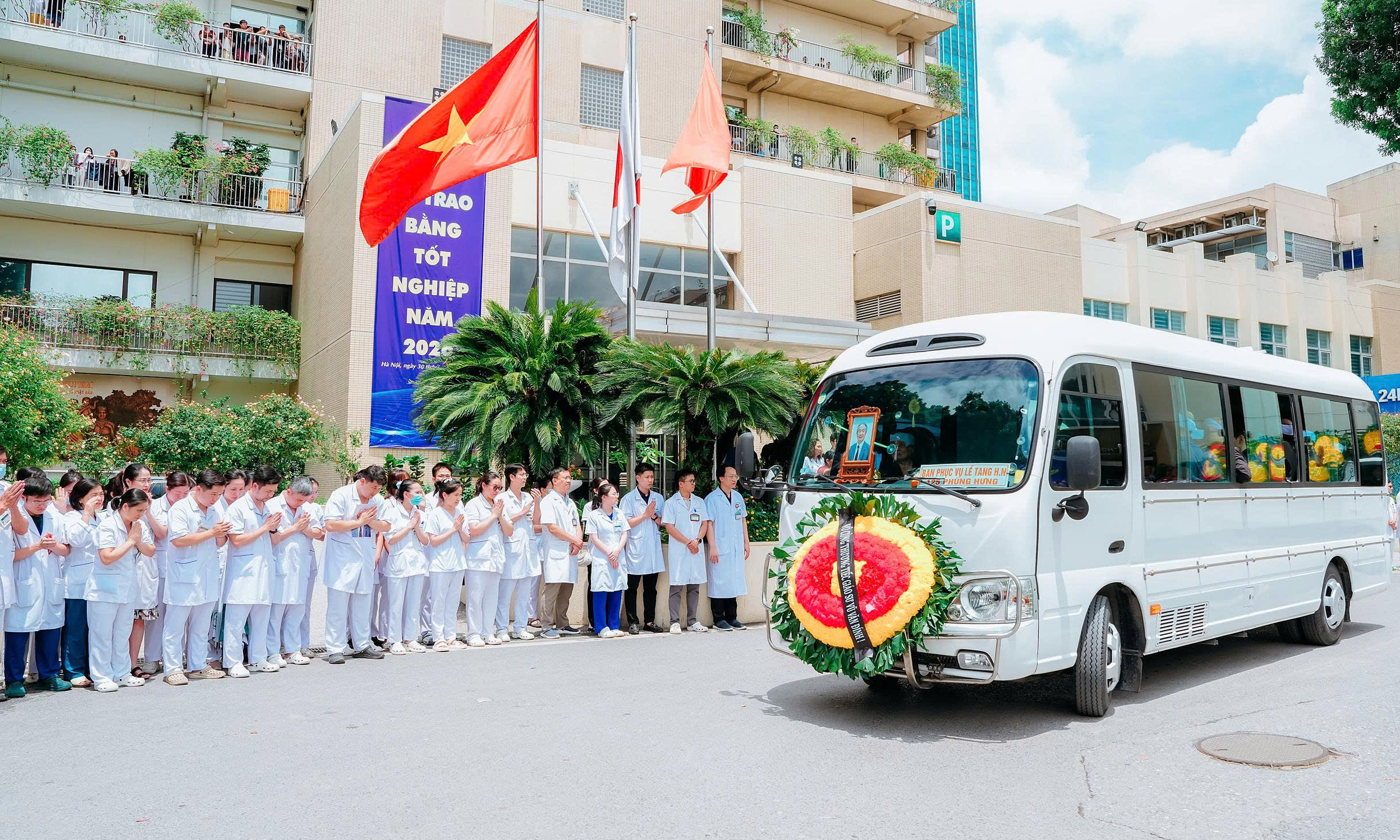 |
Bach Mai Hospital medical staff bow their heads to bid farewell to Professor Vu Van Dinh. Photo: The Anh |
Born in 1933 in Hai Duong (now part of Hai Phong City), Professor Vu Van Dinh graduated from Hanoi Medical University in 1959 and dedicated almost his entire life to Bach Mai Hospital and Hanoi Medical University. His name became synonymous with the A9 Emergency and Resuscitation Department, often referred to as Bach Mai Hospital's "gateway between life and death."
From its early days of scarcity, he and his colleagues developed a modern emergency resuscitation model, implementing a range of advanced techniques of that era. These included electric shock, pacemaker insertion, artificial ventilation, peritoneal dialysis, and continuous hemodialysis, which opened doors to survival for thousands of critically ill patients.
Professor Dinh also advised on establishing an organizational model for three specialized departments: examination, emergency, and intensive care. This model was subsequently replicated in numerous hospitals nationwide and remains the operational foundation for hospital emergency systems today.
In 1994, Professor Dinh established the Poison Control and Resuscitation team within Department A9, the precursor to the current Center for Poison Control. From this foundation, Bach Mai Hospital's emergency system evolved into specialized centers: the A9 Emergency Center, the Intensive Care Center, the Center for Poison Control, and the Stroke Center, collectively saving tens of thousands of severely ill patients each year.
Beyond his pioneering work in treatment, Professor Dinh directly developed the Department of Emergency Resuscitation at Hanoi Medical University. He authored textbooks, designed training programs, and mentored many generations of doctors across the country. Many of his students became educators, scientists, and clinical leaders in major hospitals.
His scientific contributions are also recognized through numerous practical research works. Notably, his research on treating severe malaria significantly reduced mortality rates. He established a national system of guidelines for diagnosis, treatment, and technical procedures for emergency resuscitation.
One of the stories frequently recounted by his students involves his journey of "raising snakes to save lives." In the early 1980s, Vietnam could not produce snake antivenom serum, leading to many patient deaths due to lack of treatment. He mobilized local communities and various localities to provide venomous snakes, setting up a breeding area right next to Department A9 to extract venom for research. He personally cared for and monitored venomous snake species such as cobras, king cobras, kraits, and green pit vipers.
These studies significantly contributed to the development of snake antivenom serum in Vietnam, paving the way for effective treatment for patients and laying the groundwork for the country's poison control field.
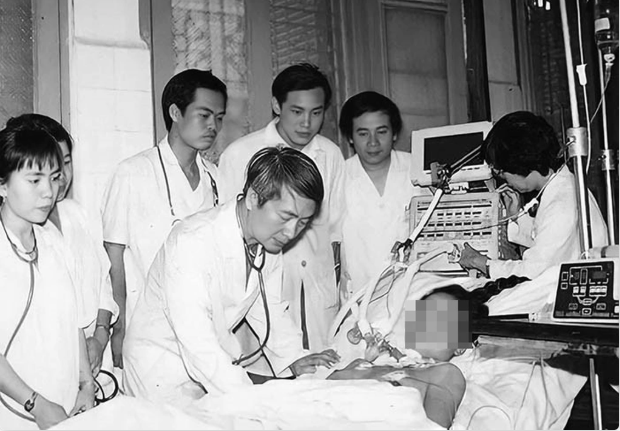 |
Professor Vu Van Dinh examining a patient during his time in service. Archive photo provided by Bach Mai Hospital |
Throughout his career, Professor Dinh held many important positions, including Head of the A9 Emergency and Resuscitation Department, Head of the Department of Emergency Resuscitation at Hanoi Medical University, and Chairman of the Vietnam Association of Emergency, Resuscitation, and Poison Control.
The State bestowed upon him the title of People's Physician, two titles of Labor Hero, the Independence Order, and many other esteemed awards. In 2012, he received the "Lifetime Achievement" award for healthcare at the Hospital Management Asia Conference held in Hanoi.
Concluding nearly a century of dedication, the professor leaves behind not only scientific works, specialized units, or pioneering techniques for Vietnamese medicine. What remains is a generation of medical professionals imbued with his medical ethics, spirit of devotion, and aspiration to fight for patients' lives.
One life has ended, but the path he forged for Vietnam's emergency resuscitation sector continues to be preserved and advanced by succeeding generations.
Le Nga