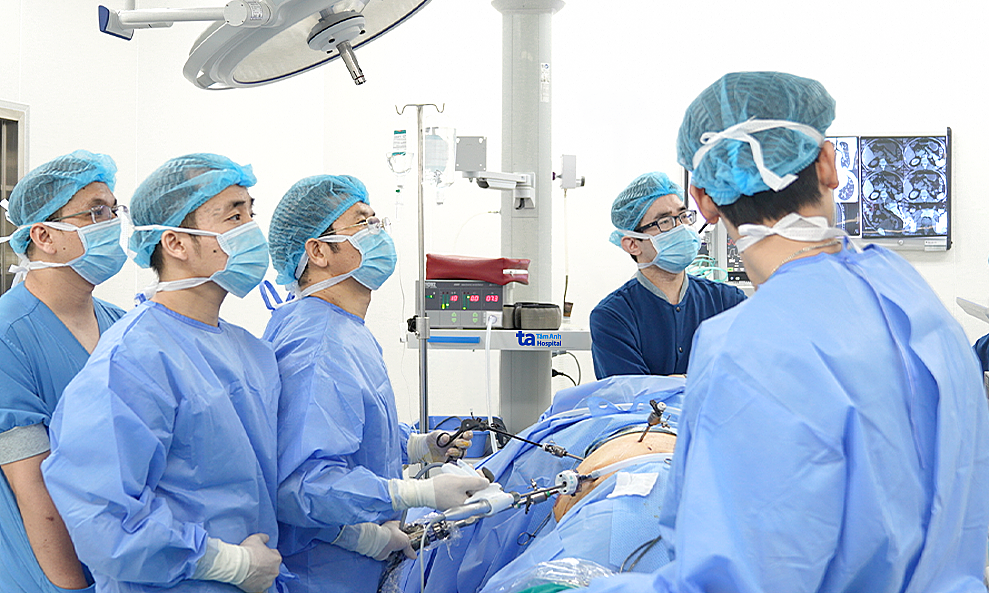
Due to the small, benign tumor, Ly did not undergo regular check-ups for four years. Recently, she experienced a dull ache in her right hypochondrium. A CT scan at Tam Anh General Hospital in Ho Chi Minh City revealed an eight cm liver hemangioma, occupying nearly an entire liver lobe and compressing surrounding structures.
Doctor of Medicine II Thi Van Gung, Head of the Endovascular Intervention Unit at the Imaging Diagnosis and Interventional Radiology Center, stated that the tumor risked continued growth and further compression if left untreated. Doctors determined the patient was in the optimal stage for tumor embolization (TAE) to cut off its blood supply.
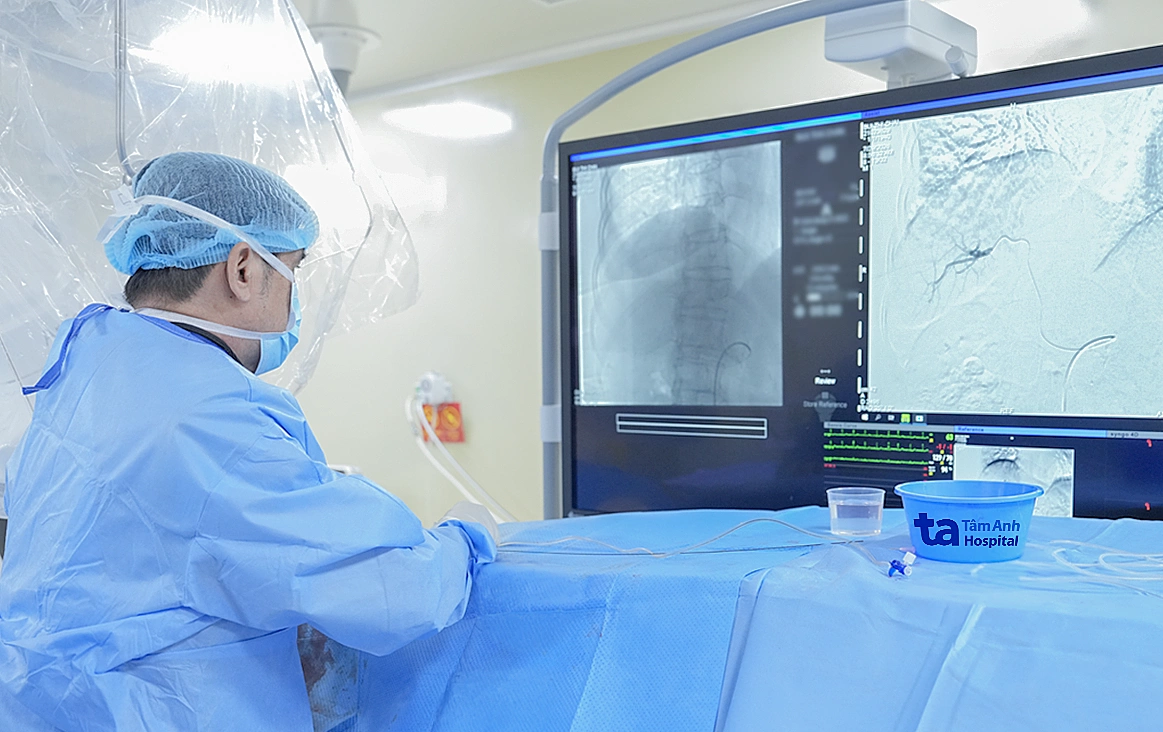 |
Doctor Gung performing endovascular intervention on Ly. Photo: Tam Anh General Hospital |
According to Doctor Gung, arterial embolization offers significant advantages for large tumors like Ly's, as separating such tumors from healthy liver tissue is often challenging. Traditional surgery could be prolonged, increasing risks of massive bleeding, damage to major hepatic arteries or veins, and requiring the removal of a substantial amount of healthy liver parenchyma. Patients might face acute liver failure or insufficient liver reserve volume to sustain vital functions.
TAE allows doctors to directly access the arterial branches supplying the tumor, significantly reducing blood flow to it without needing direct surgery through the liver parenchyma. This minimally invasive arterial embolization helps limit damage to healthy liver tissue.
Using a digital subtraction angiography (DSA) system, the medical team created a small entry point, a few millimeters in size, in the femoral artery. They then guided a microcatheter precisely to the arterial branch feeding the tumor and injected an embolizing agent. Once the blood supply was cut off, the tumor, deprived of nourishment, gradually fibrosed and shrank over time.
Post-surgery, the patient no longer experienced pain in her hypochondrium and was discharged the next day. A follow-up visit one month later showed the tumor had shrunk to 4,8 cm and continued to decrease, with its blood supply nearly eliminated.
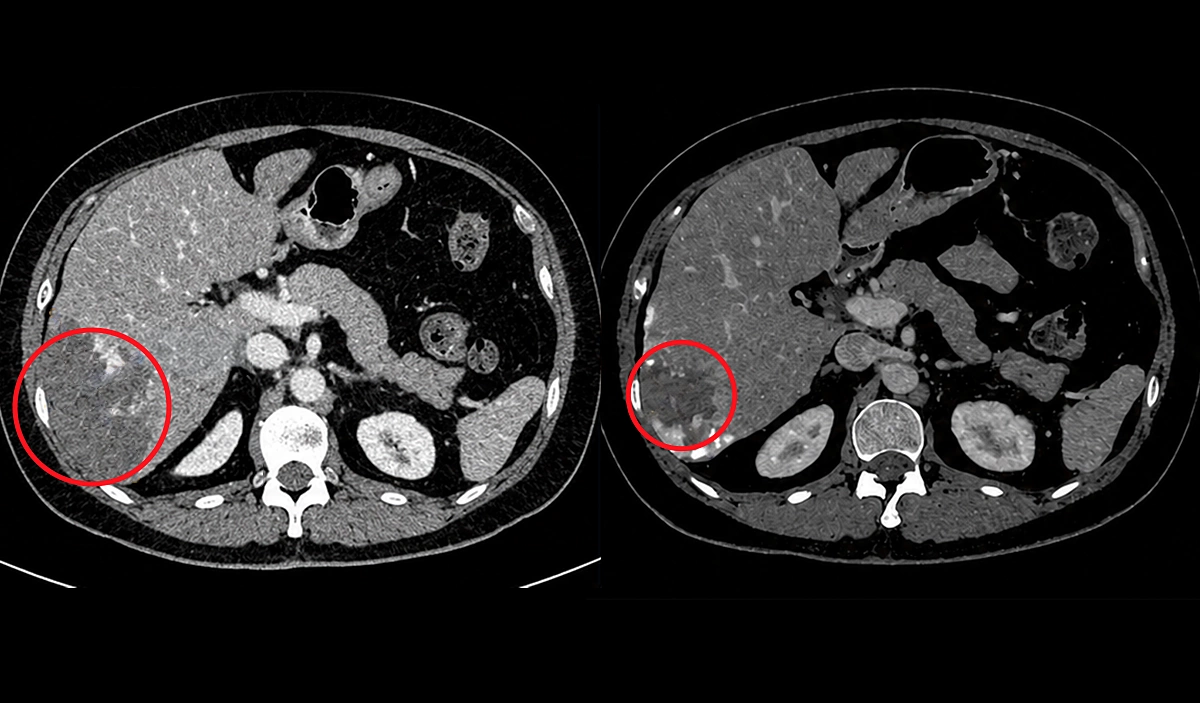 |
Ly's liver hemangioma after intervention (right) has shrunk by nearly 50%. Photo: Tam Anh General Hospital |
According to doctors, liver hemangioma is the most common benign liver tumor. Most are small and asymptomatic, often overlooked by patients. If a tumor grows rapidly, becomes large, causes pain, or compresses the stomach, bile ducts, or blood vessels, patients require evaluation for intervention. In some cases, tumors can rupture, leading to intra-abdominal hemorrhage or coagulation disorders, which are life-threatening.
Doctors advise individuals with liver hemangiomas to attend scheduled follow-up appointments to monitor the tumor's size and growth rate. Early detection of abnormalities and regular monitoring enable doctors to choose the appropriate treatment time, preventing the tumor from growing too large or developing complications that could complicate treatment.
*Patient's name has been changed
Nhu Ngoc
| On 19/8 at 8:00 PM, the Tam Anh General Hospital system will host an online health consultation titled "High-tech general health check-up: Early detection, intensive treatment, optimal costs". Doctor of Medicine II Tran Thi Thanh Truc, Head of General Internal Medicine; Doctor Nguyen Anh Dung, Head of Thoracic and Vascular Surgery, Tam Anh General Hospital in Ho Chi Minh City; and Doctor of Medicine II Le Van Khanh, Head of Interventional Radiology, Tam Anh General Hospital in Hanoi, will participate in the consultation. Readers can submit questions here. |