


Tuan had congenital bowlegs, also known as O-legs. Over time, his right leg gradually became 15 degrees more angled than his left and one cm shorter. This condition caused him to limp and experience frequent pain after playing sports. Following bone-cutting surgery to correct the limb axis at another hospital, Tuan's right leg unfortunately deformed from an O-shape into an X-shape.
At Tam Anh General Hospital Hanoi, Master, Doctor Nguyen Quang Ton Quyen, Deputy Head of the Orthopedic Trauma Department, diagnosed the patient with a 6-degree outward deviation in his right knee. Dr. Quyen recommended leg axis correction surgery, to be assisted by the Artis Pheno robotic arm.
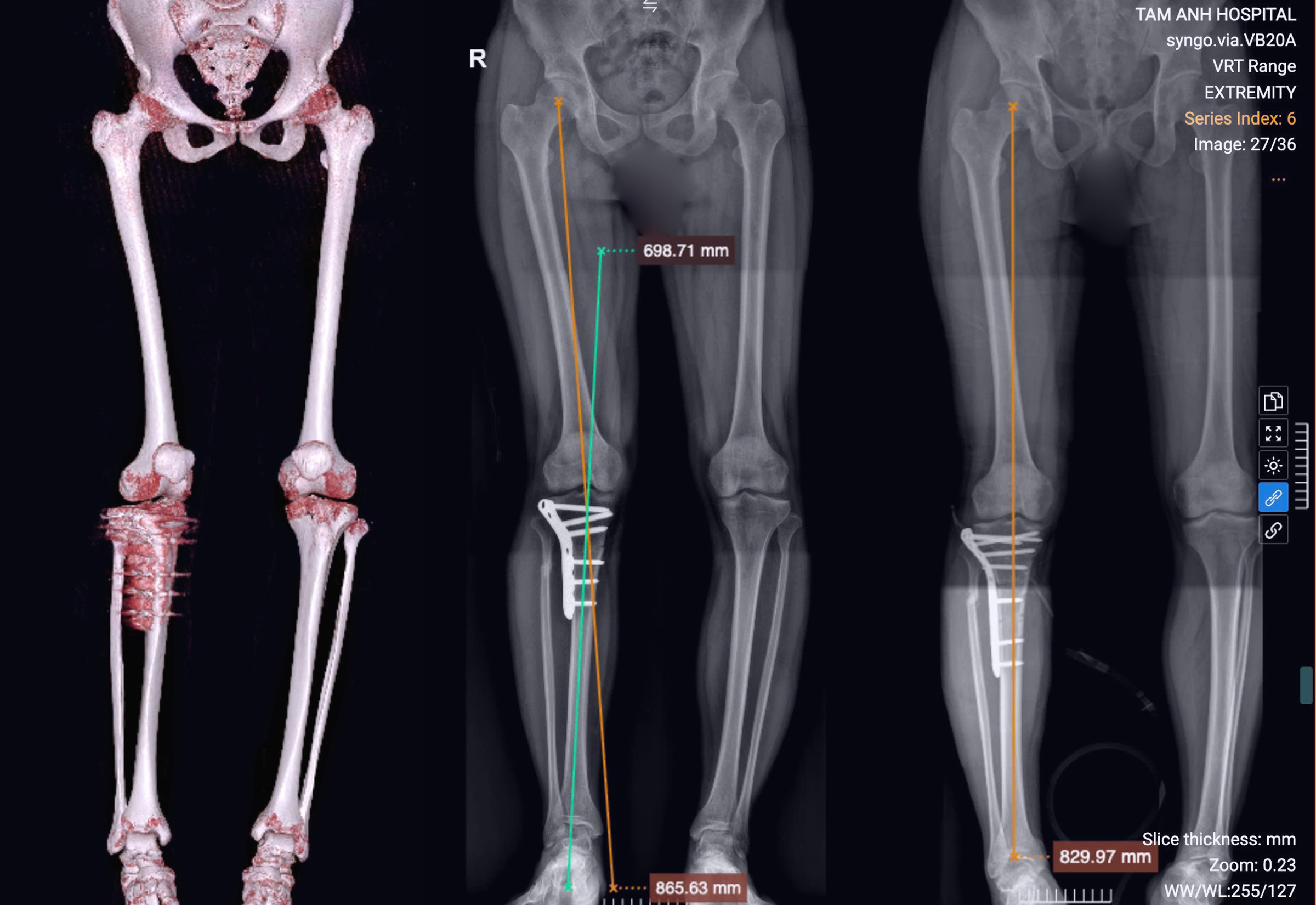 |
Right leg axis with outward deviation on CT (left) and X-ray (middle) images was surgically corrected to neutral (right). Photo: Tam Anh General Hospital
Dr. Quyen utilized 3D software to meticulously plan the surgery, accurately simulating the bone cutting position, the angle for axis correction, and the required bone graft wedge. He reopened the old incision, removed the existing plate and screws, and cut the bone along the previous line. The Artis Pheno robotic arm provided continuous 3D imaging during the operation, enabling the doctor to monitor the patient's leg mechanical axis in real-time, adjust the tibia, and graft bone precisely.
Once Tuan's leg was in the correct neutral 0-degree position, Dr. Quyen secured a new locking plate outside the tibial head to fix the bone in its new alignment. Two hours after the surgery, Tuan reported little pain and could get out of bed, walk with support, and perform normal daily activities. Post-operative X-rays confirmed that the right leg was no longer deviated, had returned to a neutral anatomical position, and both legs were of equal length.
Tuan was discharged two days after the surgery. Dr. Quyen advised the patient to walk gently for the initial 6 weeks and to begin early rehabilitation to regain knee joint range of motion. After 6-8 weeks, Tuan could start weight-bearing on the operated leg. Full recovery is expected after 3-6 months, at which point he should be able to resume sports.
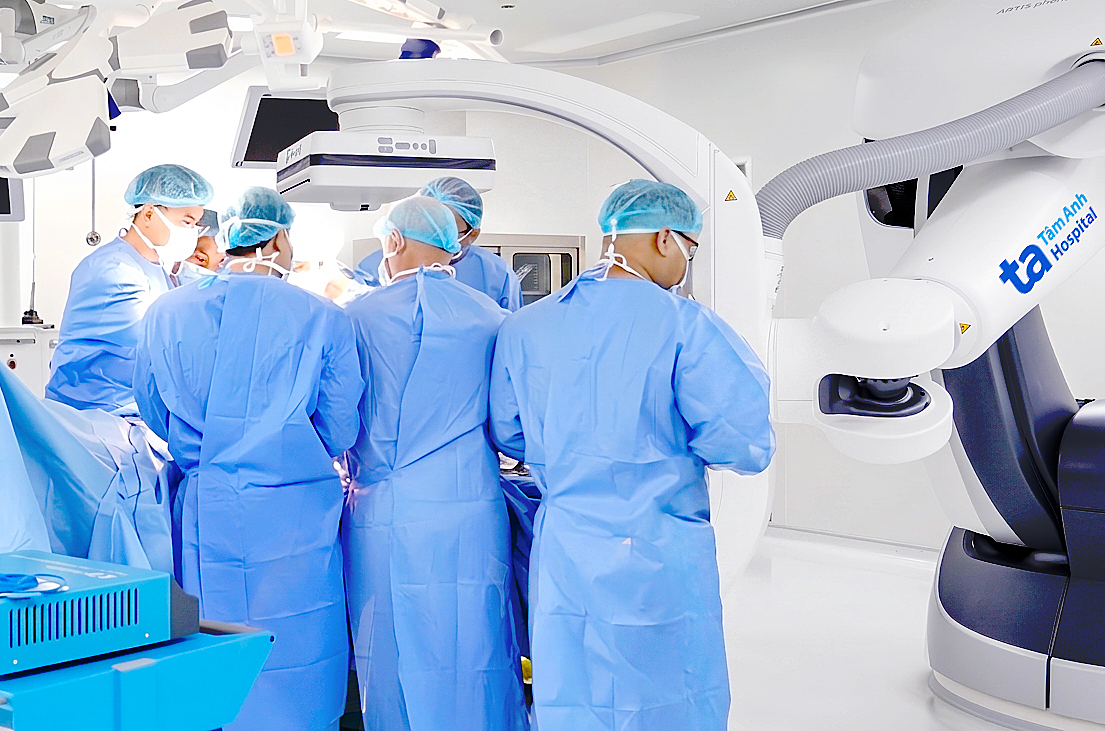 |
Dr. Quyen and his team operating on Tuan. Photo: Tam Anh General Hospital
According to Dr. Quyen, bowlegs are a common physiological condition in young children, often resolving naturally as they grow. However, some children have more severe bowlegs; if not treated correctly, the condition does not improve with age, leading to abnormally shaped legs and cosmetic concerns. Bowlegs place increased pressure on the hips, knees, and ankles, causing early joint degeneration and raising the risk of needing joint replacement in middle age.
Dr. Quyen recommends parents have children examined early if their bowlegs remain severe. Depending on the condition, doctors may advise further monitoring or the use of specialized shoes and braces to shape the leg bones. Adults with bowlegs can undergo knee joint preservation surgery, avoiding the risk of artificial joint replacement later in life.
Currently, many technologies such as 3D computed tomography imaging and intraoperative 3D C-arm assist doctors in precisely correcting bowleg and X-leg deformities. Patients should seek treatment at specialized hospitals for accurate, effective surgery, to avoid complications that necessitate repeat operations.


