Master of Science, Doctor Duong Minh Phuc, from the High-Tech Eye Center at Tam Anh General Hospital Ho Chi Minh City, stated that Quang often squinted and had unclear distant vision. When he tried on glasses with appropriate refractive parameters, his vision remained unclear.
The doctor suspected Quang had accommodative dysfunction and administered temporary pupil-dilating drops to perform a precise refraction and retinoscopy. After 45 minutes, a re-measurement revealed that his right eye had 5 diopters of astigmatism and his left eye had 4,5 diopters.
According to Dr. Phuc, accommodative dysfunction combined with silently progressing refractive errors can cause vision abnormalities in children to be overlooked. When the eyes struggle to adjust focus, images may appear clear at times and blurry at others, leading children to gradually adapt. Simultaneously, the eyes continuously adjust to compensate, resulting in inaccurate refractive measurements and delaying diagnosis and treatment. Some cases lead to "pseudomyopia," requiring cycloplegic drops before measurement to accurately determine the refractive error.
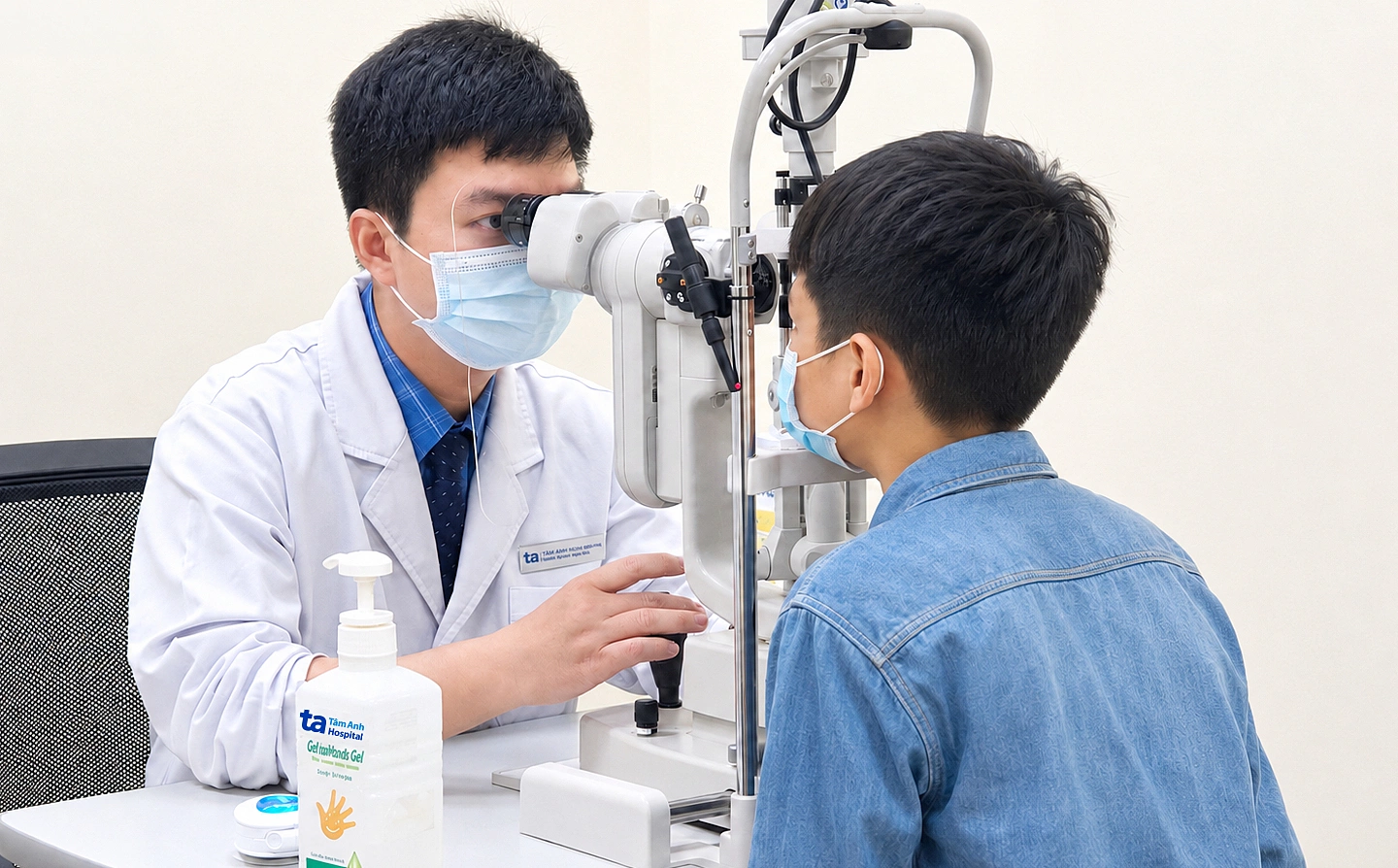 |
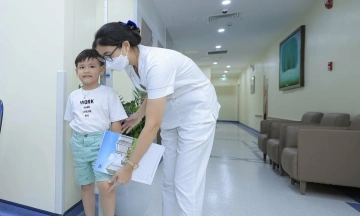
Dr. Phuc examines Quang's eyes. Photo: Tam Anh General Hospital
Doctors assessed Quang's astigmatism as severe for a child, potentially linked to keratoconus—a condition that causes severe astigmatism and vision loss if left untreated. Specialized tests, including corneal topography and pachymetry, confirmed a normal corneal structure. Doctors prescribed corrective glasses for Quang to manage his astigmatism. He also received guidance on daily habits and eye rest to gradually reduce accommodative dysfunction.
Two weeks later, Quang had adapted well to his glasses, seeing clearly with 10/10 vision in both eyes. However, the doctor cautioned him to avoid rubbing his eyes or vigorously rubbing his face to prevent corneal deformation, which could lead to keratoconus.
Quang's severe astigmatism put him at high risk for amblyopia (lazy eye). Doctors recommend that parents take their children for regular eye exams every six months to ensure they wear the correct prescription glasses. If a child exhibits abnormal signs such as blurred vision despite wearing glasses, difficulty seeing at night, double vision, or glare, they should visit an ophthalmology department at a hospital for timely examination and treatment.
Astigmatism is a condition where the cornea or lens has an irregular curvature, causing light rays entering the eye to scatter instead of converging precisely on the retina, leading to distorted or blurred images. It is often congenital but can also be related to trauma, eye surgery, or corneal diseases like keratoconus.
Doctors noted that many cases like Quang's involve undiagnosed refractive errors or incorrect glasses prescriptions for extended periods. This not only affects development and learning but also increases the risk of amblyopia. In such cases, the brain relies only on the stronger eye, ignoring signals from the weaker eye, commonly seen in children with high refractive errors or significant differences in prescription between the two eyes. Without timely treatment, the condition can cause permanent vision loss.
Dr. Phuc advises that children should have regular eye exams from birth to screen for refractive errors and other visual abnormalities. Parents should bring their children to the hospital for an examination if they show signs such as squinting, leaning close to objects to see, poor concentration in school, headaches, or dizziness.
Ngoc Kim Tham
*Patient's name has been changed
| Readers can submit ophthalmology questions here for doctors to answer. |