Initial tests at Tam Anh General Hospital, Ho Chi Minh City, revealed severe anemia in the patient, with a hemoglobin level of only 4-5 g/dL, well below the normal 13-17 g/dL range. An abdominal CT scan further identified an unevenly thickened colon wall in the splenic flexure region, along with fat tissue infiltration and enlarged nearby lymph nodes. These findings indicated a narrowed colon lumen, resulting in dilation and significant stool retention in the upper bowel.
Further examinations revealed multiple lesions in the liver and lumbar vertebrae. An endoscopy identified a large tumor in the descending colon, and a subsequent biopsy confirmed it as late-stage colon cancer that had metastasized to both the liver and bones.
Doctor Tran Thanh Binh, from the Center for Endoscopy and Endoscopic Digestive Surgery, explained that the large tumor had severely narrowed the colon lumen and caused chronic bleeding. This resulted in severe anemia, fatigue, and exhaustion for Khanh. The cancer's spread to his bones was the cause of his persistent back pain.
Due to the cancer's spread to distant organs, radical surgery was not an option. Instead, doctors opted for an endoscopic procedure to place a self-expanding metallic stent, aiming to restore gastrointestinal flow. This minimally invasive method effectively addressed the bowel obstruction caused by the tumor, creating a pathway for Khanh to receive further systemic cancer treatments.
 |
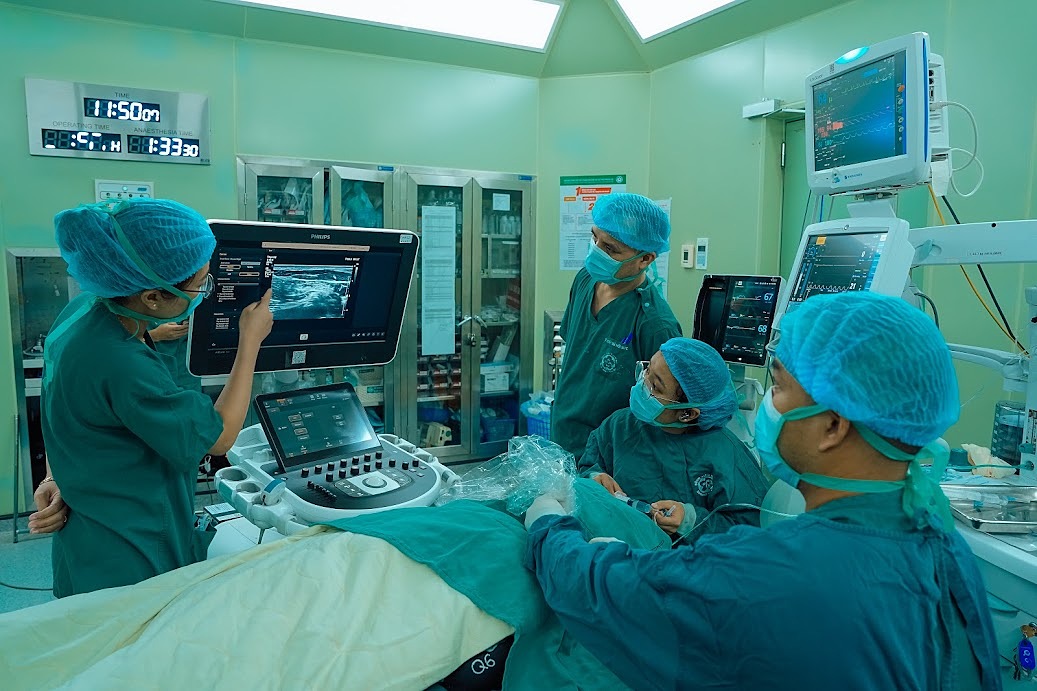
Doctor Binh (right) places a stent for Khanh. Photo: Tam Anh General Hospital. |
The lesion in the descending colon, characterized by its hard, ulcerated, and fungating nature, had severely narrowed the bowel lumen, making it impossible for the endoscope to pass. To overcome this, doctors used a specialized guidewire to navigate through the constricted segment. Following this, a self-expanding metallic stent was precisely inserted into position, guided by a C-arm X-ray system that provided continuous imaging throughout the procedure.
Once the stent was confirmed to be fully expanded and correctly placed, the bowel lumen was reopened, effectively restoring digestive flow. Khanh's symptoms of bowel obstruction quickly subsided, enabling him to resume eating orally and continue his specialized oncology treatment plan.
 |
The metallic stent placed in the reopened bowel lumen restores digestive flow. Photo: Tam Anh General Hospital. |
Colorectal cancer is a prevalent health concern both in Vietnam and globally. Doctor Binh noted a concerning trend: while most patients were historically over 50, there is a growing number of cases among individuals under 50. A key factor contributing to late-stage diagnoses is the common misconception that younger, healthier individuals are less susceptible, leading them to disregard subtle symptoms. Early signs, such as persistent changes in bowel habits, prolonged constipation or diarrhea, dull abdominal pain, or bloody stools, are often non-specific and easily confused with less serious digestive issues.
Colorectal cancer carries a favorable prognosis when detected early. This is typically when lesions are confined to the mucosa or submucosa, have not deeply invaded surrounding tissues, and have not spread to lymph nodes or distant organs.
Doctors advise early screening endoscopy for individuals with a direct family history of colorectal cancer or colon polyps. Furthermore, anyone experiencing persistent symptoms for more than two weeks – including changes in bowel habits, bloody stools, prolonged abdominal pain, or unexplained weight loss – should promptly seek consultation with a gastroenterologist for timely diagnosis and treatment.
Quyen Phan
*Patient's name has been changed.
| Readers can submit questions about digestive diseases here for doctors to answer. |