Doctor Nguyen Tien Dung, Deputy Director of the Stroke Center at Bach Mai Hospital, highlighted that "extracranial carotid artery stenosis is the most effectively preventable cause of stroke, yet it presents the most ambiguous boundary between diagnosis and treatment indication." He made these remarks at a workshop titled "Carotid Artery Surgery in Awake Patients: Technical Updates and Clinical Experience" on 14/8.
Doctor Dung noted that carotid artery atherosclerosis is linked to approximately 15-20% of ischemic stroke cases globally. A study conducted at Bach Mai Hospital on 1,191 patients experiencing transient ischemic attack (TIA) or ischemic stroke revealed a 5,2% incidence of carotid artery lesions. This rate is lower than some Western findings but aligns with reports from many other Asian nations.
Carotid arteries are a primary blood supply to the brain. When atherosclerotic plaques form in their walls, the artery lumen can gradually narrow, potentially leading to thrombus formation and occlusion. Experts explain that stroke related to carotid artery stenosis can occur through several mechanisms. The first and most critical is thromboembolism. Ulcerated or ruptured plaques can form thrombi, which may then detach as fragments or parts of the thrombus. These travel with the bloodstream to the brain, blocking cerebral arteries.
A second mechanism involves reduced cerebral perfusion. Severe carotid artery narrowing diminishes blood flow to the brain, particularly when the body struggles to maintain adequate circulatory volume. This can lead to ischemic damage in "watershed" areas of the brain, located between the supply territories of major arteries.
Furthermore, thrombi can extend at the lesion site or obstruct branch vessels, elevating the risk of acute cerebral ischemia.
Patients with carotid artery stenosis have several treatment options: medical management, interventional procedures, or surgery. The complex decision to revascularize requires doctors to carefully evaluate multiple factors, including the degree of stenosis, patient symptoms, plaque morphology, brain status, co-existing medical conditions, and the inherent risks of the chosen procedure.
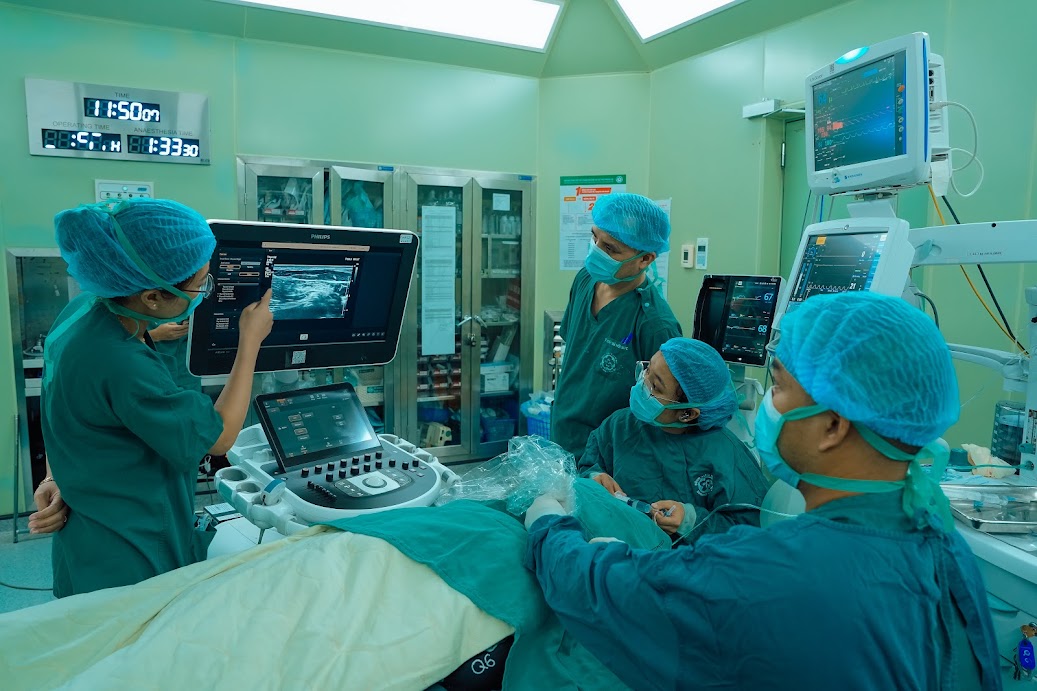 |
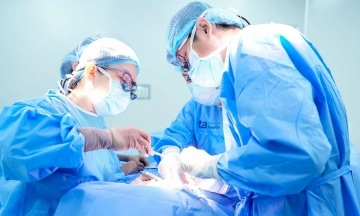
Bach Mai doctors perform an intervention for a patient with carotid artery stenosis. Photo: The Anh |
Bach Mai doctors perform an intervention for a patient with carotid artery stenosis. Photo: The Anh
Associate Professor Dao Xuan Co, Director of Bach Mai Hospital, stated that extracranial carotid artery stenosis and occlusion are significant causes of cerebral ischemia and ischemic stroke. Early and appropriate detection and treatment can substantially reduce the risk of adverse events.
Bach Mai Hospital has performed 500 surgical procedures for carotid artery stenosis. Notably, the technique of carotid artery surgery in awake patients, utilizing regional anesthesia instead of general anesthesia in appropriate cases, offers significant advantages. A key benefit of this approach is the surgical team's ability to directly monitor the patient's neurological status throughout the operation.
With an awake patient, doctors can continuously assess consciousness, language, motor function, and any neurological changes throughout each surgical stage. This direct observation allows for more precise monitoring of cerebral perfusion during the operation.
Experts describe the value of direct neurological monitoring during surgery by stating, "the patient's brain becomes a living monitor." Consequently, the surgical objective extends beyond merely removing atherosclerotic plaques, opening the artery lumen, and restoring blood flow; it also encompasses protecting the brain throughout the entire interventional process.
Doctor Co outlined the hospital's three-year development strategy, which includes establishing a comprehensive vascular disease treatment program. This initiative will extend beyond carotid arteries to encompass aortic diseases, peripheral arteries, veins, and complex vascular conditions. Treatment approaches, including medical management, open surgery, endovascular interventions, and hybrid procedures, will be tailored to individual patient needs, transcending traditional departmental distinctions.
Carotid artery stenosis can remain asymptomatic for years. However, when atherosclerotic plaques rupture or thrombi form, patients may experience a transient ischemic attack (TIA) or a sudden stroke. This underscores that stroke prevention should commence long before symptoms appear. Key preventative measures include managing blood pressure, blood sugar, and cholesterol, avoiding smoking, maintaining appropriate physical activity, and treating underlying cardiovascular conditions.
Le Nga