A study published in the medical journal JAMA on 22/1 confirmed this serious shift. Colorectal cancer, which was the fifth leading cause of cancer death in the early 1990s, climbed to the top for men under 50 and ranked second for women of the same age as of 2023. Data from the US National Center for Health Statistics for the period from 1990 to 2023 shows that while the overall cancer mortality rate in young people decreased by 44%, colorectal cancer bucked this trend with an annual increase of 1,1% since 2005.
Dr. Ahmedin Jemal, Vice President of the American Cancer Society and lead author of the study, acknowledged that the medical community has not clearly identified the reasons for this sharp increase in disease rates. Currently, the 5 leading cancer 'killers' for people under 50 in the US include: colorectal, breast, brain, lung, and leukemia. Dr. Jemal stressed that this disease is no longer solely an issue for the elderly and called for intensified research into this new wave of cancer in generations born after 1950.
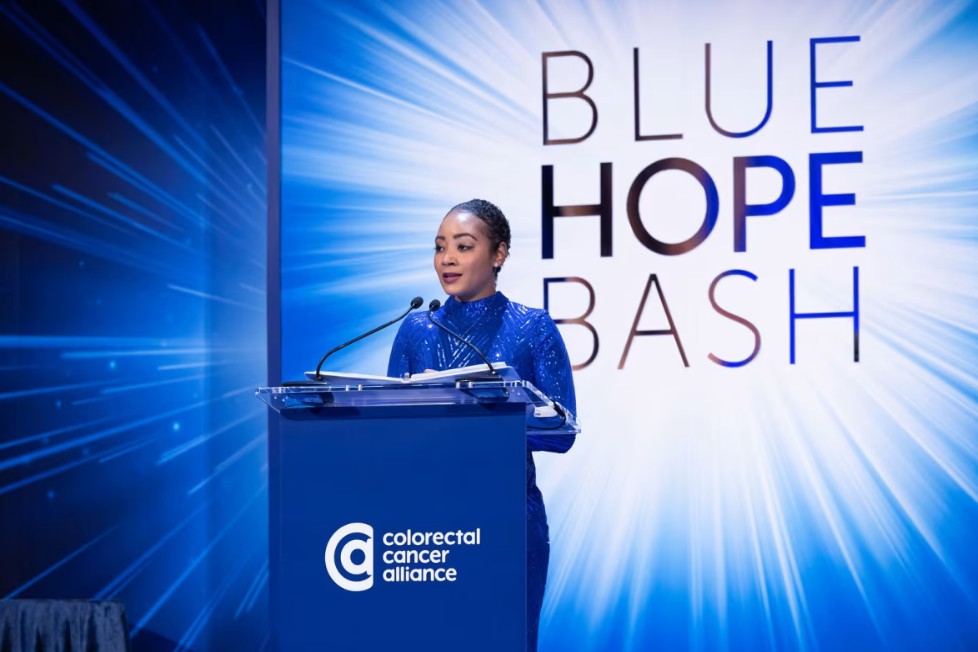 |
Jenna Scott speaks at a Colorectal Cancer Alliance event. Photo: Colorectal Cancer Alliance
Jenna Scott was diagnosed with stage 4 colorectal cancer at just 31 years old, a little over a year after giving birth to her first child. Despite experiencing severe abdominal pain throughout her pregnancy, doctors repeatedly dismissed warning signs, attributing them to normal pregnancy symptoms. Even after her healthy baby was born, the persistent pain forced her to undergo an endoscopy. Her gastroenterologist confirmed cancer immediately upon viewing the endoscopy images, without waiting for biopsy results.
A former athlete who avoided red meat and prioritized health, Scott never imagined cancer would enter her life. Her story highlights a significant gap in early diagnosis: the complacency of young patients and misdiagnosis by doctors as common ailments. Dr. Andrea Cercek from Memorial Sloan Kettering Cancer Center points out that because individuals under 45 are not subject to mandatory screening, they often only seek medical attention when symptoms are pronounced. As a result, three-quarters of young adult cases, equivalent to over 60% of patients under 50, are only diagnosed in late stages (3 or 4), significantly reducing their chances of survival.
The Colorectal Cancer Alliance estimates nearly 60 new cases are diagnosed in young people in the US daily, meaning one person receives a diagnosis every 25 minutes. Experts recommend starting regular screening from age 45, yet only 37% of the 45-49 age group adheres to this schedule.
After years of treatment with chemotherapy, targeted therapy, and surgery, Scott's condition is now stable. However, she stated she must "undergo chemotherapy and targeted therapy indefinitely," because whenever treatment stops, the tumor recurs and metastasizes to other organs. Scott's current goal is to continue fighting the disease so she can "one day see her grandchildren."
By Binh Minh (via CNN)