"The terrifying aspect is not only the life-threatening act itself, but the millions of likes underneath, transforming a deadly game into a celebrated challenge," said the mother from Phu Thuong ward. Upon questioning, her son admitted many friends had attempted it to prove their courage and experience momentary sensations.
This trend, known as the "6-second sleep," "bat pen," or a variant of the "blackout challenge," is spreading through schools via short video platforms. Participants apply dangerous physical pressure to their necks or chests to restrict blood and oxygen flow to the brain, causing them to become dazed or suddenly faint. These harmful videos quickly gain hundreds of millions of interactions, becoming a craze among 12 to 18-year-olds.
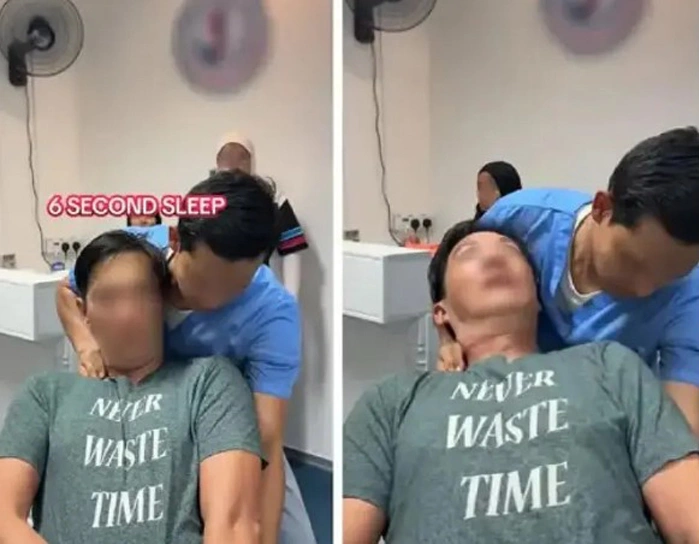 |
KKM states that the "6-second sleep" therapy is actually a dangerous act of neck compression causing brain hypoxia, which can lead to stroke or death. Photo:MyCheck Malaysia |
This dangerous curiosity arises from an extreme physiological reaction that many teenagers mistake for relaxation. Doctor Doan Du Manh, a member of the Vietnam Vascular Disease Association, explains that the actual mechanism is the brain's struggle during suffocation. The body activates an emergency system, releasing survival hormones like adrenaline and dopamine. The momentary exhilaration, which participants misinterpret as stress relief or a way to sleep easily, is a sign of brain cells succumbing to oxygen deprivation. Fainting and then recovering is not a harmless game; it represents a fragile boundary between a brief unconscious state and death.
Doctor Bui Duc Ngot from Post Hospital warns that violent compression of areas controlling cardiovascular and respiratory functions can lead to immediate, devastating consequences. Sudden pressure increases the risk of ruptured blood vessels, stroke, cervical spinal cord injury, quadriplegia, and cerebral circulatory arrest after only three minutes of oxygen deprivation. For adolescent brains, which are still developing, repeated oxygen deprivation can cause permanent damage, including memory impairment, dementia, and personality changes.
Data from the US Centers for Disease Control and Prevention (CDC) shows that even between 1995-2007, before social media's rise, this choking game claimed 82 adolescent lives. More recently, independent reports from Bloomberg and Yahoo News link its digital version directly to the deaths of at least 20 children globally in just 18 months, resulting in numerous compensation lawsuits. The severity of the problem recently prompted the Malaysian Ministry of Health to issue an urgent national warning. The ministry condemned the trend for violating the medical ethics principle of "do no harm" by disguising clinical fainting as "deep sleep" and urged the public to avoid it immediately.
Doctor Manh notes that adolescent psychology and technology complicate the issue. Teenagers' desire for exploration, self-expression, and peer pressure often leads them to overlook risks to remain part of their friend groups. Meanwhile, social media algorithms act as catalysts, accelerating the trend's spread.
Under public pressure, TikTok announced it would block keywords related to the fainting challenge and redirect users to a safety warning page. However, content continues to circumvent these rules, appearing under new slang terms like "bat pen." If a student lingers on such a video, the platform's algorithm will continuously feed similar content into their stream, fostering obsession and encouraging imitation.
Doctors advise that children are easily influenced by challenges and prone to imitating praised trends. Therefore, vigilance and careful information filtering are crucial for educating children. Families and schools must monitor, guide, and educate students to avoid harmful behavior. Prompt intervention is necessary if children exhibit unusual signs to prevent tragic outcomes.
Thuy An