Answer:
Astigmatism is a common refractive error in children, occurring when the cornea or lens has an irregular curvature, preventing light from focusing on a single point on the retina. As a result, images appear blurry, distorted, or hazy at both near and far distances, affecting academic performance and visual development.
This condition is often difficult to detect. However, parents can observe signs such as squinting, tilting the head when looking, easy eye fatigue, headaches, or reduced concentration while reading. If not detected and corrected early, children may experience fatigue and declining academic performance, along with an increased risk of amblyopia if the astigmatism is severe.
Wearing glasses is currently the simplest, safest, and most effective method to correct astigmatism. Glasses help light focus precisely on the retina, improving image quality and supporting the brain's development of normal visual function. Wearing glasses does not weaken the eyes; rather, it is *not* wearing glasses when prescribed by a doctor that can lead to vision decline and potential complications.
In most cases, children with astigmatism of 1,0 diopter or more, or those with co-occurring myopia or hyperopia, need to wear glasses regularly. Consistent glasses wear helps maintain stable clear vision and reduces excessive eye strain. If glasses are only worn when needed, the eyes must constantly adjust, which can easily cause eye fatigue, headaches, and reduce treatment effectiveness.
For children with mild astigmatism (below 1,0 diopter), no symptoms, and good vision, a doctor may recommend monitoring or only wearing glasses for specific activities like studying or looking at distant objects. This decision must be based on a specialized eye examination and should not be applied without professional guidance.
Regarding your child's case, the current information is insufficient to determine if regular glasses wear is necessary. However, it is important to note that during the initial adaptation period to new glasses, children may experience slight dizziness, discomfort, or minor image distortion as their brain adjusts. This is a normal phenomenon that typically subsides after a few days to one week. Parents should patiently encourage their child to wear glasses consistently.
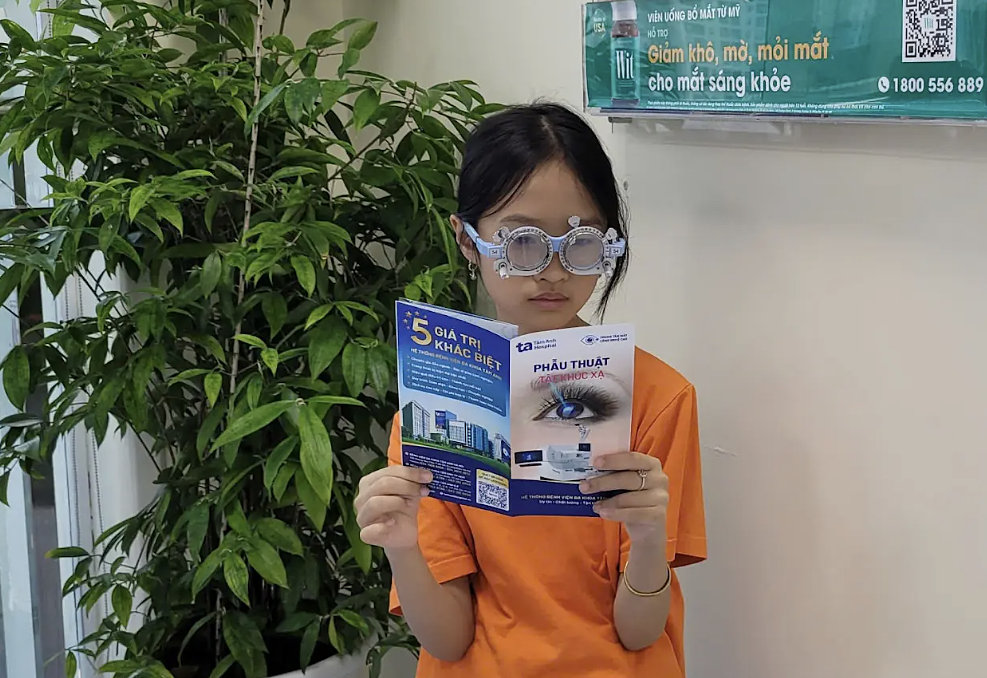 |
Children trying on glasses at Tam Anh Cau Giay General Clinic. Illustration: Hai Au |
To support treatment, families should help children develop healthy eye habits. The 20-20-20 rule can be applied: after every 20 minutes of studying or screen time, have the child look at an object about 6 m away for 20 seconds to relax their eyes. Additionally, ensure adequate lighting, maintain a distance of 30-35 cm when reading, and avoid reading while lying down or using electronic devices in the dark.
Parents should encourage children to engage in outdoor activities for 2 hours daily. Maintaining a balanced diet rich in vitamins A, C, E, omega-3, and lutein – found in foods like fish, green vegetables, eggs, and nuts – helps support visual health and slow the progression of refractive errors.
You should take your child for regular eye exams every 6-12 months, or sooner if there are unusual symptoms such as persistent eye strain or blurry vision, so that the doctor can monitor and adjust the prescription as needed.
Master, Doctor Le Thanh Huyen
High-Tech Eye Unit
Tam Anh Cau Giay General Clinic
| Readers can send questions about eye conditions here for a doctor's answer |