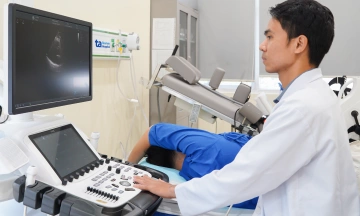
Dr. Nguyen Te Kha, Head of the Department of Urological Oncology Surgery at Binh Dan Hospital, spoke at the European standard training workshop on urological pathology 2026 on 20/6. He stated that urinary tract cancers currently comprise three main groups: kidney, bladder, and prostate cancer. Over 10,000 new cases are detected annually in Vietnam. Prostate cancer is showing an increasing trend, accounting for a significant proportion of surgeries at the hospital. This rise may be attributed to increased life expectancy, improved detection capabilities, and greater public health awareness.
According to Dr. Kha, prostate cancer is dangerous because it often progresses silently. In its early stages, most patients experience almost no clear symptoms. Manifestations such as difficulty urinating, frequent nighttime urination, frequent urination, or a feeling of incomplete bladder emptying are often mistaken for benign prostatic hyperplasia, leading many people to be complacent.
"Many patients arrive at the hospital when the cancer has already progressed because they previously thought they only had a common urinary condition," the doctor explained. Data from Binh Dan Hospital indicates that only about 20% of prostate cancer patients are detected in the early stages, while the remaining 80% seek medical attention when the disease has advanced.
According to the expert, the PSA (prostate-specific antigen) test, costing approximately 200,000-300,000 Vietnamese dong, is the most crucial screening tool. This simple blood test helps detect abnormalities even before a patient experiences symptoms. The PSA level is typically below 4 ng/ml. When PSA rises to 4 or higher, especially above 10, doctors may recommend additional MRI scans or biopsies to confirm cancer. A PSA level of 10-20 indicates the tumor is still localized within the prostate, meaning the cancer is at stage two. If this index is 20 or higher, the cancerous tumor has invaded outside but has not yet spread to lymph nodes or distant sites, placing the disease at stage three.
However, an elevated PSA does not definitively confirm cancer. This level can also increase following inflammation, catheterization, rectal examination, or after sexual intercourse. Therefore, a specialist doctor must comprehensively evaluate the test results.
 |
Dr. Kha examining a patient. Photo: Tran Nhung |
Dr. Kha noted that men with a family history of prostate cancer are considered a high-risk group. If a father or sibling has the disease, the risk increases significantly compared to the general population, making it advisable to begin screening from age 40 instead of 50. Additionally, obesity, smoking, heavy alcohol consumption, a diet high in red meat and low in green vegetables, and physical inactivity are also considered factors that increase the risk of the disease.
The later prostate cancer is detected, the worse the prognosis. When the cancer is still localized within the prostate, the five-year survival rate is nearly 100%, indicating that many cases can be completely cured. Patients also have the opportunity to preserve urinary and sexual function.
Conversely, when cancer is invasive or metastatic, the survival rate drops sharply. Patients may face severe bone pain, pathological fractures, urinary retention, lower limb paralysis, or metastasis to the lungs, liver, and other organs.
"Late-stage treatment is very costly; many patients require prolonged surgery, radiation therapy, hormonal therapy, or chemotherapy, with costs potentially reaching hundreds of millions of Vietnamese dong," Dr. Kha stated.
 |
Foreign experts at the European standard training workshop on Urological Pathology 2026 on 20/6. Photo: Tran Nhung |
Assoc. Prof. Dr. Tran Vinh Hung, Director of Binh Dan Hospital, emphasized that accurate diagnosis is the foundation for effective urinary cancer treatment. Detecting the disease in its early stages not only increases the chances of a cure but also helps preserve organs, function, and the patient's quality of life.
While there are currently no specific preventive measures for prostate cancer, experts recommend that men maintain a healthy weight, exercise regularly, limit red meat, increase green vegetable intake, quit smoking, reduce alcohol consumption, and critically, not skip regular screening.
Le Phuong