Eng English
China 中国人

Eng English
China 中国人
  • News
  • World
  • Business
  • Entertainment
  • Sports
  • Law
  • Education
  • Health
  • Lifestyle
  • Travel
  • Science
  • Digital
  • Automobiles
  • Trở lại Thể thao
  • Health
Monday, 31/8/2026 | 14:04 GMT+7

Does strabismus surgery for children require general anesthesia?

My child, who is about to start first grade, has congenital strabismus in both eyes. How should the child be treated, and if surgery is needed, will it involve general or local anesthesia? (Thuy, Vinh Long)

Strabismus not only affects appearance but also directly impacts a child's visual development, causing eye strain, reduced vision, distorted perception of objects, and even amblyopia (lazy eye). This condition occurs when the brain "ignores" signals from the weaker eye, potentially leading to permanent vision loss if not treated promptly.

Pathological strabismus does not resolve on its own. The treatment method depends on the cause, condition, and degree of eye misalignment. For strabismus related to refractive errors, doctors may prescribe appropriate glasses. If conservative treatment is ineffective, the angle of strabismus is large, or if it affects vision or causes amblyopia, surgery may be considered to adjust the extraocular muscles, aligning both eyes correctly.
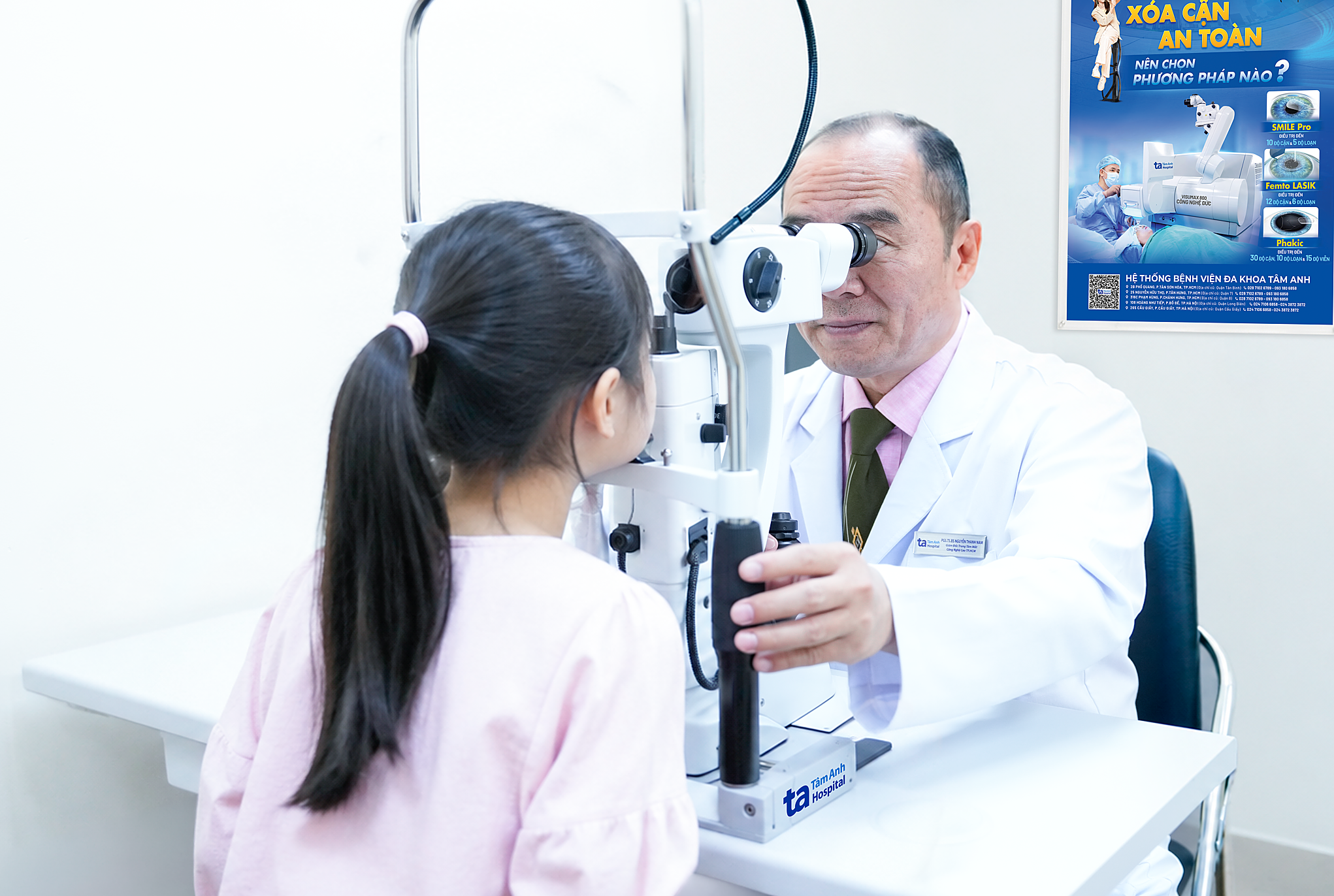
Associate Professor, Doctor Nguyen Thanh Nam examines a girl's eyes. Illustration: Tam Anh General Hospital

Depending on age and cooperation ability, children may receive local or general anesthesia during surgery. Local anesthesia is typically used for older children who can cooperate and control their emotions, while younger or uncooperative children usually receive general anesthesia.

General anesthesia can cause some temporary side effects such as nausea, dizziness, sore throat, and fatigue. For children under 3 years old, doctors carefully weigh the benefits and risks before recommending it.

Your 6-year-old child has congenital strabismus, making them suitable for surgery under general anesthesia. You should take your child for a comprehensive examination at a hospital with an ophthalmology department for diagnosis and appropriate treatment advice.

Before strabismus surgery, the child undergoes a health check, blood tests, and heart and lung evaluations to ensure they are fit for the procedure. Families need to inform the doctor about the child's medical history, congenital abnormalities, current medications, and any allergies. The child also receives an eye exam, screening for refractive errors, and amblyopia. Based on these results, the doctor develops a suitable treatment plan to optimize effectiveness.

Strabismus occurs when both eyes do not look in the same direction due to a disorder in the coordination of the 6 extraocular muscles. In the first few months of life, infants may experience physiological strabismus as their oculomotor system is not yet fully developed. This condition often improves as the child grows older.

If strabismus persists after 4-6 months of age or appears frequently, it may indicate pathological strabismus, related to congenital factors, refractive errors, or certain neurological conditions. Parents should seek medical attention if both eyes are not aligned, one eye frequently deviates, or if the child often squints, rubs their eyes, experiences headaches, or eye strain. Early detection and treatment help limit the impact on vision and quality of life.

Associate Professor, Doctor Nguyen Thanh Nam

Director of High-Tech Eye Center

Tam Anh General Hospital System, Ho Chi Minh City

Readers can submit questions about ophthalmic diseases here for doctors to answer.
By VnExpress: https://vnexpress.net/phau-thuat-mat-lac-cho-tre-co-can-gay-me-5115176.html
Tags: general anesthesia surgery strabismus

News in the same category

Why frequent constipation occurs during travel

Why frequent constipation occurs during travel

Every time I travel, I experience constipation. Why does this happen, and how can it be prevented? (Lien, Ho Chi Minh City)

Flesh-eating bacteria attacks man's brain

Flesh-eating bacteria attacks man's brain

A 54-year-old man experienced a high fever and headache, only seeking emergency hospital care after suffering seizures and losing consciousness. He was diagnosed with Whitmore bacteria, commonly known as "flesh-eating bacteria."

Can a patient with a knee replacement undergo an MRI of the spine?

Can a patient with a knee replacement undergo an MRI of the spine?

A 60-year-old patient, who underwent left knee replacement over one year ago, is experiencing back pain radiating down the leg and asks if a lumbar spine MRI is possible. (Thanh Hai, Hanoi)

7 ways to maintain gut health during the holidays

7 ways to maintain gut health during the holidays

Eating moderately, staying hydrated, increasing vegetables and fiber, limiting alcohol, maintaining physical activity, and prioritizing food safety can help your digestive system function optimally during the holiday season.

Six trans-tympanic injections help man improve hearing

Six trans-tympanic injections help man improve hearing

A 52-year-old man, suffering from dizziness and tinnitus for three years, had his hearing improved after doctors administered six trans-tympanic dexamethasone injections.

Typical signs of sleep apnea

Typical signs of sleep apnea

Loud snoring, waking up in the middle of the night, daytime sleepiness, and headaches after waking are common but easily overlooked symptoms of sleep apnea.

Mistakes that prolong bronchitis cough

Mistakes that prolong bronchitis cough

Self-medicating with cough suppressants, inadequate hydration, overexertion, or neglecting humidity levels can irritate airways, leading to a persistent cough.

4 skincare habits to avoid during erratic weather

4 skincare habits to avoid during erratic weather

Leaving sweat on the skin for too long, over-cleansing, skipping sunscreen, or constantly changing cosmetics can make skin prone to irritation, clogged pores, and a weakened protective barrier.

Three holiday habits increase stroke risk

Three holiday habits increase stroke risk

Excessive alcohol consumption, late nights, and forgetting to take medication for underlying conditions during holidays can cause blood pressure fluctuations and heart rhythm disturbances, potentially increasing stroke risk.

Why does shingles cause electric shock-like pain?

Why does shingles cause electric shock-like pain?

My 67-year-old mother is suffering from shingles on her right back, experiencing needle-prick and electric shock-like pain. Why does this condition cause such symptoms, and what medication should be applied? (Hoang Kim, 45, Hai Phong)

Eng English
China 中国人
  • News
  • World
  • Business
  • Entertainment
  • Sports
  • Law
  • Education
  • Health
  • Lifestyle
  • Travel
  • Science
  • Digital
  • Automobiles
FPT Tower, 10 Pham Van Bach Street, Dich Vong Ward,
Cau Giay District, Hanoi, Vietnam
Email: contacts@vnportal.net
Tel: 028 7300 9999 - Ext 8556
Advertise with us: 090 293 9644
Register
© Copyright 2026 vnnow.net. All rights reserved.
Terms of use Privacy policy Cookies