Mr. Cong had been living with diabetes for over one decade, yet he had never undergone screening for eye complications. Recently, Dr. Pham Huy Vu Tung, Deputy Head of the Department of Ophthalmology at the High-Tech Eye Center, Tam Anh General Hospital, TP HCM, conducted an eye examination. He recorded Mr. Cong's right eye vision at 8/10 and his left eye vision at 6/10, noting early-stage cataracts but no fundus damage. During the oculomotor examination, Mr. Cong's left eye could not move outward, with the eyeball deviating inward.
Dr. Tung diagnosed Mr. Cong with 6th cranial nerve palsy, also known as abducens nerve palsy. This nerve controls the lateral rectus muscle, which is responsible for outward eye movement.
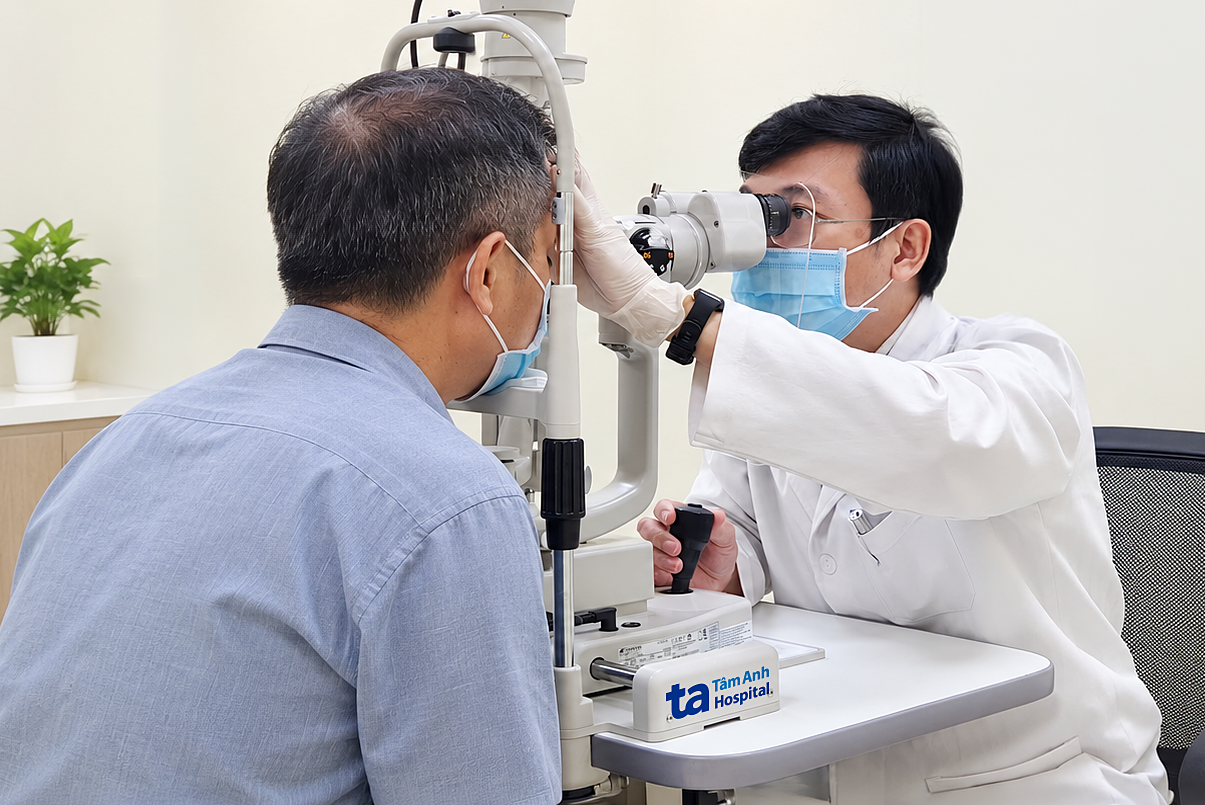 |
Dr. Tung examines Mr. Cong's eyes. *Photo: Tam Anh General Hospital* |
Eyeball movement is controlled by three pairs of cranial nerves: the third, fourth, and sixth. Paralysis of one of these nerves can lead to reduced or lost function in the eye muscles, resulting in limited eye movement and double vision. The specific nerve affected can often be identified by the direction in which eye movement is restricted.
Oculomotor nerve palsy can be linked to conditions such as: diabetes, hypertension, increased intracranial pressure, aneurysms, meningitis, or head trauma. An MRI scan is typically required to pinpoint the underlying cause. Mr. Cong's MRI results revealed no abnormalities, which helped doctors exclude brain-related causes.
Dr. Tung attributed Mr. Cong's condition to his long history of diabetes, suggesting that persistently elevated blood sugar levels likely damaged the blood vessels nourishing the nerve and the eye. The early cataract development in his left eye further supported the possibility of diabetes-related eye complications.
Mr. Cong received instructions for eye massage and exercises, involving moving his eyes side to side, up, and down, to stimulate the lateral rectus muscle. Most patients recover with effective blood sugar control. An endocrinologist-diabetologist will provide long-term monitoring and adjustment of his blood sugar levels.
After one month, Mr. Cong's double vision resolved, and his left eye regained full, flexible movement. However, the condition carries a risk of recurrence if blood sugar levels are not consistently well-controlled. Patients must adhere to scheduled follow-up appointments to monitor oculomotor function, cataract progression, and other potential diabetic eye complications.
Diabetes can damage various eye structures, potentially leading to conditions such as: diabetic retinopathy, cataracts, increased intraocular pressure, and glaucoma. Dr. Tung recommends that older adults, individuals with underlying health conditions, a history of eye disease, or those on prolonged corticosteroid therapy undergo regular eye examinations every 6-12 months to screen for abnormalities. Should symptoms like sudden double vision, strabismus, blurred vision, eye socket pain, or proptosis appear, patients should seek prompt evaluation at a specialized ophthalmology clinic.
Ngoc Kim Tham
*Patient's name has been changed*
| Readers can submit questions about ophthalmological conditions here for doctors to answer. |