"Older people in Vietnam often live with illnesses for about five to seven years at the end of their lives, with each person suffering from an average of four to five different medical conditions," Associate Professor Doctor Nguyen The Anh, Director of Huu Nghi Hospital, shared at the International Scientific Conference on Comprehensive Care for the Elderly on 26/3. At Huu Nghi Hospital, an elderly person visits for examinations seven to eight times annually, a figure that can be even higher when hospital admissions are included. This frequency is two to 2,5 times higher than that of other patient groups.
Vietnam is currently experiencing one of Asia's fastest rates of population aging. Data indicates that in 2011, older people comprised about 9,9% of the population; by 2012, this figure exceeded 10%, officially marking the start of the aging phase. Projections suggest this proportion will increase to 20% within about 20 years. Currently, the country has approximately 16,1 million older people, accounting for over 16% of the population.
Vietnam's aging index is projected to surpass 100 in 2032, at which point the number of older people will exceed the number of children. Pressure on the workforce is also increasing as the ratio of working-age individuals supporting one older person rapidly declines, from over seven people in 2023 to about two people by 2049.
"These figures highlight the significant burden of illness among older people, demanding special attention from the healthcare system, as well as families and communities, with the goal not just of living longer but also of living healthier," Associate Professor The Anh stated.
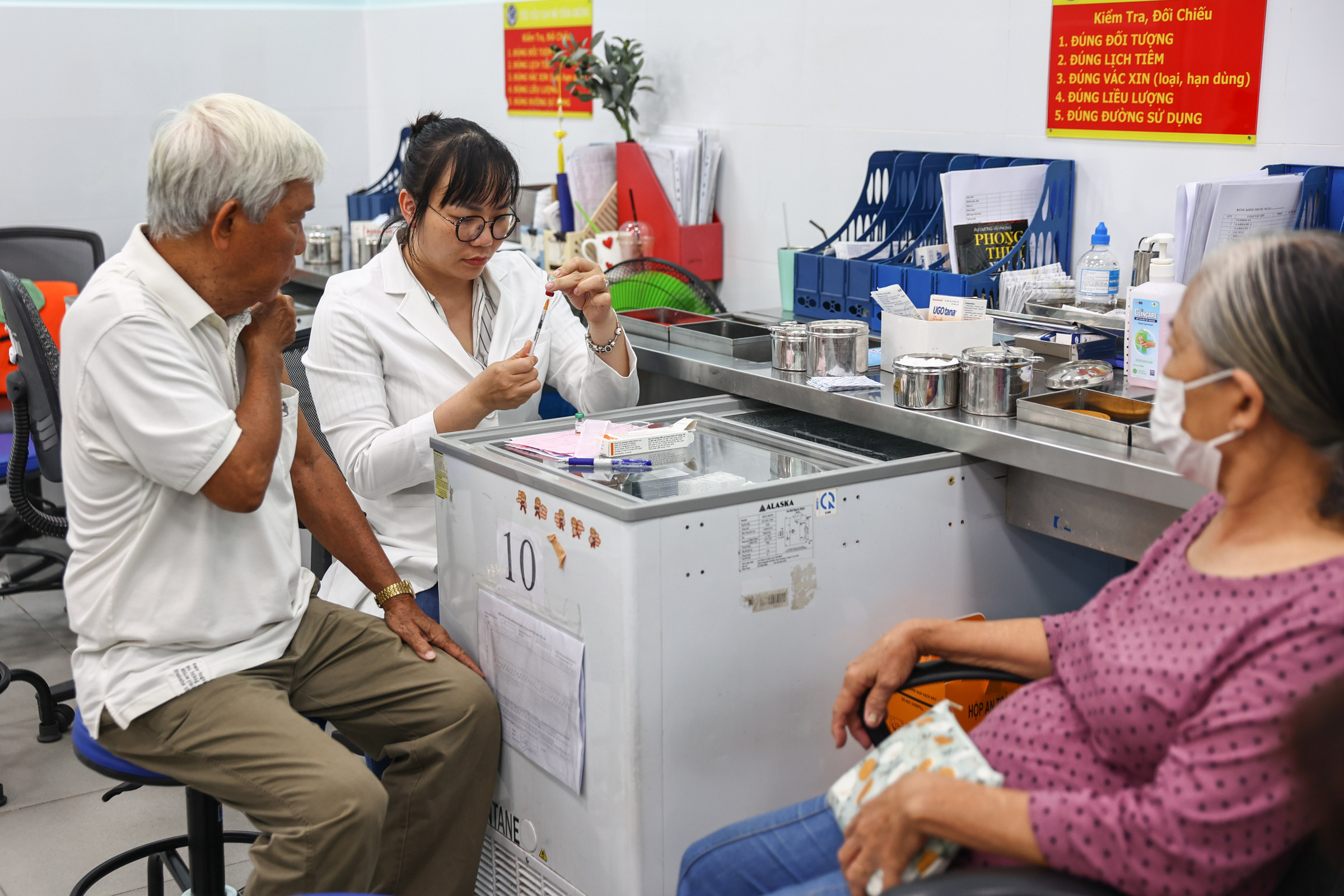 |
Older people receiving vaccinations. Photo: Quynh Tran. |
Older people receiving vaccinations. Photo: Quynh Tran.
The Director of Huu Nghi Hospital expressed concern that many older people, especially in deep and remote areas, have never undergone medical examinations, some even having never had their blood pressure checked. Some do not understand how to use medication properly; for example, blood pressure medication, if only taken when feeling unwell and then stopped, is completely incorrect and very dangerous.
Furthermore, treatment adherence among older people presents a challenge. Without close monitoring and guidance, patients may easily forget or discontinue their medication midway, leading to worsening conditions and an increased risk of complications.
Given this situation, Associate Professor The Anh believes a change in approach is necessary, starting at the community level. Health management for older people should not be confined to hospitals but should be continuous and proactive, carried out in their living environments through regular monitoring. To adapt to the rapid pace of population aging, he suggested developing continuous and comprehensive care models. The application of technology, such as personal health monitoring software, could support patients in managing their own conditions.
At the conference, experts also affirmed that Vietnam needs to develop comprehensive policies and plans to improve the quality of life for older people. One significant change involves shifting from a single-disease treatment model to a multi-disease, multi-specialty approach. Nguyen Ngo Quang, Director of the Department of Science, Technology, and Training, Ministry of Health, stated that older people now require not only treatment but also long-term management that combines medical care, rehabilitation, nutrition, psychological support, and social assistance. This is an essential requirement as disease patterns have shifted towards chronic and multi-pathological conditions.
To address aging, the Ministry of Health recently proposed developing home and community-based care models for older people, establishing daytime care centers that utilize existing facilities like cultural houses and sports areas in villages and residential blocks. This proposal is included in the draft Decree guiding the implementation of the Population Law, which the Ministry of Health is currently seeking feedback on and expects to submit to the Government for issuance before 30/4.
Le Nga