On 20/2, a representative from Bach Mai Hospital reported a surge in emergency cases during the recent Tet holiday, with patients arriving in critical condition. These individuals presented with severe and complex injuries including corneal tears, intraocular hemorrhage, deeply embedded metal fragments, and chemical burns. Most face grave long-term consequences and a high risk of permanent vision loss. One such case involved a 48-year-old woman from Ha Tinh who suffered a devastating injury while visiting during Tet. An unexpected firecracker explosion caused a complete rupture of her eyeball, crushed eyelids, a fractured orbital bone, and traumatic brain injury. Doctors from the ophthalmology, otolaryngology, and neurosurgery departments collaborated on emergency surgery to address her multiple injuries, but could not save her vision.
Another victim, a 45-year-old man from Hai Phong, was hospitalized with damage to both eyes, a brain contusion, and subdural hemorrhage after lighting firecrackers himself. Among younger victims, a 10-year-old boy from Hanoi suffered severe intraocular hemorrhage after secretly picking up an unexploded firecracker to relight it.
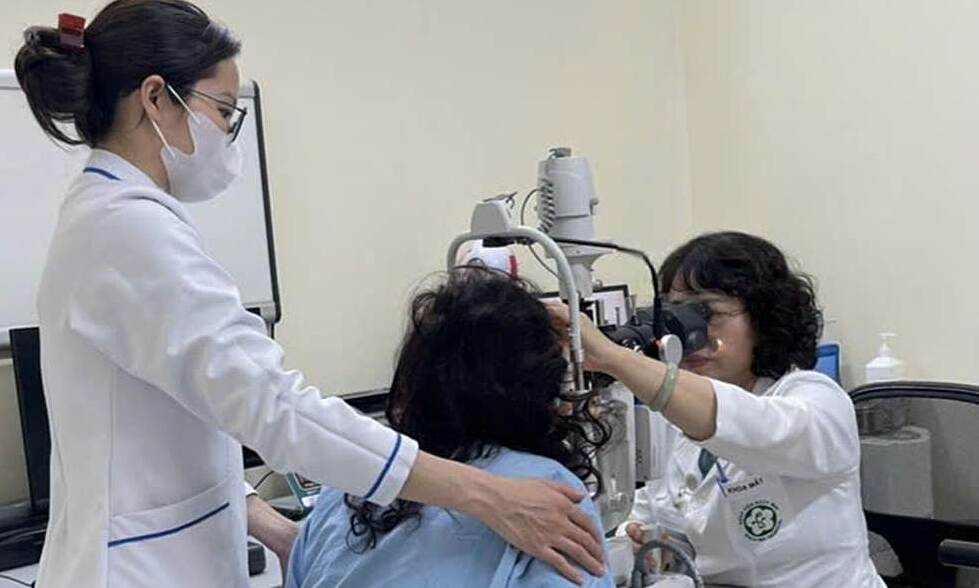 |
An ophthalmologist at Bach Mai Hospital examines a patient. *Photo: Nguyen Ha*
Experts emphasize that firecrackers generate immense pressure, high-velocity metal fragments, sparks, and intense heat upon explosion. An eyeball can be punctured in an instant. Due to its delicate structure, the eye has almost no natural defense against such impacts.
Children are often a high-risk group in firecracker accidents because they are curious, enjoy playing with and watching firecrackers, but lack the skills to identify and manage danger. Children often do not know how to choose a safe viewing distance. Therefore, a moment of adult carelessness combined with a child's curiosity can lead to regrettable accidents.
Furthermore, many people are careless when playing with and lighting firecrackers, often in confined spaces or near homes. They assume small or homemade firecrackers are harmless, allowing children to light them or pick up unexploded ones to check. However, all types of firecrackers pose a high risk of injury, especially to the eyes.
Doctors advise that if a firecracker-related eye accident occurs, victims should not rub their eyes, attempt to remove foreign objects, or apply arbitrary medication. Patients should gently cover the eye with a clean gauze pad and immediately go to the nearest ophthalmology medical facility. The golden hour for managing eyeball injuries is measured in hours. The earlier the intervention, the higher the chance of preserving vision.
Le Nga