Alzheimer's disease (AD) is a progressive neurodegenerative disorder characterized by the accumulation of amyloid-β plaques and tau neurofibrillary tangles in brain tissue. This process damages nerve cells, disrupting the brain's information transmission network.
Alzheimer's disease is categorized into two main groups: typical and atypical variants. Master of Science, Doctor Diem Thi Huyen, from the Department of Neurology - Stroke, Tam Anh Cau Giay General Clinic, states that typical Alzheimer's usually causes damage in the hippocampus and medial temporal lobe, which are the brain's centers for forming and storing memories.
In this typical form, patients experience short-term memory impairment, struggling to recall newly acquired information. This progresses to long-term memory loss, where they forget old memories, including their home address and the identities of family members. In severe stages, the disease leads to profound memory loss, loss of self-care ability, and complete dependence on caregivers.
However, according to Doctor Huyen, some patients, particularly those with early onset under 65 years old, develop atypical Alzheimer's variants that are not associated with early memory impairment. At onset, these patients exhibit functional disorders such as: visual, language, executive, behavioral, and motor dysfunction, while temporary memory remains relatively well-preserved.
Visual Alzheimer's variant
This variant targets the brain regions responsible for higher visual processing in the occipital and parietal lobes. Patients experience a loss of spatial awareness, left-right disorientation, inability to perceive multiple objects simultaneously (Balint's syndrome), or impaired object recognition. They find reading and driving difficult, even without physical eye damage.
Language Alzheimer's variant
Damage in this variant concentrates in the posterior temporo-parietal region of the cerebral hemisphere, primarily affecting communication abilities.
A prominent symptom of the language Alzheimer's variant is hesitant speech, as patients frequently pause to search for words. They struggle with long sentences, express themselves circuitously, and make pronunciation errors. This condition is often mistaken for stroke, language disorders, or other forms of dementia.
Executive Alzheimer's variant (dysexecutive AD)
This variant severely impairs the ability to plan, organize tasks, think abstractly, and solve problems. Patients easily lose focus and find it challenging to perform complex tasks that were once familiar.
Behavioral Alzheimer's variant (behavioral AD)
Damage from this variant causes changes in personality and emotions. Patients may exhibit unusual behaviors such as sudden intense cravings for sweets, uncontrolled eating, apathy, reduced empathy, obsessive-compulsive behaviors, or actions inappropriate for social norms. This variant is often confused with frontotemporal dementia (FTD), according to Doctor Huyen.
Motor Alzheimer's variant (CBS)
This variant causes asymmetrical motor symptoms, typically affecting one side of the body, such as an arm or leg, accompanied by cortical dysfunction. Patients experience muscle rigidity, muscle jerks, and difficulty performing actions like buttoning clothes, holding chopsticks, or writing.
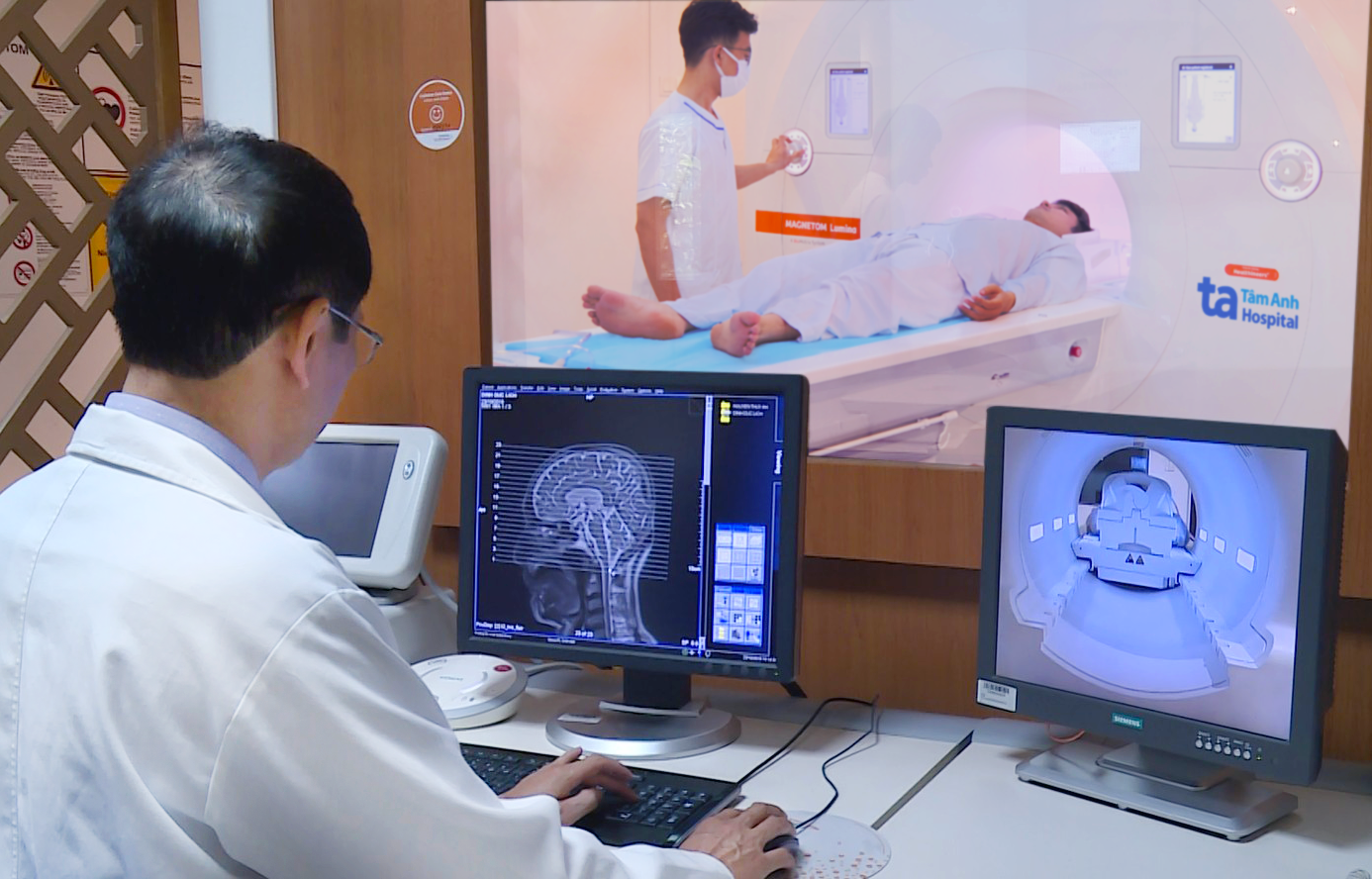 |
A doctor performs an MRI scan on an Alzheimer's patient. Illustration: Tam Anh Cau Giay General Clinic |
Doctor Huyen notes that because initial symptoms are not related to memory impairment, atypical Alzheimer's disease variants are easily misdiagnosed as eye conditions, Parkinson's disease, depression, or similar.
For an accurate diagnosis, patients should visit multidisciplinary hospitals for a comprehensive examination and evaluation. Doctors may order neurological examinations, specialized cognitive tests, magnetic resonance imaging (MRI), and positron emission tomography (PET) scans when necessary. Cerebrospinal fluid/serum tests to measure amyloid-β and p-tau biomarkers are methods that help confirm Alzheimer's disease, allowing doctors to establish a treatment plan and manage the condition.
Thanh Long
| Readers can submit questions about neurological diseases here for doctors to answer |